Astronauts who experience weightlessness frequently get motion sickness. The astronauts see their own motion relative to passing objects, but while the astronauts are weightless their inner ears indicate that their bodies are not moving. The astronauts’ experience is best explained by the hypothesis that conflicting information received by the brain about the body’s motion causes motion sickness.

Summarize Argument: Phenomenon-Hypothesis
The author concludes that motion sickness is caused by the brain receiving conflicting information about the body’s motion.

Notable Assumptions
The author assumes that conflicting information rather than some other phenomenon that astronauts experience in space is responsible for motion sickness. This same phenomenon of conflicting information should thus be applicable on earth, as well.

A
During rough voyages ship passengers in cabins providing a view of the water are less likely to get motion sickness than are passengers in cabins providing no view.
If the passengers can’t see the water, then they wouldn’t be receiving conflicting information. Since these passengers are less likely to get motion sickness, it would seem the cause really is conflicting information.
B
Many people who are experienced airplane passengers occasionally get motion sickness.
We don’t care about occasional motion sickness. Besides, we have no idea if planes feature the same “conflicting information” phenomenon as space shuttles.
C
Some automobile passengers whose inner ears indicate that they are moving and who have a clear view of the objects they are passing get motion sickness.
The author never says conflicting information is the only way motion sickness occurs. It’s simply the explanation for how motion sickness occurs for austronauts.
D
People who have aisle seats in trains or airplanes are as likely to get motion sickness as are people who have window seats.
This would seem to strengthen the author’s argument, but we have no idea if people who sit in window seats are looking out the windows and getting conflicting information. (A) closes that ambiguity.
E
Some astronauts do not get motion sickness even after being in orbit for several days.
The author never says all astronauts get motion sickness. She simply explains what probably causes motion sickness for astronauts.

47 comments

Research indicates that 90 percent of extreme insomniacs consume large amounts of coffee. Since Tom drinks a lot of coffee, it is quite likely that he is an extreme insomniac.

Summarize Argument
The author concludes that it’s likely Tom is an extreme insomniac. This is based on the fact that 90 percent of extreme insomniacs drink lots of coffee, and Tom drinks lots of coffee.

Identify and Describe Flaw
The author misinterprets the claim “Most A are B” as “Most B are A.” Although 90 percent of extreme insomniacs drink lots of coffee, that doesn’t tell us anything about what proportion of lots-of-coffee drinkers are extreme insomniacs. It could be that the vast majority of lots-of-coffee drinkers aren’t extreme insomniacs, even if most extreme insomniacs drink lots of coffee.

A
It fails to acknowledge the possibility that Tom is among the 10 percent of people who drink large amounts of coffee who are not extreme insomniacs.
The premises don’t establish that only 10 percent of people who drink lots of coffee are not extreme insomniacs. Also, the conclusion doesn’t say that Tom definitely is an extreme insomniac. So, the author acknowledges that he might not be an extreme insomniac.
B
It fails to consider the possible contribution to extreme insomnia of other causes of insomnia besides coffee.
The author’s argument does not make any assumptions about cause. The issue is whether membership in the set of people who drink lots of coffee implies a likelihood of membership in the set of people who are extreme insomniacs.
C
It relies on evidence that does not indicate the frequency of extreme insomnia among people who drink large amounts of coffee.
The author relies on the fact that 90% of extreme insomniacs drink lots of coffee. This does not reveal the frequency (i.e. proportion) of extreme insomnia among people who drink lots of coffee. It could be that only a small % of lots-of-coffee drinkers have extreme insomnia.
D
It draws an inference about one specific individual from evidence that describes only the characteristics of a class of individuals.
The author does not commit the whole-to-part fallacy. The issue is misinterpretation of the claim “90% of extreme insomniacs consume lots of coffee.” This statistic is not a claim about a class — it’s a claim about 90% of the individuals within the class.
E
It presumes without warrant that drinking coffee always causes insomnia.
The author doesn’t make any assumptions about cause. The issue is whether membership in the set of people who drink lots of coffee implies a likelihood of membership in the set of people who are extreme insomniacs.

62 comments

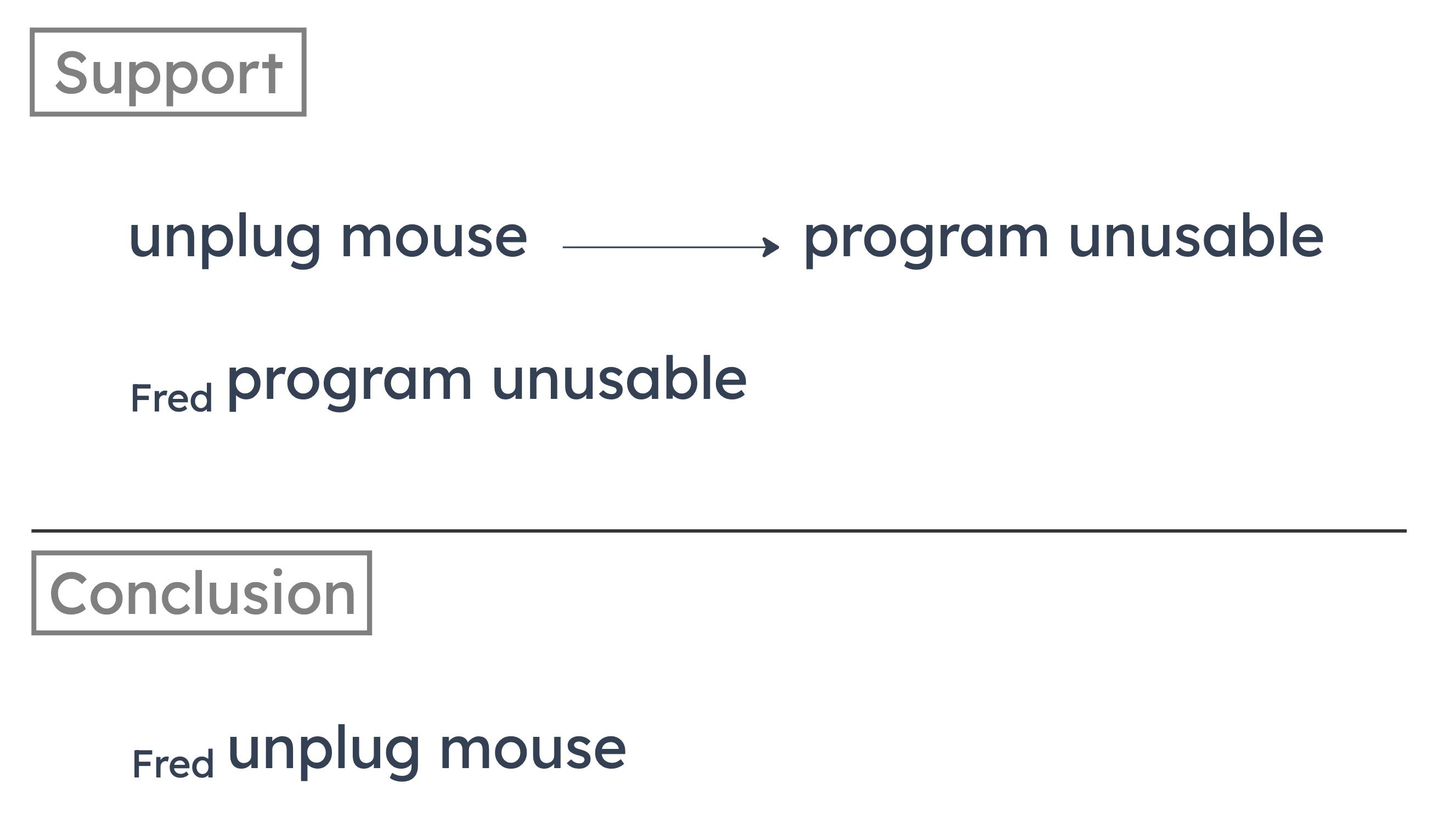
Unplugging a peripheral component such as a “mouse” from a personal computer renders all of the software programs that require that component unusable on that computer. On Fred’s personal computer, a software program that requires a mouse has become unusable. So it must be that the mouse for Fred’s computer became unplugged.

Summarize Argument: Phenomenon-Hypothesis
The author concludes that Fred’s computer mouse must have been unplugged. He supports this by saying that unplugging the mouse from a computer causes all programs that require the mouse to become unusable. He then notes that a software program on Fred’s computer that requires the mouse has become unusable.

Identify and Describe Flaw
This is the flaw of mistaking sufficiency for necessity. The author treats “unplugging the mouse” as necessary for “the program becoming unusable.” But according to his argument, “unplugging the mouse” is sufficient, not necessary.

In other words, the argument overlooks the possibility that Fred’s program could become unusable without his mouse becoming unplugged.

A
It contains a shift in the meaning of “unusable” from “permanently unusable” to “temporarily unusable.”
This is the cookie-cutter flaw of “equivocation.” But the author doesn’t use multiple meanings of the word “unusable” throughout his argument. He simply uses it to mean that a software program has stopped working.
B
It treats an event that can cause a certain result as though that event is necessary to bring about that result.
Unplugging the mouse can cause a program to become unusable, but the author assumes that it’s necessary to bring about that result. In other words, the conclusion mistakenly treats “unplugging the mouse” as a necessary condition, while in the premises, it’s merely sufficient.
C
It introduces information unrelated to its conclusion as evidence in support of that conclusion.
The author never introduces unrelated information as evidence. His evidence is related to his conclusion, but he mistakes the sufficient condition for a necessary condition.
D
It attempts to support its conclusion by citing a generalization that is too broad.
The argument cites a specific scenario about Fred, not a broad generalization.
E
It overlooks the possibility that some programs do not require a peripheral component such as a mouse.
The author is only addressing Fred’s software program that does require a mouse. Presumably other programs don’t require a mouse, but those programs aren’t relevant to the argument.

13 comments

Ticks attach themselves to host animals to feed. Having fed to capacity, and not before then, the ticks drop off their host. Deer ticks feeding off white-footed mice invariably drop off their hosts between noon and sunset, regardless of time of attachment. White-footed mice are strictly nocturnal animals that spend all daytime hours in their underground nests.

Summary
Ticks attach themselves to other animals to feed on them. Ticks drop off their host only after they have fed to capacity. And, if they have fed to capacity, they will drop off their host.
Deer ticks that feed on white-footed mice always drop off their hosts between noon and sunset, no matter when the ticks first attached to the host.
White-footed mice are strictly nocturnal (they are active only at night). During daytime hours, these mice are underground.

Very Strongly Supported Conclusions
Deer ticks that feed on white-footed mice always drop from the mice they’re feeding on while the mice are underground. We know this is supported because the deer ticks always drop off during the daytime, and during the daytime the mice are underground.

A
Deer ticks all attach themselves to white-footed mice during the same part of the day, regardless of day of attachment.
We don’t know anything about when deer ticks attach themselves to mice. We know when they drop off the mice, but that doesn’t reveal anything about the timing of attachment.
B
Deer ticks sometimes drop off their hosts without having fed at all.
Ticks drop off only after feeding to capacity. So it can’t be true that deer ticks sometimes drop off without feeding at all.
C
Deer ticks that feed off white-footed mice drop off their hosts in the hosts’ nests.
This is strongly supported, because we know the ticks always drop off from the mice during the daytime, and during the daytime, the mice are in their underground nests.
D
White-footed mice to which deer ticks have attached themselves are not aware of the ticks.
We know nothing about the awareness of the white-footed mice. None of the facts suggest anything about whether the mice know the ticks are feeding on them.
E
White-footed mice are hosts to stable numbers of deer ticks, regardless of season of the year.
We know nothing about the stability of the numbers of deer ticks that feed on white-footed mice.

36 comments

Although 90 percent of the population believes itself to be well informed about health care, only 20 percent knows enough about DNA to understand a news story about DNA. So apparently at least 80 percent of the population does not know enough about medical concepts to make well-informed personal medical choices or to make good public policy decisions about health care.

Summarize Argument

The author concludes that at least 80% of people don’t know enough about medical concepts to make well-informed personal medical decisions or good public policy decisions about health care. He supports this by noting that 20% of people understand enough about DNA to understand a news story about DNA, meaning 80% of people don't.

Identify and Describe Flaw

The author assumes that because 80% of people don't understand DNA well enough to follow a news story about it, they can't make well-informed personal medical decisions or public health decisions. However, he fails to provide evidence that explains how understanding DNA is necessary for making those decisions.

A
those people who can understand news stories about DNA are able to make well-informed personal medical choices

The author assumes that people who cannot understand news stories about DNA are unable to make well-informed personal medical decisions (or that people who can make these decisions must be able to understand news stories about DNA). (A) has this backward.

B
more than 20 percent of the population needs to be well informed about health care for good public policy decisions about health care to be made

The author concludes that 80% of people can’t make good public policy decisions because they can’t understand a news story about DNA, but he never suggests that over 20% of people need to be well informed about health care for good public policy decisions to be made.

C
one’s being able to make well-informed personal medical choices ensures that one makes good public policy decisions about health care

The author never suggests a causal connection between making well-informed personal medical choices and making good public policy decisions about health care. Instead, he assumes that one has to understand DNA in order to make these personal and public health decisions.

D
an understanding of DNA is essential to making well-informed personal medical choices or to making good public policy decisions about health care

This describes the author’s unsupported assumption. He claims that 80% of people can’t make good personal medical decisions or public policy decisions because they can’t understand DNA, but he fails to demonstrate that understanding DNA is necessary for making those decisions.

E
since 90 percent of the population believes itself to be well informed about health care, at least 70 percent of the population is mistaken in that belief

Just because 80% of people don’t understand DNA doesn’t mean they’re not well informed about health care. The author doesn’t argue that not understanding DNA means someone isn’t well informed about health care, but rather that they can't make informed personal medical decisions.


19 comments

P: Complying with the new safety regulations is useless. Even if the new regulations had been in effect before last year’s laboratory fire, they would not have prevented the fire or the injuries resulting from it because they do not address its underlying causes.

Q: But any regulations that can potentially prevent money from being wasted are useful. If obeyed, the new safety regulations will prevent some accidents, and whenever there is an accident here at the laboratory, money is wasted even if no one is injured.

Summarize Argument: Counter-Position
In response to P’s claim that complying with the new safety regulations is useless, Q concludes any regulations that potentially prevent money from being wasted are useful. As evidence, Q states that the new safety regulations would prevent some accidents, and money is wasted whenever there is an accident.

Describe Method of Reasoning
Q counters a position held by P. Q does this by expanding the scope of P’s argument. Instead of only narrowly considering whether the new safety regulations would have prevented last year’s fire, Q considers what effect the regulations could have upon all potential accidents.

A
extending the basis for assessing the utility of complying with the new regulations
P’s basis for assessing the utility of compliance is whether the new regulations would have prevented last year’s laboratory fire. Q extends this basis to assessing whether the new regulations would prevent some accidents.
B
citing additional evidence that undermines P’s assessment of the extent to which the new regulations would have prevented injuries in last year’s laboratory fire
Q does not state a position on whether he believes the new regulations would have prevented injuries in last year’s laboratory fire. Q’s argument addresses accidents generally.
C
giving examples to show that the uselessness of all regulations cannot validly be inferred from the uselessness of one particular set of regulations
P’s argument does not conclude that all regulations are useless. P only concludes that the new safety regulations are useless, and Q responds to this narrow conclusion.
D
showing that P’s argument depends on the false assumption that compliance with any regulations that would have prevented last year’s fire would be useful
Q does not point out any false assumptions in P’s argument. Moreover, Q does not state a position on whether he believes the new regulations would have prevented last year’s laboratory fire.
E
pointing out a crucial distinction, overlooked by P, between potential benefits and actual benefits
Q does not explicitly point out a distinction overlooked by P. Rather, Q expands the scope of argument to all regulations instead of just the new safety regulations.

19 comments

Frankie: If jelly makers were given incentives to make a certain percentage of their jellies from cloudberries, income for cloudberry gatherers would increase.

Anna: That plan would fail. Cacao, like cloudberries, was once harvested from wild plants. When chocolate became popular in Europe, the cacao gatherers could not supply enough to meet the increased demand, and farmers began to grow large quantities of it at low cost. Now all cacao used in commercial chocolate production is grown on farms. Likewise, if the demand for cloudberries increases, domesticated berries grown on farms will completely supplant berries gathered in the wild.

Summarize Argument: Phenomenon-Hypothesis
Anna concludes if demand for cloudberries increases, then domesticated berries would completely replace wild berries. As evidence, Anna points to what happened in the past with cacao. Cacao was harvested from wild plants until it became popular in Europe. As a result, cacao gatherers could not meet demand and farms began growing large quantities at low cost. Now all cacao used in commercial chocolate production comes from farms, not wild plants.

Describe Method of Reasoning
Anna concludes a cause-and-effect relationship based on what happened in an analogous case. She does this by showing what happened in the past with cacao, and suggests if demand increases for cloudberries in a similar way to cacao the same effect would occur.

A
giving a reason why a proposed course of action would be beneficial to all those affected by it
Anna does not claim Frankie’s proposed course of action would be beneficial to everyone. She believes that Frankie’s proposal would hurt cloudberry gatherers because increased demand would cause the berries to strictly be grown on domestic farms.
B
reinterpreting evidence presented in support of a proposal as a reason to reject the proposal
Anna does not reinterpret any evidence. In fact, Frankie does not provide any evidence for Anna to reinterpret. Anna is the only one who gave evidence in support of her conclusion.
C
projecting the result of following a proposal in a given situation by comparing that situation with a past situation
The past situation being compared is what happened with cacao. The projected result is Anna’s predicted consequence of increasing the demand for cloudberries, resulting in domesticated berries completely replacing wild berries.
D
proposing a general theory as a way of explaining a specific market situation
Anna does not propose a general theory. She cites specific evidence of a past situation in order to make comparisons.
E
contending that the uses for one product are similar to the uses for another product
Anna does not address the subject of use.

12 comments