A
The line of Tennyson’s poetry cannot now be construed as an apt description of Darwin’s theory of evolution.
B
The dominant biological theory in the early nineteenth century was a creationist theory.
C
Tennyson’s line of poetry was written well before Darwin had published his theory of evolution.
D
Darwin’s theory of evolution was not the dominant biological theory in the early nineteenth century.
E
Tennyson’s line of poetry was not a reference to Darwin’s theory of evolution.
Ethicist: A person who treats others well is more worthy of praise if this treatment is at least partially motivated by feelings of compassion than if it is entirely motivated by cold and dispassionate concern for moral obligation. This is so despite the fact that a person can choose to do what is morally right but cannot choose to have feelings.
Summary
Who is more worthy of praise? A person who treats others well partially out of feelings of compassion, or a person who treats others well entirely out of of moral obligation? The person motivated by feelings is more worthy of praise.
People can choose to do what is morally right.
People cannot choose to have feelings.
Notable Valid Inferences
People can be more worthy of praise even when they are motivated by something they cannot control than when they are motivated by something that they can control.
A
Only actions that are at least partially the result of a person’s feelings should be used in measuring the praiseworthiness of that person.
Could be true. The author believes a person motivated by compassion is more worthy of praise. So he could believe that only actions resulting from feelings should be used in determining praiseworthiness.
B
If a person feels compassion toward the people affected by that person’s actions, yet these actions diminish the welfare of those people, that person does not deserve praise.
Could be true. The stimulus only tells us about who is more or less deserving of praise. This is a relative relationship. We do not know who does or does not deserve praise.
C
Only what is subject to a person’s choice should be used in measuring the praiseworthiness of that person.
Must be false. We know a person who’s motivated by feelings, which we can’t control, is more worthy of praise than a person who’s motivated by obligation, which we can control. So the author disagrees with the idea that praiseworthiness depends only on stuff we can choose.
D
Someone who acts without feelings of compassion toward those affected by the actions is worthy of praise if those actions enhance the welfare of the people affected.
Could be true. The stimulus only tells us about who is more or less deserving of praise. This is a relative relationship. We do not know who is or is not worthy of praise.
E
If someone wants to have compassion toward others but does not, that person is worthy of praise.
Could be true. The stimulus only tells us about who is more or less deserving of praise. This is a relative relationship. We do not know who is or is not worthy of praise.
If it makes others less virtuous → do it.
For people who are more virtuous → praise makes them less virtuous.
For people who are less virtuous → praise makes them more virtuous.
Nobody except for the more virtuous deserve praise. In other words, if you’re not the more virtuous, you don’t deserve praise. If you are the more virtuous, then you do deserve praise.
People who are less virtuous should be praised (because it will make them more virtuous).
People who deserve praise (the more virtuous) should not be praised.
People who do not deserve praise (the less virtuous) should be praised.
(Make sure to keep “should be praised” and “deserve praise” distinct. These are not the same concepts.)
A
We should withhold praise from those who deserve it least.
B
We should not fail to praise those who deserve it most.
C
We should praise those who do not deserve it and withhold praise from those who deserve it.
D
We should praise everyone, regardless of whether or not they deserve it.
E
We should withhold praise from everyone, regardless of whether or not they deserve it.
(1) Marion hates taking the train.
(2) If she doesn’t take the train, she must leave 45 minutes early to be on time for work.
(3) If she leaves 45 minutes early, her bank won’t be open yet.
(4) She must stop at her bank before leaving for work (so she can’t leave 45 minutes early).
A
mistakes a situation that almost certainly affects many people for one that affects a particular person alone
B
ignores the fact that people often know that something is the case without considering all the consequences that follow from its being the case
C
assumes without justification that because people generally have an interest in avoiding a given result, any particular person will have an interest in avoiding that result
D
treats evidence that someone will adopt a particular course of action as though that evidence excluded the possibility of an alternative course of action
E
overlooks the possibility that someone might occasionally adopt a given course of action without having a good reason for doing so
A
fails to provide an adequate definition of the word “messages”
B
infers that there is no extraterrestrial intelligence in neighboring star systems from the lack of proof that there is
C
assigns too little importance to the possibility that there is extraterrestrial intelligence beyond our neighboring star systems
D
neglects to mention that some governments have sent meticulously prepared messages and recordings on spacecraft
E
overlooks the immense probability that most star systems are uninhabited
Large discount chains can make a profit even while offering low prices, because they buy goods in large quantities at favorable cost. This creates a problem for small retailers. If they try to retain their customers by lowering prices to match those of large discount chains, the result is a lower profit margin. But small retailers can retain their customer base without lowering prices if they offer exceptional service. Hence, small retailers that are forced to compete with large discount chains must offer exceptional service in order to retain their level of profitability.
Summarize Argument
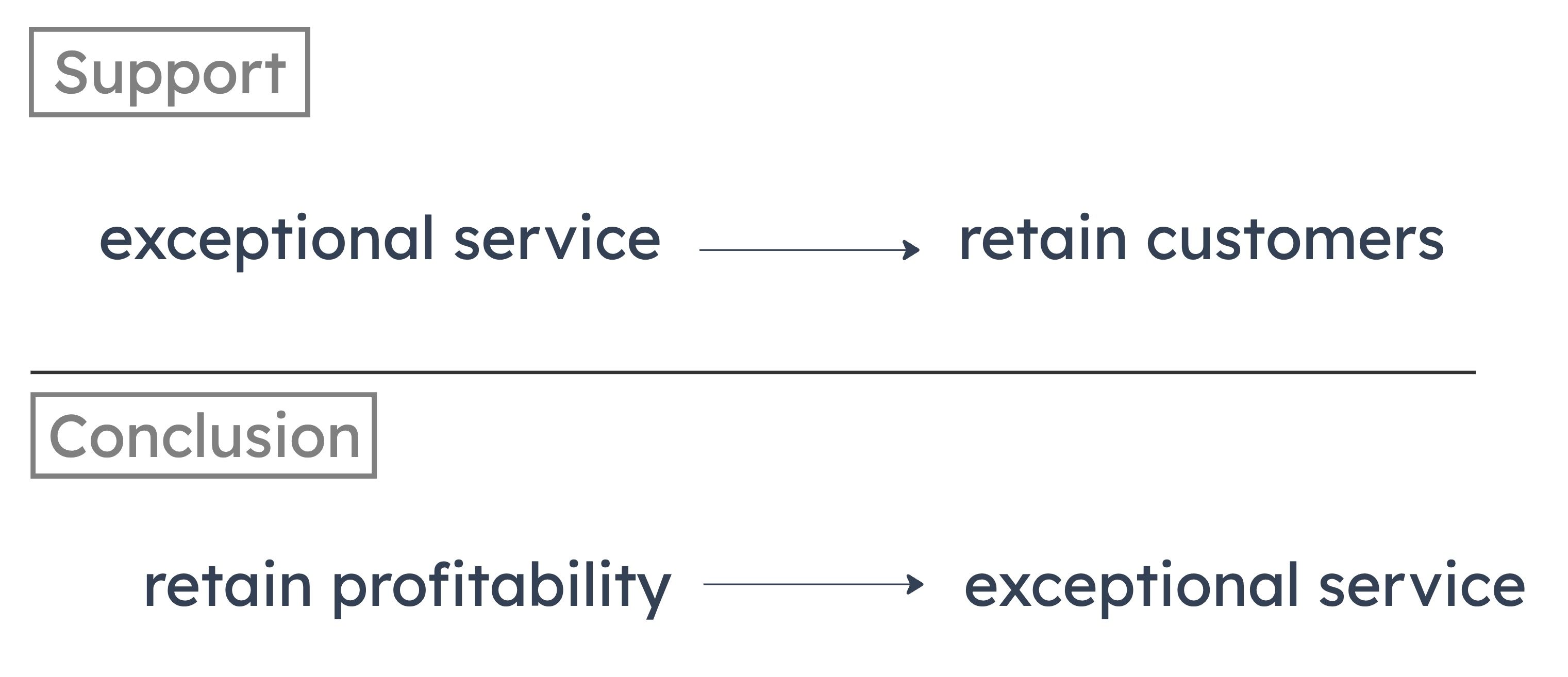
The author concludes that small retailers competing with large discount chains must offer exceptional service in order to retain profitability. She supports with a conditional claim: if small retailers offer exceptional service, then they can keep their customers without lowering prices.
Identify and Describe Flaw
This is the flaw of mistaking sufficiency for necessity. The author treats “offering exceptional service” as necessary for “retaining profitability.” But according to her premise, “offering exceptional service” is sufficient, not necessary.
In other words, her reasoning is flawed because it fails to take into account the possibility that small retailers may be able to retain their profitability by some other means.
Note that the author assumes that “retaining profitability” either leads to or else is the same as “retaining their customer base...”
A
not all large discount chains do in fact make a profit
The argument is about the profit of small retailers, not large discount chains. Whether or not some discount chains fail to make a profit doesn't affect the author’s argument.
B
some large discount chains have lower profit margins than do some small retailers
The author is addressing what small retailers need to do in order to retain their customers and profit. It doesn't matter whether some large discount chains have lower profit margins than some small retailers; the author never compares the two.
C
small retailers are often motivated by things other than the desire for profit
This doesn't affect the author’s argument, because her conclusion is only addressing what small retailers need to do in order to retain profitability. Whether or not they want to retain profitability is irrelevant.
D
not all small retailers are forced to compete with large discount chains
This is irrelevant because the author’s conclusion isn’t about all small retailers. Instead, it only addresses “small retailers that are forced to compete with large discount chains.”
E
exceptional service is not the only reason customers prefer small retail stores
The author’s conclusion mistakenly treats “offering exceptional service” as a necessary condition, while in the premises, it’s merely sufficient. In other words, she overlooks the possibility that customers may prefer small retailers for other reasons.
A successful chess-playing computer would prove either that a machine can think or that chess does not involve thinking. In either case the conception of human intelligence would surely change.
Summarize Argument
The author concludes that a successful chess-playing computer would change how we see human intelligence, because it would either prove that a machine can think or that chess doesn’t require thinking.
Identify and Describe Flaw
The author uses premises about computers playing chess to support a conclusion about humans playing chess. He mistakenly assumes that what is true of a computer’s chess-playing method is also true of a human’s chess-playing method. But what if, for example, a computer doesn’t require thinking to play chess, but a human does? In that case, our understanding of human intelligence might not be affected by a successful chess-playing computer.
A
the conception of intelligence is inextricably linked to that of thought
The author doesn't overlook the possibility that an understanding of intelligence is linked to an understanding of thought. Instead, he assumes that the two are linked.
B
a truly successful chess program may never be invented
This may be true, but it doesn’t affect the author’s argument, so it can’t be the flaw. The author never claims that a successful chess-playing computer will be invented. He just says that if one is invented, it will change our understanding of human intelligence.
C
computer programs have been successfully applied to games other than chess
This may be true, but it doesn’t affect the author’s argument, so it can’t be the flaw. His argument only addresses chess-playing computers; it doesn’t matter if computers can play any other kinds of games.
D
a successful chess-playing computer would not model a human approach to chess playing
By applying premises about a computer’s approach to chess to a conclusion about a human’s approach to chess, the author assumes that the two are relevantly similar. But if the two approaches are different, a chess-playing computer may not affect how we see human intelligence.
E
the inability to play chess has more to do with lack of opportunity than with lack of intelligence
The author’s argument addresses what would happen if a computer were able to play chess. He never discusses an inability to play chess.