In a town containing a tourist attraction, hotel and restaurant revenues each increased more rapidly over the past year than did revenue from the sale of passes to the attraction, which are valid for a full year. This led those in charge of the attraction to hypothesize that visitors were illicitly selling or sharing the passes.

Summarize Argument: Phenomenon-Hypothesis
People in charge of a tourist attraction hypothesize that visitors illegally sold or shared passes to the attraction in the past year. This is because hotel and restaurant revenues increased more than did revenue from the attraction itself.

Notable Assumptions
The people in charge of the tourist attraction assume that the only reason anyone would use the nearby hotels and restaurants is to go to the tourist attraction. In other words, these people believe that there should be a 1:1 correlation in how rapidly revenue rises for the tourist attraction, and how rapidly revenue rises for nearby restaurants and hotels.

A
During the past year other tourist attractions have opened up in the area.
If other tourist attractions opened up in the area, then they’re probably attracting visitors who don’t also visit the tourist attraction in question. This weakens the 1:1 correlation the people talking in the stimulus seem to think must exist.
B
Those possessing passes made more frequent trips to the attraction last year than in previous years.
Revenue for passes didn’t increase at the same rate as hotels and restaurants since people holding passes visited more frequently. They spent money on hotels and restaurants each trip, but not on a tourist attraction pass.
C
While the cost of passes is unchanged since last year, hotel and meal prices have risen.
Hotels and restaurants charge more than they did the year before, while the tourist attraction costs the same. Thus, all things being equal, revenue for the former increased more rapidly than the latter.
D
The local board of tourism reports that the average length of stay for tourists remained unchanged over the past year.
This doesn’t explain why hotel and restaurant revenue would’ve risen more rapidly than tourist attraction revenue. It simply states that one possibly important factor has in fact stayed the same.
E
Each pass contains a photograph of the holder, and during the past year these photographs have usually been checked.
This suggests that selling or sharing the passes wouldn’t work. There must be some other reason why tourist attraction revenue hasn’t risen as rapidly as hotel and restaurant revenue.

11 comments

Shortly after Isaac Newton circulated some of his theories of light in 1672, his colleague Robert Hooke claimed that most of those theories were based on Hooke’s own work. A modern reader might interpret Newton’s famous comment, “if I have seen further it is by standing on the shoulders of giants,” as a conciliatory gesture acknowledging indebtedness to Hooke and other contemporary scientists for some of his theories. Conciliatory gestures acknowledging indebtedness were uncharacteristic of Newton, however, and in his day such allusions to “giants” typically referred to the ancient Greeks, not to contemporary scientists.

Summary
After Isaac Newton announced his theories of light, his colleague Robert Hooke claimed most of those theories were based on Hooke’s work. Newton famously commented “if I have seen further it is by standing on the shoulder of giants.” A modern reader may interpret this quote as acknowledging Newton’s indebtedness to Hooke and other scientists for some of Newton’s theories. However, these gestures were uncharacteristic of Newton, and in Newton’s day “giants” usually referred to the ancient Greeks.

Strongly Supported Conclusions
Newton probably did not intend his famous quote to give credit to Hooke and other scientists for his theories.

A
Newton did not intend the quoted comment to be an acknowledgment that his theories of light were largely derived from Hooke’s.
This answer is strongly supported. If Newton’s reference to “giants” typically referred to the ancient greeks, then it is highly unlikely Newton’s famous quote was intended to give credit to Hooke for Newton’s theories of light.
B
Newton did not take credit for any advances that Hooke made in the theory of light.
This answer is unsupported. We don’t know for a fact if Newton did not take credit for any part of Hooke’s work. We only know from the stimulus that Hooke claims that most of Newton’s theories were based on Hooke’s work.
C
Newton did not believe that any of Hooke’s theories of light were based on those of the ancient Greeks.
This answer is unsupported. We don’t know from the stimulus what Newton believed about Hooke’s work. We only know that Hooke claimed that most of Newton’s theories were based on Hooke’s work.
D
Newton intended to credit some contemporary scientists other than Hooke for some of the advances that Newton made in the theory of light.
This answer is unsupported. We don’t know for a fact what Newton’s intentions were.
E
Newton was not familiar with Hooke’s work on the theory of light.
This answer is unsupported. We don’t know from the stimulus what Newton knew about any of Hooke’s work. We only know that Hooke claimed that most of Newton’s theories were based on Hooke’s work.

Comment on this

Ideally, scientific laws should display the virtues of precision and generality, as do the laws of physics. However, because of the nature of their subject matter, laws of social science often have to use terms that are imprecise; for example, one knows only vaguely what is meant by “republicanism” or “class.” As for generality, laws that apply only in certain social systems are typically the only ones possible for the social sciences.

Summary
The ideal scientific laws are precise and general. The laws of physics have these qualities. Social science laws tend to be imprecise because the subject matter may be less clearly defined. Social science laws are also more specific because they can only apply to certain social systems.

Strongly Supported Conclusions
Social science laws deviate more from the ideal of scientific laws than physics laws.
It is not always possible for social science laws to be precise and general.

A
All else being equal, a precise, general scientific law is to be preferred over one that is not general.
Strongly supported. This restates the rule in the first sentence. Ideally, scientific laws should be precise and general.
B
The social sciences would benefit if they redirected their focus to the subject matter of the physical sciences.
Unsupported. The author discusses how it is harder for social science laws to match the ideal, but does not claim that the social sciences should change for that reason.
C
Terms such as “class” should be more precisely formulated by social scientists.
Unsupported. The author makes no claims as to what social scientists “should” do. In fact, the author implies that the imprecision of certain terms is inherent: “laws of social science have to use terms that are imprecise”.
D
Social scientists should make an effort to construct more laws that apply to all societies.
Unsupported. The author makes no claims as to what social scientists “should” do. In fact, the author implies that the specificity of the rules is all that is possible in the social sciences.
E
The laws of social science are invariably not truly scientific.
Unsupported. The author does not claim that laws that deviate from the ideal are unscientific. The author only distinguishes how the fields vary.

14 comments

Nutritionist: A study revealed that although most adults estimated their diets to correspond closely with the recommendations of standard nutritional guidelines, most of their diets did not come close to those recommendations. Both women and men underestimated the amount of fat in their diets and overestimated their intake of most other foods. In most food categories, especially fruits and vegetables, women’s diets did not meet the recommendations. Men underestimated their fat intake by half, and though they met the recommendations for breads, they fell short in all other categories.

Summary

A study concluded that most adult’s diets do not conform to standard nutritional guidelines. This is despite most adults estimating that their diets conform closely with the guidelines. Women and men underestimate the amount of fat in their diets and overestimate their intake of other foods. Women’s diets did not meet guidelines in most food categories, especially fruits and vegetables. Men met the guidelines’ recommendations for breads, but underestimated their fat intake by half and did not meet guidelines in all other categories.

Strongly Supported Conclusions

Most men in the study did not consume the amount of fruits and vegetables recommended by standard nutritional guidelines.

A
Both men and women in the study misjudged their compliance with the nutritional guidelines in every food category.

This answer is anti-supported. We know from the stimulus that most men in the study met the nutritional guidelines for breads.

B
In the study, more men than women were aware that in some food categories their diet failed to reflect the recommendations closely.

This answer is unsupported. We don’t know whether more men than women were aware of their shortfalls when it comes to the standard nutritional guidelines. We only know that most of the adults in the study overestimated their compliance with the guidelines.

C
Women in the study were more aware than men were of the recommended intake of breads.

This answer is unsupported. We don’t know from the stimulus whether women’s bread intake complied with the guidelines. It’s possible that women complied with the recommended intake of breads, but it’s equally possible that they did not.

D
Men in the study estimated their daily intake of fruits and vegetables to be significantly lower than it in fact was.

This answer is anti-supported. We know from the stimulus that men overestimated their intake of most food categories. To estimate your intake as lower than it actually is would be an underestimation, not an overestimation.

E
Most men in the study did not consume the amounts of fruits and vegetables that the nutritional guidelines recommend.

This answer is strongly supported. We know from the stimulus that men met the recommendations for bread and fell short in all other categories. Therefore, men must not have met the recommended guidelines for fruits and vegetables.


8 comments

Generic drugs contain exactly the same active ingredients as their brand-name counterparts, but usually cost much less to develop, produce, and market. So, generic drugs are just as effective as their brand-name counterparts, but cost considerably less.

Summarize Argument
The author concludes that generic drugs are just cheaper, equally effective versions of brand-name drugs. This is because generic drugs contain the same active ingredients as brand-name drugs but cost less to produce.

Notable Assumptions
The author assumes generic drugs have no relevant difference to brand-name drugs. True, the active ingredients are the same, but there could be other differences in composition that alter how effective these drugs are.

A
The ingredients used in the manufacture of brand-name drugs cost no more than the ingredients used to produce their generic counterparts.
We don’t care. We already know generic drugs are cheaper.
B
Generic drugs are no more likely than brand-name drugs to suffer from defects in composition.
While generic drugs are cheaper and as effective based on their active ingredients, are they likely to suffer from some other issue? This says they aren’t, so this rules out a potential problem with generic drugs.
C
Generic drugs are just as likely as brand-name drugs to be readily available in pharmacies.
We don’t care about availability. We care about efficacy and cost.
D
The higher costs of brand-name drugs underwrite drug companies’ heavy investment in research.
This simply explains why brand-name drugs are more expensive. But we already know they’re more expensive.
E
Because of advertising, doctors frequently prescribe brand-name drugs by their brand name, rather than by their chemical name.
Irrelevant. We don’t care what doctors prescribe. We care about cost and efficacy.

5 comments

Space programs have recently suffered several setbacks with respect to their large projects, and much money has been lost. Consequently, these grand projects should be abandoned in favor of several small ones.

Summarize Argument
The author concludes that large space program projects should be abandoned in favor of smaller ones. This is because large projects have recently suffered costly setbacks.

Notable Assumptions
The author assumes that large projects shouldn’t continue to be funded if they suffer costly setbacks. He further assumes that funding for these projects should be reallocated to smaller projects, which presumably are less likely to fail.

A
The cost of starting a space project increases every year.
This seems to weaken the author’s argument. If projects cost more to start every year, then those smaller projects might not actually be much less expensive.
B
It is just as easy to revise, and even scrap, small projects as it is large ones.
Irrelevant. We need to strengthen the claim that large projects should be abandoned if they suffer costly setbacks.
C
Large projects are intrinsically more likely to fail and so are more financially risky than small projects.
Large projects are a big risk. Small projects are a safer bet. Thus, money should be reallocated towards the safer options.
D
Project managers prefer to work on small projects rather than large ones.
We don’t care what project managers prefer. The author doesn’t factor them into funding decisions.
E
Large space projects can explore a few places thoroughly, while small projects can investigate more regions, though less thoroughly.
We don’t know what sort of space exploration we’re trying to do. If we want thorough exploration, then this would be a weakener.

Comment on this

James: Chemists have recently invented a new technique for extracting rhodium, an element necessary for manufacturing catalytic converters for automobiles, from nuclear waste. Catalytic converters function to remove noxious gases from automobile exhaust. The use of nuclear power is therefore contributing in at least one way to creating a cleaner environment.

Marta: The technique you mention, though effective, is still at an experimental stage, so there has been no shift in the sources of the rhodium currently used in manufacturing catalytic converters.

Summarize Argument: Counter-Position
In response to James’s claim that nuclear power has contributed to creating a cleaner environment, Marta concludes that there has been no shift to extract rhodium from nuclear waste in order to manufacture catalytic converters. As evidence, Marta points out that the technique is still in an experimental stage.

Describe Method of Reasoning
Marta counters the position held by James. She does this by pointing out something that James did not consider about the technique he describes. If the technique is still in its experimental stages, then it is unlikely that nuclear power has had any effect on the process of extracting rhodium yet.

A
casting doubt on the accuracy of the claims made by James in support of his conclusion
Marta does not doubt the accuracy of James’s premises. In fact, she concedes that the technique James mentions is effective.
B
questioning the credibility of advocates of nuclear power
There are no arguments from advocates of nuclear power in the stimulus. We cannot assume James is such an advocate for endorsing the technique he describes. Moreover, Marta does not question anybody’s credibility.
C
indicating that James is assuming the truth of the conclusion that he intends to establish
James’s argument is not circular. He is not assuming that nuclear power is contributing to a cleaner environment. What James is assuming is that the technique he describes is already being put to use. Marta is attacking this assumption by stating the technique is experimental.
D
pointing out a fact that James, in drawing his conclusion, did not take into account
The fact James’s fails to take into account is that the technique he describes is still in an experimental stage. Just because the technique was discovered and is possible to implement does not mean it is actually being implemented.
E
pointing out that James’s premises are no more plausible than is his conclusion
Marta does not doubt the plausibility of James’s premises. In fact, she concedes that the technique James mentions is effective.

1 comment

If an artist receives a public subsidy to support work on a specific project—e.g., making a film—and if this project then proves successful enough to allow the artist to repay the subsidy, is the artist then morally obliged to do so? The answer is clearly yes, since the money returned to the agency distributing the subsidies will be welcome as a source of support for other artists deserving of public subsidies.

Summarize Argument
The author considers a question of whether artists who receive public subsidies should repay those subsidies and concludes that artists are morally required to do so. As evidence, the author states that returning the money would be a source of support for other artists deserving of public subsidies.

Describe Method of Reasoning
The author establishes an artists moral obligation by suggesting other artists would be able to receive the same benefit if the public subsidies were repaid.

A
this person has benefited from other people’s acting in just this way in the past
The author does not suggest an artist’s moral obligation is based on other people’s past actions. The subsidy an artist is initially granted if funded by the public, but this money could have a different source other than another artist’s repayment.
B
acting this way would allow others to obtain a benefit such as the one that this artist has obtained in the past
The author’s support for his conclusion is that, if the subsidy is repaid, other deserving artists would have access to this source of support.
C
this person had in fact, at an earlier time, made a tacit promise to act this way
The author does not mention whether an author made a promise to repay the funds before being granted the subsidy.
D
not acting this way would be a small benefit to the person in the short term but a substantial detriment to the person in the long run
The author does not compare short and long term benefits or detriments.
E
this person, by acting this way, would provide general benefits with a value exceeding the cost to the person of acting this way
The author does not mention what benefits or costs an artist repaying a subsidy would incur.

1 comment

Linguist: Only if a sentence can be diagrammed is it grammatical. Any grammatical sentence is recognized as grammatical by speakers of its language. Speaker X’s sentence can be diagrammed. So, speaker X’s sentence will be recognized as grammatical by speakers of its language.

Summarize Argument
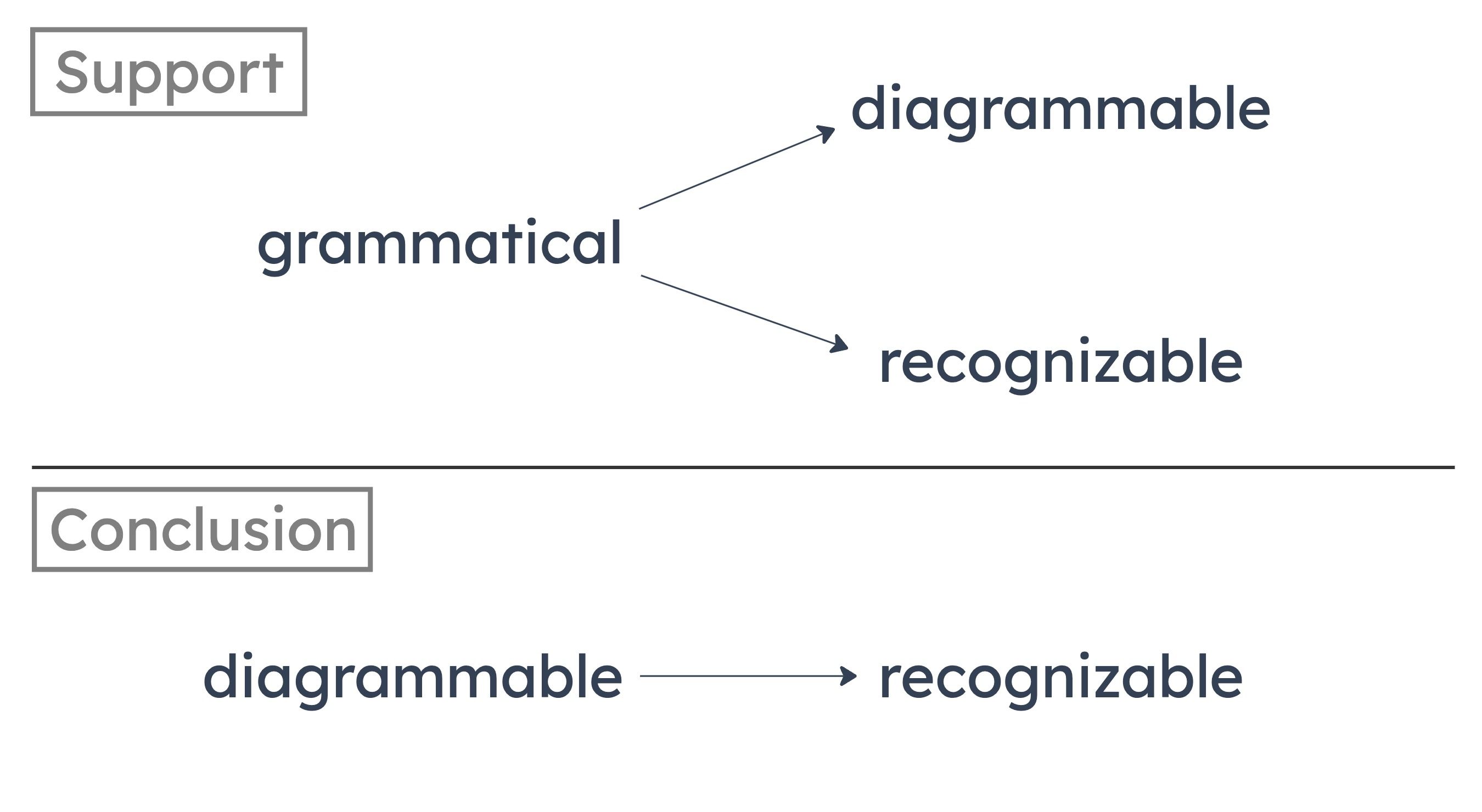
The linguist concludes that speaker X’s sentence will be recognized as grammatical by speakers of its language. As premises, he gives three claims:

(1) If a sentence is grammatical, it is diagrammable.

(2) If a sentence is grammatical, it will be recognized as grammatical by speakers of its language.

(3) Speaker X’s sentence is diagrammable.
Identify and Describe Flaw
The linguist mistakes sufficiency and necessity. He assumes that because speaker X’s sentence is “diagrammable,” it is also “grammatical,” and therefore “recognizable.” But “grammatical” is the sufficient condition for “diagrammable,” not the other way around. Perhaps speaker X’s sentence is “diagrammable” but is not grammatical, and is therefore not “recognizable.”

In other words, he draws a conditional connection between “diagrammable” and “recognizable” when no such connection exists.

A
most people are unable to diagram sentences correctly
This wouldn’t damage the argument, so overlooking it can’t be a flaw. Even if most people can't diagram a sentence correctly, it doesn't affect whether the sentence can be diagrammed.
B
some ungrammatical sentences are diagrammable
This points out the linguist’s key flaw. He draws a conditional connection between “diagrammable” and “recognizable” when no such connection exists. It could be that speaker X’s sentence is diagrammable but is ungrammatical. In that case, the conclusion would fall apart.
C
all sentences recognized as grammatical can be diagrammed
If this were true, it wouldn’t impact the linguist’s argument either way. His argument rests on the mistaken assumption that all sentences that can be diagrammed can also be recognized as grammatical, not the other way around.
D
all grammatical sentences can be diagrammed
The linguist doesn’t fail to consider this. In fact, it’s just restating his first premise: “only if a sentence can be diagrammed is it grammatical.”
E
some ungrammatical sentences are recognized as ungrammatical
The linguist’s argument only states that all grammatical sentences can be recognized as grammatical. Whether some ungrammatical sentences are recognized as ungrammatical is not relevant.

3 comments

To hold criminals responsible for their crimes involves a failure to recognize that criminal actions, like all actions, are ultimately products of the environment that forged the agent’s character. It is not criminals but people in the law-abiding majority who by their actions do most to create and maintain this environment. Therefore, it is law-abiding people whose actions, and nothing else, make them alone truly responsible for crime.

Summarize Argument
The author concludes that law-abiding people are solely responsible for crime. This is based on the assertions that (1) criminal actions, like all actions, are products of the environment, and (2) law-abiding people do the most to create and maintain the environment.

Identify and Describe Flaw
The author’s conclusion contradicts parts of the reasoning. The author uses as a premise the claim that all actions are products of the environment. Because this means criminals’ actions are products of the environment, the author believes criminals are not responsible for their crimes. But law-abiding persons’ actions that create the environment would also be products of the environment, and thus they should not be responsible for their actions, either. The conclusion, however, asserts law-abiding people are responsible for crime.

A
it exploits an ambiguity in the term “environment” by treating two different meanings of the word as though they were equivalent
The author does not shift between multiple meanings of “environment.” “Environment” throughout the stimulus refers to the surroundings, conditions, and circumstances of a person’s life.
B
it fails to distinguish between actions that are socially acceptable and actions that are socially unacceptable
The stimulus concerns responsibility for crime. The distinction between socially acceptable and socially unacceptable plays no role in the reasoning. Even if you believe crime is socially unacceptable, the author does not fail to distinguish between crime and law-abiding actions.
C
the way it distinguishes criminals from crimes implicitly denies that someone becomes a criminal solely in virtue of having committed a crime
The argument does not deny that one becomes a “criminal” solely by committing a crime. There’s a difference between what gives someone the status of “criminal” (which is what (C) is about) and what causal factors lead one to commit crimes (which is what the stimulus is about).
D
its conclusion is a generalization of statistical evidence drawn from only a small minority of the population
There is no statistical evidence presented. And, the conclusion is not a generalization from what’s true about a small minority of the population.
E
its conclusion contradicts an implicit principle on which an earlier part of the argument is based
In denying the responsibility of criminals, the author uses the implicit principle that one is not responsible for actions that are a product of one’s environment. But the author contradicts this principle when claiming that law-abiding persons are responsible for crime.

79 comments