A
Different things make different people happy.
B
The proposed reform would make a few people happy, but would not increase the happiness of most other people.
C
The proposed reform would affect only the member of Parliament’s constituents and would make them happy.
D
Increasing some people’s happiness might not increase the sum total of human happiness if others are made unhappy.
E
Good social reforms usually have widespread support.
A
Once on these islands, the cave painters hunted and ate land animals.
B
Parts of the cave paintings on the islands did not survive the centuries.
C
The cave paintings that were discovered on the islands depicted many land animals.
D
Those who did the cave paintings that were discovered on the islands had unusually advanced techniques of preserving meats.
E
The cave paintings on the islands were done by the original inhabitants of the islands who ate the meat of land animals.
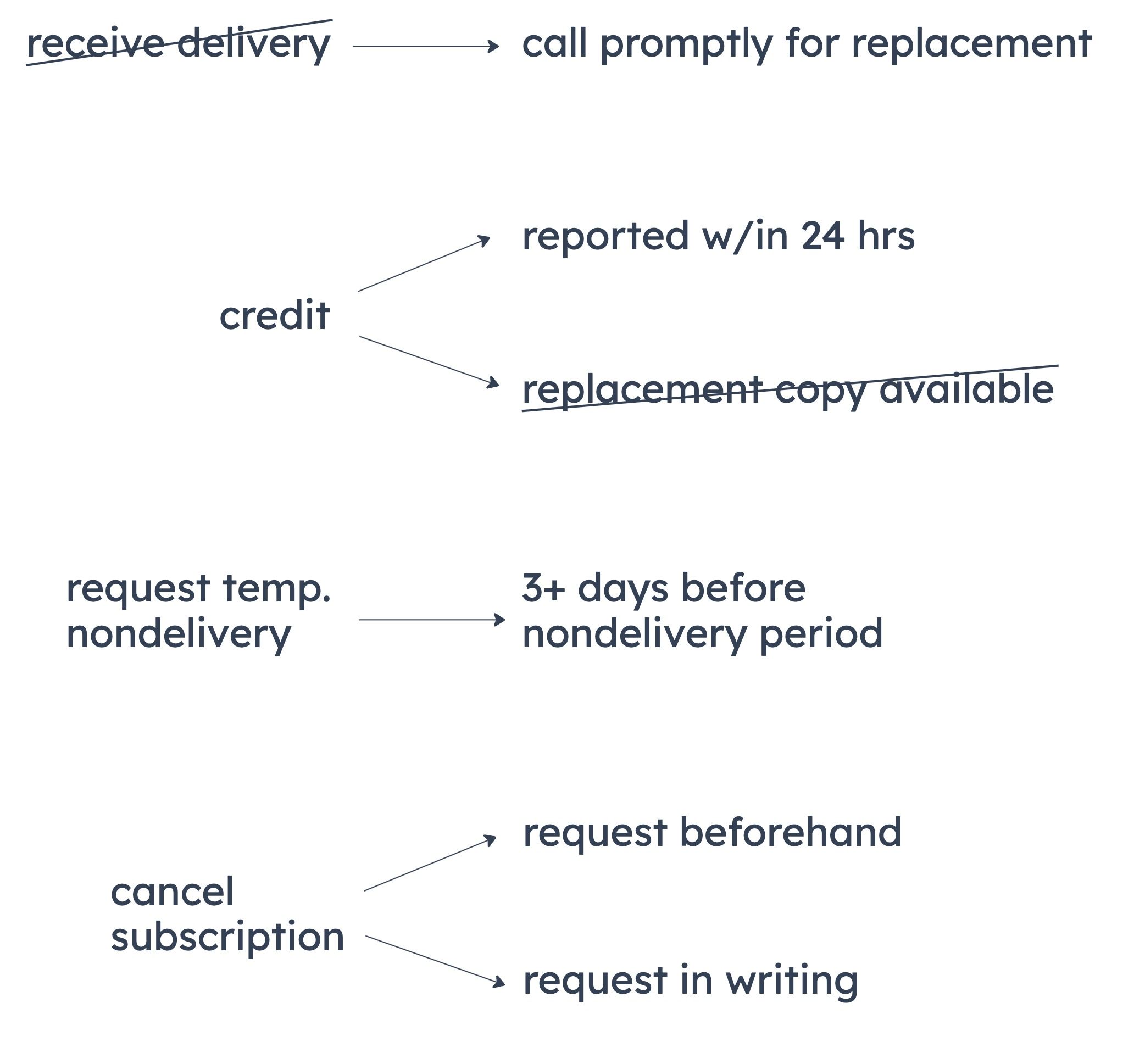
Notice to subscribers: In order for us to provide you with efficient and reliable newspaper service, please note the following policies. You will be billed for home delivery every four weeks, in advance. If you do not receive delivery, call us promptly to receive a replacement copy. Credit can be given only if the missed copy is reported to us within twenty-four hours and only if a replacement copy is unavailable. Request for temporary nondelivery must be made at least three days prior to the first day on which delivery is to stop. No subscription will be canceled unless the subscriber explicitly requests the cancellation beforehand and in writing.
The Daily Gazette
Summary
The stimulus can be diagrammed as follows:
Notable Valid Inferences
This is a MBT Except question. For this question, all the wrong answers must be true (i.e., the denials can be justified), and the right answer must be false (i.e., the denial cannot be justified). We are looking for an answer choice that describes a subscriber who fulfilled all the requirements to be granted their request but was still denied.
A
Mr. Rathanan did not send in his advance payment two weeks ago; he states that his inaction was intended as cancellation and requests that he not be charged for the past two weeks of delivery of The Daily Gazette.
This denial is justified. A written request must be made beforehand to cancel a subscription, and Mr. Rathanan did not fulfill this requirement. We can also see this relationship by taking the contrapositive of the last conditional statement in the stimulus.
B
Dr. Broder called The Daily Gazette Monday morning to report that her Sunday edition had not been delivered; she requests credit instead of the offered replacement copy.
This denial is justified. A credit will only be offered if a replacement copy is unavailable. Because a replacement copy was available, a credit cannot be offered. We can also see this relationship by taking the contrapositive of the second conditional statement in the stimulus.
C
The Daily Gazette was delivered to Ms. Herrera during her one-week vacation even though she called on a Wednesday to stop delivery the following Monday for the entire week; she requests credit for the full week’s delivery.
This denial is not justified. Ms. Herrera requested temporary nondelivery more than three days before the first day she wanted delivery to stop, fulfilling the requirements for requesting temporary nondelivery. Based on the stimulus, there is no reason for her claim to be denied.
D
Although Ms. Jackson telephoned The Daily Gazette at the beginning of June requesting that her subscription be canceled on June 30, delivery was continued until July 3 when she called to complain; she requests that she not be charged for the papers delivered in July.
While Ms. Jackson did request her subscription be cancelled in advance, she did not make this request in writing. Therefore, the denial is justified. We can also see this relationship by taking the contrapositive of the last conditional statement in the stimulus.
E
Ms. Silverman was out of town on Sunday and Monday and when she returned on Tuesday she found that her Sunday edition had not been delivered; she called The Daily Gazette on Tuesday afternoon requesting credit for the undelivered copy.
This denial is justified. As we can see from the second conditional statement in the stimulus, a missing copy should be reported within 24 hours. Ms. Silverman failed to meet this condition, which implies the denial is justified.
A
establish that the number of police officers does not need to be increased
B
illustrate the need for increasing the number of police officers in major cities
C
prove that there are factors other than the number of police officers that are more important in reducing the crime rate
D
demonstrate that there is no relation between the number of police officers and the crime rate
E
suggest that the number of police officers is not the only influence on the crime rate
A
ignores the fact that businesses that achieve high levels of customer satisfaction are often profitable even if they pay high wages
B
presumes, without providing justification, that businesses that pay the lowest wages have the lowest general operating expenses and thus the highest profits
C
ignores the fact that in a family business, paying family members low wages may itself reduce the family’s prosperity
D
presumes, without providing justification, that family members are willing to work for low wages in a family business because they believe that doing so promotes the family’s prosperity
E
presumes, without providing justification, that only businesses with low general operating expenses can succeed
Witness: Yes.
Lawyer: And the best writer?
Witness: Yes.
Lawyer: In fact everyone she assigned to work on the project was top notch?
Witness: That’s true.
Lawyer: So, you lied to the court when you said, earlier, that Congleton wanted the project to fail?
The author overlooks the possibility that Congleton may have wanted the project to fail despite assigning only excellent people to it.
The author assumes that Congleton had the ability to choose other people for the project.
The author assumes that the witness believed Congleton did not want the project to fail when the witness said that Congleton did want the project to fail.
A
It takes for granted that Congleton was not forced to assign the people she did to the project.
B
It takes for granted that the project could fail only if Congleton wanted it to fail.
C
It ignores the possibility that Congleton knew that the people assigned to the project would not work well together.
D
It ignores the possibility that the witness failed to infer from known facts what should have been inferred and therefore was not lying.
E
It ignores the possibility that Congleton failed to allot enough time or resources to the project team.
(D) points out that there is a distinction between being stupid and being deceitful.
For example, say we know that "X is a banana" and we know that "all bananas are fruits". Does it follow that X is a fruit? Of course it does. Simple logic. But, does it follow that we should know that X is a fruit? Well, that depends on a lot of circumstances. Are we 15 months old? If that's the case, then probably not. Are we 15 years old with normal brain function? If so, then probably yes.
(D) is simply saying that when the witness said that "X is not a fruit" it could be that he's lying or it could be that he's stupid (or that he's a 15 month old baby, but now I'm being redundant).
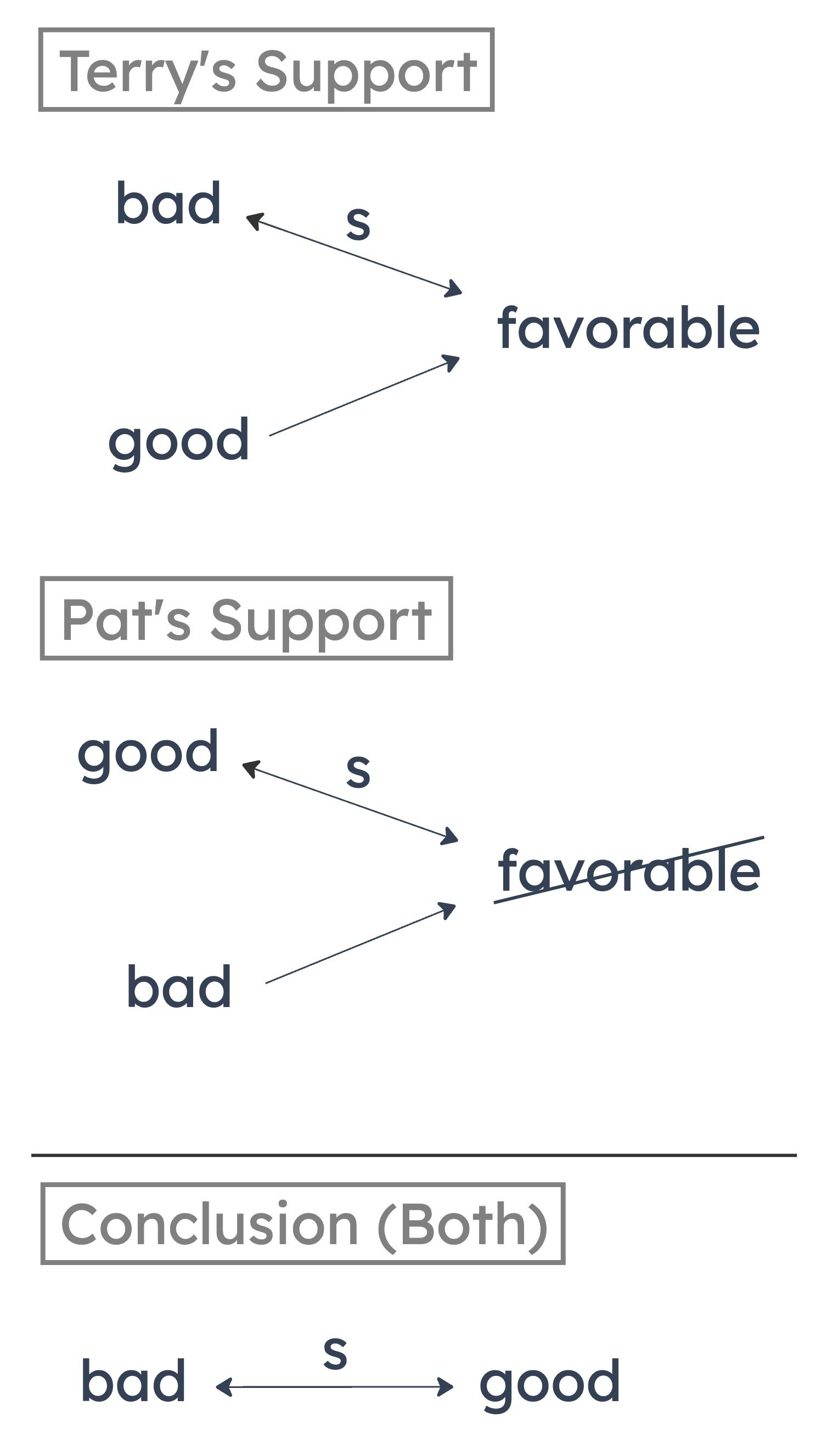
Pat: I agree with your conclusion, but not with the reasons you give for it. Some good actions actually do not have favorable consequences. But no actions considered to be bad by our society have favorable consequences, so your conclusion, that some actions our society considers bad are actually good, still holds.
A
presupposing that if a certain property distinguishes one type of action from another type of action, then that property is one of many properties distinguishing the two types of action
B
presupposing that if most actions of a certain type share a certain property, then all actions of that type share that property
C
presupposing that if a certain property is shared by actions of a certain type in a given society, then that property is shared by actions of that type in every society
D
presupposing that if an action’s having a certain property is necessary for its being a certain type of action, then having that property is sufficient for being that type of action
E
presupposing that if a certain property is shared by two types of action, then that property is the only property distinguishing the two types of action from actions of other types