Commissioner: Budget forecasters project a revenue shortfall of a billion dollars in the coming fiscal year. Since there is no feasible way to increase the available funds, our only choice is to decrease expenditures. The plan before you outlines feasible cuts that would yield savings of a billion dollars over the coming fiscal year. We will be able to solve the problem we face, therefore, only if we adopt this plan.
Summarize Argument
The commissioner concludes that the only way to solve the problem of the revenue shortfall is by adopting his plan. He supports this with three premises:
(1) Budget forecasters predict a billion-dollar shortfall next year.
(2) We can't increase funds, so we must cut spending.
(3) This plan would cut spending and save a billion dollars.
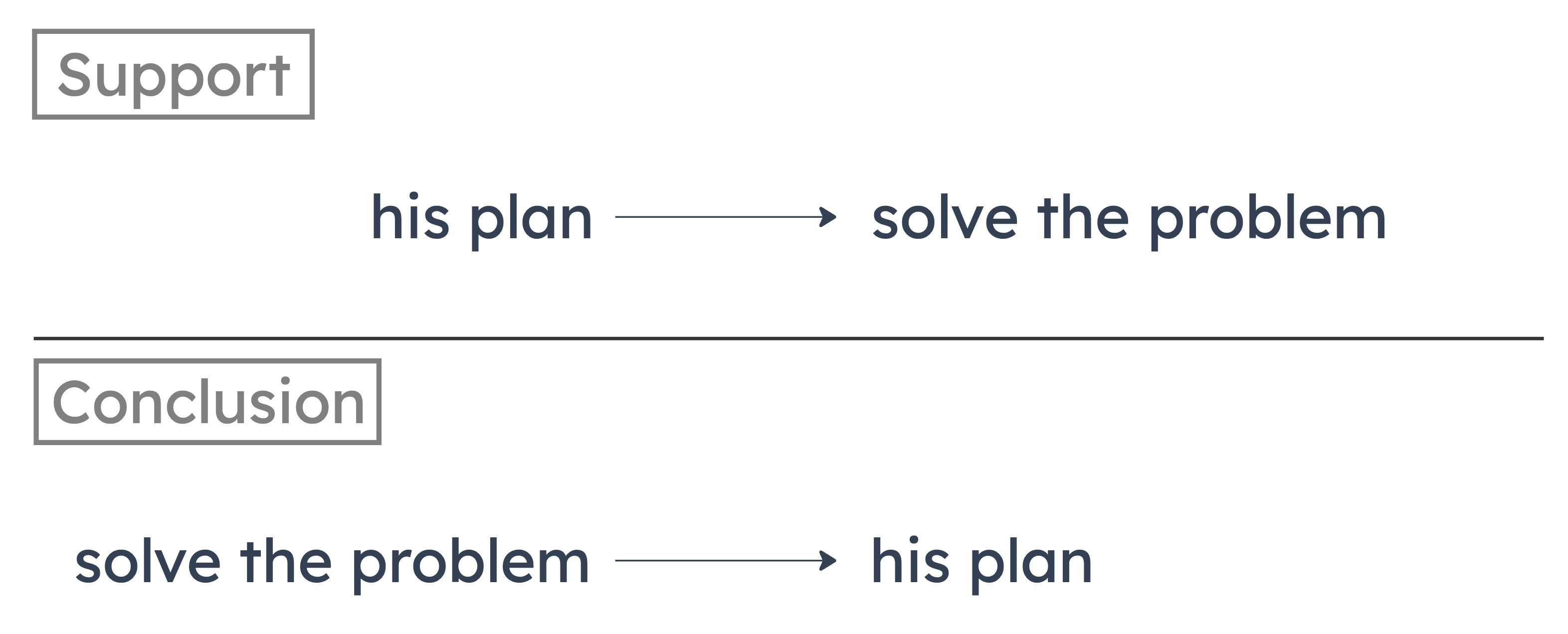
Identify and Describe Flaw
This is the cookie-cutter flaw of mistaking sufficiency for necessity. The author treats “his plan” as necessary for “solve the problem.” But according to the premises, “his plan” is sufficient, not necessary.
In other words, the commissioner’s argument is flawed because he ignores the possibility that some other plan or solution could also solve the revenue shortfall. His plan might not be the only option.
A
relies on information that is far from certain
We have no reason to doubt the forecasters’ prediction and we can’t assume that it’s uncertain.
B
confuses being an adequate solution with being a required solution
The commissioner confuses an adequate (or sufficient) solution— his plan— with being a required (or necessary) solution. But just because his plan would solve the problem doesn't mean that it’s the only way to solve the problem.
C
inappropriately relies on the opinions of experts
The commissioner points to budget forecasters’ prediction about next year’s revenue shortfall. He relies on experts, but he doesn’t do so inappropriately since the experts’ prediction is within their own field.
D
inappropriately employs language that is vague
The commissioner uses clear and precise language throughout his argument. He doesn't inappropriately rely on vague language.
E
takes for granted that there is no way to increase available funds
The commissioner’s claim that there is no way to increase funds is a premise; we must accept that it’s true. So (E) doesn't describe a flaw in his argument.
When the gene is affected in this way, it causes lung cells to metabolize in a way that makes the cells cancerous.
Smokers in whom this gene is not stimulated have as high a risk of developing lung cancer from smoking as other smokers do.
A
stimulation of the gene by chemicals in cigarette smoke is not the only factor affecting the risk for smokers of developing lung cancer
B
nonsmokers have as high a risk of developing lung cancer as do smokers in whom the gene has not been stimulated
C
smokers in whom the gene has been stimulated are more likely to develop lung cancer than are other smokers
D
the gene is more likely to be stimulated by chemicals in cigarette smoke than by other chemicals
E
smokers are less likely to develop lung cancer if they do not have the gene
Anthropologist: All music is based on a few main systems of scale building. Clearly, if the popularity of a musical scale were a result of social conditioning, we would expect, given the diversity of social systems, a diverse mixture of diatonic and nondiatonic scales in the world’s music. Yet diatonic scales have always dominated the music of most of the world. Therefore, the popularity of diatonic music can be attributed only to innate dispositions of the human mind.
Summarize Argument: Phenomenon-Hypothesis
The anthropologist hypothesizes that human nature alone explains the widespread popularity of diatonic music. He supports this by saying that if musical popularity was based on social conditioning, we'd expect to see a mix of diatonic and nondiatonic scales in music across different cultures. However, diatonic scales have always been the dominant type of music worldwide.
Identify and Describe Flaw
The anthropologist offers two possible explanations for the popularity of diatonic music: human nature (or “innate dispositions...”) and social conditioning. He then assumes that if social conditioning alone can’t explain its popularity, then human nature must be the sole explanation. He ignores the possibility that human nature and social conditioning could explain it together, or that some other factor might also be involved.
A
consider the possibility that some people appreciate nondiatonic music more than they do diatonic music
The anthropologist doesn’t fail to consider this possibility. Diatonic scales “have always dominated the music of the world,” but it’s still possible that some people appreciate nondiatonic music more.
B
explain how innate dispositions increase appreciation of nondiatonic music
The anthropologist doesn’t explain this, but he doesn’t need to explain it. He’s arguing that innate dispositions explain the popularity of diatonic music.
C
explain the existence of diatonic scales as well as the existence of nondiatonic scales
The anthropologist doesn’t explain this, but he doesn’t need to. He just needs to explain why diatonic music is more popular, given the fact that both kinds of scales exist.
D
consider that innate dispositions and social conditioning could jointly affect the popularity of a type of music
The author concludes that innate dispositions alone explain the popularity of diatonic music, simply because social conditioning alone does not explain it. He fails to consider that both of these factors might affect the popularity of diatonic music together.
E
consider whether any appreciation of nondiatonic music is demonstrated by some nonhuman species of animals
The anthropologist’s argument is only concerned with the popularity of diatonic music among humans. Whether some animals appreciate nondiatonic music is irrelevant.
A
questioning the accuracy of the statistical evidence that the newspaper article uses
B
detailing historical changes that make the newspaper article’s analysis outdated
C
reinterpreting evidence that the newspaper article uses as indicating the opposite of what the newspaper concludes
D
arguing that the newspaper article’s conclusion is motivated by a desire to change the role of unions
E
pointing to common interests among unions and management which the newspaper article ignores
A
The negotiating position of a union is weak if the only means it has of achieving its end is a strike or the threat of a strike.
B
Although unions represent the interests of their members, that does not preclude them from having interests in common with other participants in the labor market.
C
There is no reason to believe, on the basis of what the newspaper article said, that union strength in Britain is declining.
D
The reason for unions’ existence is to work for goals such as profitable and humane working conditions by organizing strikes.
E
With strong unions it is possible for a modern industrial society to achieve profitable and humane working conditions, but without them it would be impossible.
Model student summary:
This question was really subtle and tricky and lends itself best to a lawgic representation.
F –> LT
F –> /LP
_________
Not(LP –> LT)
So this is a flaw, that we need to mirror and there is one really tricky answer choice that comes close.
Answer choice (A) is not correct.
B–> /PB
B –> E
_________
Not(PB some E)
Answer choice (B) is the correct answer.
PWF –> 75+
PWF –> /N
___________
Not(N –> 75+)
Answer choice (C) is incorrect.
OB –> CBTC
OBh
___________
CBTCh
Answer choice (D) is the trick answer choice.
E –> EP
E –> /EM
_________
Not(EP –> /EM)
Answer choice (E) is also incorrect.
PDOC –> CF
CFnn
___________
PDOCnn
While it was once believed that the sort of psychotherapy appropriate for the treatment of neuroses caused by environmental factors is also appropriate for schizophrenia and other psychoses, it is now known that these latter, more serious forms of mental disturbance are best treated by biochemical—that is, medicinal—means. This is conclusive evidence that psychoses, unlike neuroses, have nothing to do with environmental factors but rather are caused by some sort of purely organic condition, such as abnormal brain chemistry or brain malformations.
The author concludes that psychoses have nothing to do with environmental factors and are caused only by organic conditions. She supports this by saying that neuroses that are caused by environmental factors are treated with therapy, but psychoses are more easily treated with medicine.
Identify and Describe Flaw
The author believes that psychoses are caused by physical factors (or organic conditions) because they respond better to medicine, while neuroses, caused by environmental factors, are treated with therapy. She overlooks the possibility that both environmental and physical factors could contribute to psychoses, or that environmental factors could lead to the physical conditions that cause psychoses.
A
the organic conditions that result in psychoses can be caused or exacerbated by environmental factors
The author ignores the possibility that environmental factors might cause or worsen the physical conditions that then result in psychoses. She assumes that psychoses “have nothing to do with environmental factors” and are caused only by physical factors.
B
the symptoms of mental disturbance caused by purely organic factors can be alleviated with medicine
The author doesn't ignore this possibility. She argues that psychoses, which she claims are caused by purely organic factors, are best treated with medicine.
C
organic illnesses that are nonpsychological in nature may be treatable without using biochemical methods
The author doesn’t discuss this, but it doesn’t weaken her argument because she’s only addressing psychological illnesses. The treatment of nonpsychological illnesses is irrelevant.
D
the nature of any medical condition can be inferred from the nature of the treatment that cures that condition
The author actually seems to assume that the nature of a medical condition can be inferred from the nature of its treatment. She draws a conclusion about the nature of psychoses based on the nature of their treatment. So, (D) doesn’t describe something that the other ignores.
E
organic factors having little to do with brain chemistry may be at least partially responsible for neuroses
The author’s conclusion is about psychoses, not neuroses. She ignores the possibility that environmental factors may be at least partially responsible for psychoses.
Model student summary:
Okay so I got this one wrong and failed to identify it as a blind review question. Bummer. Going to try and explain this one to really understand why I got it wrong.
It is a necessary assumption question that deals with how we learn to use machines. Parsing out the stimulus we get:
Premise: We learn to use most of the machines in our lives through written instructions, without knowledge of machines’ inner workings, because most machines are specifically designed for use by non-experts.
Conclusion: So, in general, attaining technological expertise would prepare students for tomorrow’s job market no better than would a more traditional a more traditional education stressing verbal and quantitative skills.
Looking back at the question its actually not that difficult, and I don’t quite know what prompted me to choose answer choice (B). In any event, we need to find an assumption upon which the argument depends. Well, at its core the argument is simply saying that a technical education (something that goes over the inner workings of machines) is no better than a traditional education at preparing students for jobs in the future. What does this depend on? It depends on the machine requirements staying the same. If all of a sudden we have to start using machines not designed for non-experts then a technical education would be superior and this argument would fall apart.
Answer choice (A) is incorrect as it has no bearing on the argument. Consider if it were not true, and the number of people receiving a traditional education today has actually increased. Would that invalidate the argument? No. Would it even weaken the argument substantially? No. How many people are receiving each type of education is irrelevant to which type of education is actually better – teachers/policymakers could be making a mistake and teaching the wrong type.
Answer choice (B) is incorrect and based on the answer statistics looks like the most frequently chosen wrong answer choice. But how does this actually change the strength of our argument about the relationship between traditional and technical education? Our argument is that technical education is not better than traditional education at preparing children for the future. This answer might further support the argument, but it is certainly not necessary. Consider if it were negated – facility in operating machines designed for use by non-experts is enhanced by expert knowledge of the machines’ inner workings. The fact that it is enhanced tells us nothing about the relationship between technical and traditional education. For all we know there is something else that enhances the ability to use machines even more that is associated with traditional education.
Answer choice (C) is the correct answer. If most jobs tomorrow require the use of machines designed for experts, then a knowledge of the inner workings of those machines would be critical and this would give a substantial benefit to a technical education. Therefore, this argument must assume that the nature of machine use in jobs will not change in the future.
Answer choice (D) is incorrect. Again, consider if it is negated – students can attain technological expertise and also receive an education that does not neglect verbal and quantitative skills. Does this in any way alter the relationship between which type of education fosters the greatest preparedness? No. The fact that they can be taught together has no impact on which one is superior.
Answer choice (E) is incorrect as well. It may, however, be a sufficient condition. I don’t think its 100% valid, but the superiority of verbal and quantitate knowledge in learning to use a machine (expert & non-expert since it is not specified) goes a long way towards supporting the notion technological education prepares students no better than a traditional one. This is not, however, a necessary condition. The stimulus is limited to discussing machines that are made for non-experts. If we negate this answer choice it tells us that sometimes technological expertise is more important than verbal and quantitive skills. These times could be when the machine in question is designed for experts. The negation of this answer choice is completely consistent with the authors conclusion and is thus not necessary.