Ruth: Wrong. The Kelton Company was a major mining operation that went into bankruptcy. On emerging from bankruptcy, Kelton turned its mines into landfills and is presently a highly successful waste-management concern.
Summarize Argument: Counter-Position
In response to Joanna’s claim that the only way for a company to succeed after bankruptcy is to return to producing the same goods and services, Ruth concludes that this claim is incorrect. As evidence, Ruth points out that the Kelton Company, once a mining operation, operates a successful waste-management concern following bankruptcy.
Describe Method of Reasoning
Ruth counters the position held by Joanna. She does this by presenting a counterexample that contradicts Joanna’s claim. If the Kelton Company operates a successful business model different from its original business model, then it can’t be true that the only way for a company to be successful after bankruptcy is to return to their original business model.
A
She presents a counterexample to a claim.
The counterexample Ruth presents is the Kelton Company.
B
She offers an alternative explanation for a phenomenon.
Ruth does not offer an alternative explanation. She only addresses Joanna’s claims directly.
C
She supports a claim by offering a developed and relevant analogy.
Ruth’s response presents a counterexample, not an analogy.
D
She undermines a claim by showing that it rests on an ambiguity.
Ruth does not point out any ambiguity.
E
She establishes a conclusion by excluding the only plausible alternative to that conclusion.
Ruth does not exclude any alternative explanations.
Summarize Argument
The author concludes that the value of government benefits is sometimes greater than is warranted by the true change in costs because consumer price index doesn't account for technological advances that may significantly lower production costs.
Identify and Describe Flaw
The author concludes that government benefits can sometimes be too high because the consumer price index (CPI) doesn't consider technological advances that may reduce production costs. However, he also explains that the CPI tracks changes in retail prices.
Even if production costs go down, we don't know whether this will impact retail prices. Also, the CPI still measures retail price changes, which reflects the cost of living, so production cost changes are irrelevant.
A
fails to consider the possibility that there are years in which there is no change in the consumer price index
This doesn’t explain why the argument is vulnerable to criticism. Even if there are years when there’s no change in the CPI, the author still jumps to the conclusion that government benefits are sometimes too high because they don’t account for production costs.
B
fails to make explicit which goods and services are included in the consumer price index
The author doesn’t list every single good and service that’s included in the CPI, but this isn’t a flaw in his argument. We know that the CPI detects monthly changes in the retail prices of goods and services overall.
C
presumes, without providing warrant, that retirement benefits are not generally used to purchase unusual goods
This doesn’t explain why the argument is vulnerable to criticism. Even if some people use retirement benefits to purchase unusual goods and other people don’t, the CPI is still used to account for overall changes in the average cost of living.
D
uncritically draws an inference from what has been true in the past to what will be true in the future
The author doesn't draw an inference from what has been true in the past, nor does he make a conclusion about what will be true in the future. He concludes that government benefits are sometimes too high based on a claim about technology lowering production costs.
E
makes an irrelevant shift from discussing retail prices to discussing production costs
The author talks about the CPI, which measures changes in retail prices. He then draws a conclusion based on technology that may lower production costs. But we have no idea whether it would impact retail prices, and the CPI accounts for changes in retail prices anyway.
Summary
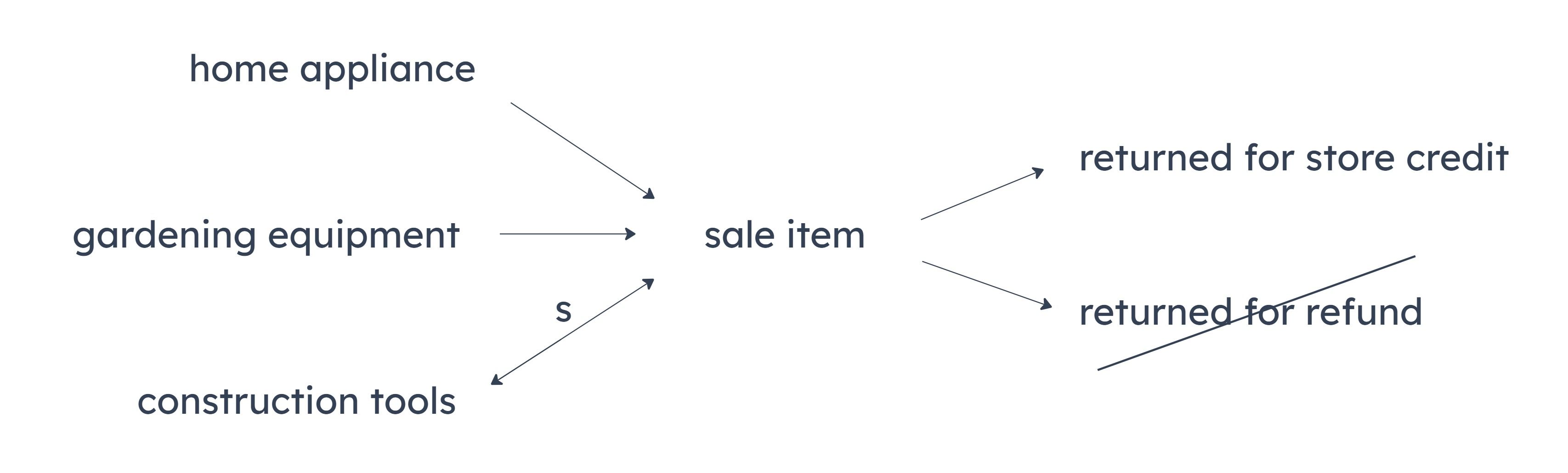
Every sale item purchased can be returned for store credit, but not returned for a refund. Every home appliance and every piece of gardening equipment is on sale. Some construction tools are on sale.
Notable Valid Inferences
Every home appliance can be returned for store credit
No home appliance can be returned for a refund
Every piece of gardening equipment can be returned for store credit
No piece of gardening equipment can be returned for a refund
Some construction tools can be returned for store credit
Some construction tools cannot be returned for a refund
No home appliance can be returned for a refund
Every piece of gardening equipment can be returned for store credit
No piece of gardening equipment can be returned for a refund
Some construction tools can be returned for store credit
Some construction tools cannot be returned for a refund
A
Any item that is not a home appliance or a piece of gardening equipment is returnable for a refund.
Could be false. This answer is a mistaken negation. The correct contrapositive would state that any item returnable for a refund is not a home appliance or a piece of gardening equipment.
B
Any item that is not on sale cannot be returned for store credit.
Could be false. The stimulus is limited to sale items. Items that are not on sale are outside of the scope of our conditions. It could be that some items that are not on sale cannot be returned for store credit.
C
Some construction tools are not returnable for store credit.
Could be false. We know from our conditions that some construction tools can be returned for store credit, but this does not imply that there are some tools that cannot be returned for store credit. The quantifier “some” has the possibility of meaning “all.”
D
No piece of gardening equipment is returnable for a refund.
Must be true. As shown below, we can chain our conditional claims and see that any piece of gardening equipment cannot be returned for a refund. 
E
None of the things that are returnable for a refund are construction tools.
Could be false. We know from our conditions that some construction tools are not returnable for a refund, but this does not imply that nothing returnable for a refund is a construction tool. We cannot take the contrapositive of a “some” statement.
Summarize Argument
The author concludes that television shows covering scientific issues need not give equal time to opposing views. Why? Because scientific issues are not like social issues, which are politically important and can rarely be settled definitively.
Notable Assumptions
The author assumes there’s no other reason a program would be obligated to provide equal airtime to opposing sides of an issue. She also assumes scientific issues can more often be settled than social issues and are less likely to have important political consequences.
A
No scientific issues raised by the claims of environmentalists have important political implications.
This strengthens the argument. It rules out the possibility that environmentalists on television raise scientific issues that, like social issues, have important political consequences.
B
There are often more than two opposing views on an issue that cannot be definitely settled on the basis of available evidence.
The number of opposing views is not relevant to the argument. Advocates of multiple positions can be given equal time even if there are three or more positions.
C
Some social issues could be definitely settled on the basis of evidence if the opposing sides would give all the available evidence a fair hearing.
This could refer to only a small number of social issues, so it doesn’t refute the author’s general assertion about them: they can “seldom” be settled definitively.
D
Many scientific issues have important political implications and cannot be definitely settled on the basis of the available evidence.
This ruins the author’s basis for contrasting social and scientific issues. If scientific issues are like social issues in this way, then by the author’s argument programs should offer equal time to opposing views on scientific issues as well.
E
Some television networks refuse to broadcast programs on issues that have important political implications and that cannot be definitely settled by the available evidence.
This implies some networks may be reluctant to discuss social issues, not that those networks would give equal time to opposing views on scientific issues. It’s possible the same networks would refuse to broadcast programs discussing scientific issues.
Summarize Argument: Phenomenon-Hypothesis
looking to the correlation between acne and consuming chocolate, the author concludes that it’s likely an effect has been mistaken for a cause. As evidence, the author points out several recent studies show hormonal changes associated with stress can cause acne. Moreover, people who are fond of chocolate tend to eat more chocolate when they are under stress.
Describe Method of Reasoning
The author questions the cause-and-effect relationship between eating chocolate and experiencing acne. She does this by pointing out a possible alternative cause that could cause both acne and consuming more chocolate. It may not be that eating chocolate causes acne. Instead, it could be that hormonal changes causes both a person to eat more chocolate and that person to experience acne.
A
It cites counterevidence that calls into question the accuracy of the evidence advanced in support of the position being challenged.
The author does not provide any counter evidence. Instead, the author reinterprets the evidence already given in support of the cause-and-effect relationship.
B
It provides additional evidence that points to an alternative interpretation of the evidence offered in support of the position being challenged.
The additional evidence is the recent studies about hormonal changes associated with stress. The alternative interpretation is the author’s view that possibly the hormonal changes cause both the acne and increased consumption of chocolate.
C
It invokes the superior authority of science over common opinion in order to dismiss out of hand the relevance of evidence based on everyday experience.
The author does not appeal to authority. The author does not suggest that their hypothesis is to be believed only because it is based on science or scientific studies.
D
It demonstrates that the position being challenged is inconsistent with certain well-established facts.
The author does not mention any well-established facts that are inconsistent with the position that eating chocolate causes acne. We cannot assume the recent scientific studies and good evidence the author points to are well-established facts.
E
It provides counterexamples to show that, contrary to the assumption on which the commonly held position rests, causes do not always precede their effects.
The author’s does not provide a counterexample. An alternative explanation is not the same thing as a counterexample.
Summary
If the polls are not grossly inaccurate → Slater will win
If Slater wins → McGuinness will be appointed head of the planning commission.
Yerxes is more qualified than McGuinness to head the planning commission because she is an architect who has been on the planning commission for 15 years.
If Slater wins → McGuinness will be appointed head of the planning commission.
Yerxes is more qualified than McGuinness to head the planning commission because she is an architect who has been on the planning commission for 15 years.
Very Strongly Supported Conclusions
If the polls are not grossly inaccurate, then someone who is less qualified than Yerxes will be appointed to head the planning commission. (This is based on connecting the two conditional statements and combining that with the fact Yerxes is more qualified than McGuinness.)
A
If the polls are grossly inaccurate, someone more qualified than McGuinness will be appointed head of the planning commission.
The stimulus tells us what will happen if the polls are NOT grossly inaccurate. But we do not know what will happen if the polls ARE grossly inaccurate. (”Unless the polls are grossly inaccurate, Slater will win” = If polls are NOT grossly inaccurate, Slater will win.)
B
McGuinness will be appointed head of the planning commission only if the polls are a good indication of how the election will turn out.
We know that if the polls are not grossly inaccurate, McGuinness will be appointed. But this doesn’t mean his appointment requires the polls to not be grossly inaccurate. He might be appointed even if the polls aren’t a good indication of how the election will turn out.
C
Either Slater will win the election or Yerxes will be appointed head of the planning commission.
If Slater does not win the election, we don’t know who will be appointed head of the planning commissions. It’s possible McGuinness could still be appointed, or perhaps someone besides McGuinness and Yerxes will be appointed.
D
McGuinness is not an architect and has not been on the planning commission for fifteen years or more.
We know that McGuinness doesn’t have both the quality of being an architect and being on the planning commission for at least 15 years, because we know he’s less qualified than Yerxes. But it’s possible McGuinness is an architect without 15 years of planning commission experience. Or he might have 15 years of planning commission experience, but without being an architect.
E
If the polls are a good indication of how the election will turn out, someone less qualified than Yerxes will be appointed head of the planning commission.
If the polls are a good indication of how the election will turn out, that means they’re not grossly inaccurate. This triggers the conditional chain in the stimulus, allowing us to know McGuinness will be appointed. And McGuinness is less qualified than Yerxes.
Summary
The level and rate of growth of aggregate output are the most significant indicators of the viability of a nation’s economy. Unemployment and inflation rates are also important indicators. Some countries have viable economies even though they do not have very large populations. For example, Switzerland and Austria have viable economies, but only about seven million people. Israel, Ireland, Denmark, and Finland all have viable economies, but less than seven million people.
Strongly Supported Conclusions
Having a very large population isn’t required to have a viable economy.
If the size of a country’s population is an indicator of the viability of a nation’s economy, it is not the most significant indicator.
If the size of a country’s population is an indicator of the viability of a nation’s economy, it is not the most significant indicator.
A
A nation’s economic viability is independent of the size of its population.
Unsupported. Although having a very large population isn’t required for a viable economy, that doesn’t imply that population size is completely independent of the viability of an economy. Maybe a population of one million, for example, is required for viability.
B
Having a population larger than seven million ensures that a nation will be economically viable.
Unsupported. We don’t have any evidence that every nation with more than seven million people is economically viable.
C
Economic viability does not require a population of at least seven million.
Strongly supported. We have several examples of countries with populations smaller than seven million that are nonetheless still economically viable.
D
A nation’s population is the most significant contributor to the level and rate of growth of aggregate output.
Unsupported. We are not told what are the most important contributors to the level and rate of growth of aggregate output.
E
A nation’s population affects the level and rate of growth of aggregate output more than it affects unemployment and inflation rates.
Unsupported. We do not have any evidence that a nation’s population affects aggregate output, unemployment, or inflation rates.