Before 1986 physicists believed they could describe the universe in terms of four universal forces. Experiments then suggested, however, a fifth universal force of mutual repulsion between particles of matter. This fifth force would explain the occurrence in the experiments of a smaller measurement of the gravitational attraction between bodies than the established theory predicted.

Summarize Argument: Phenomenon-Hypothesis
The author argues there’s a fifth universal force: mutual repulsion between particles of matter. This force would explain a phenomenon that the other four forces can’t explain on their own.

Notable Assumptions
While the fifth force would resolve one phenomenon, the scientist never tells us that the fifth force is consistent with other phenomena that the four forces already account for. The scientist therefore assumes that the fifth force is indeed compatible with other phenomena.

A
The extremely sophisticated equipment used for the experiments was not available to physicists before the 1970s.
This explains why scientists hadn’t considered the fifth force. We’re trying to strengthen the hypothesis that such a force exists.
B
No previously established scientific results are incompatible with the notion of a fifth universal force.
The fifth force doesn’t contradict settled science. If it did, the scientist couldn’t hypothesize that such a force exists.
C
Some scientists have suggested that the alleged fifth universal force is an aspect of gravity rather than being fundamental in itself.
This weakens the scientist’s hypothesis. The fifth force isn’t really a force at all—it’s an aspect of gravity.
D
The experiments were conducted by physicists in remote geological settings in which factors affecting the force of gravity could not be measured with any degree of precision.
This weakens the scientist’s hypothesis. The experiments, which the scientist uses as evidence, were undertaken in highly suboptimal circumstances
E
The fifth universal force was postulated at a time in which many other exciting and productive ideas in theoretical physics were developed.
We don’t care what else was happening in physics.

27 comments

Sandy: I play the Bigbucks lottery—that’s the one where you pick five numbers and all the players who have picked the five numbers drawn at the end of the week share the money pot. But it’s best to play only after there have been a few weeks with no winners, because the money pot increases each week that there is no winner.

Alex: No, you’re more likely to win the lottery when the money pot is small, because that’s when the fewest other people are playing.

Summarize Argument: Counter-Position
Alex implicitly concludes that Sandy should not play the Bigbucks lottery when the pot is larger. He supports this by saying Sandy is more likely to win when the pot is small, since that’s when the fewest people are playing.

Identify and Describe Flaw
Alex’s reasoning is mistaken because he doesn’t understand how the Bigbucks lottery works. To play, Sandy picks five numbers, and if they match the winning numbers, she shares the prize with anyone else who also picks correctly.

Alex thinks Sandy is more likely to win when fewer people play, but that’s not true. Her chance of picking the correct five numbers doesn't depend on how many other people are playing. The number of other players may affect how many people she’d have to split the pot with, but it doesn’t affect her individual chance of winning.

A
Sandy holds that the chances of anyone’s winning are unaffected by the number of times that person plays.
Like (C), Sandy never makes any claims about the chances of winning, nor does she claim that her chance of winning is unaffected by the number of times she plays. She just argues that it’s best to play when there’s a bigger pot.
B
Alex holds that the chances of Sandy’s winning are affected by the number of other people playing.
This describes a mistake in Alex’s reasoning. He thinks that Sandy is more likely to win when fewer people play. But actually, her chances of picking the correct five numbers are the same— extremely low— regardless of how many other players there are.
C
Sandy holds that the chances of anyone’s winning are unaffected by the size of the pot.
Like (A), Sandy never makes any claims about the chances of winning. Also, it’s true that the chances of anyone’s winning are unaffected by the size of the pot. So even if she did hold this, it wouldn’t be a mistake in her reasoning.
D
Alex holds that the chances of Sandy’s winning in a given week are unaffected by whether anyone has won the week before.
Alex never makes this claim. But even if he did, it wouldn’t describe a mistake in his reasoning because it’s true that Sandy’s chances of winning in a given week are unaffected by whether someone won the week before.
E
Sandy holds that the chances of there being a winner go up if no one has won the lottery for quite a while.
Sandy never claims that the chance of there being a winner goes up if no one has won in a while. She just argues that it’s best to play after no one has won in a while, because that’s when the pot is biggest.

49 comments

Columnist: George Orwell’s book 1984 has exercised much influence on a great number of this newspaper’s readers. One thousand readers were surveyed and asked to name the one book that had the most influence on their lives. The book chosen most often was the Bible; 1984 was second.

Summarize Argument

The author concludes that 1984 has had a great influence on the newspapers’ readers. This is because the second-most readers chose 1984 as the book that’d had the greatest influence on their lives.

Notable Assumptions

In order for 1984 to have exercised a great influence on the newspapers’s readers, the author assumes that 1984 received a substantial amount of votes. If the Bible had received 990 of the votes and 1984 had received 2, followed by an 8-way tie for third place, then the study wouldn’t demonstrate 1984’s great influence by any stretch.

A
How many books had each person surveyed read?

Irrelevant. We don’t care how many books each person read. We’re only interested in the ones the readers named as the book that most influenced their lives.

B
How many people chose books other than 1984?

If many people chose books other than 1984, then 1984 may not have received all that many votes (e.g if 500 books were chosen, 1984 might’ve only needed 10 votes to be 2nd place). If few people did, then 1984 might’ve received hundreds of votes (e.g. Bible 500, 1984 400, etc.).

C
How many people read the columnist’s newspaper?

We don’t care how many people read the newspaper. We know they surveyed 1000 people.

D
How many books by George Orwell other than 1984 were chosen?

We don’t care about other Orwell books. Even if those were chosen, we know those ranked lower than 1984.

E
How many of those surveyed had actually read the books they chose?

The author never claims people have read the books they cite as being influential on their own lives. The Bible may be influential on someone’s life even if that person hasn’t read it.


104 comments

Essayist: Knowledge has been defined as a true belief formed by a reliable process. This definition has been criticized on the grounds that if someone had a reliable power of clairvoyance, we would not accept that person’s claim to know certain things on the basis of this power. I agree that we would reject such claims, but we would do so because we really do not believe in clairvoyance as a reliable process. Were we to believe in clairvoyance, we would accept knowledge claims made on the basis of it.

Summarize Argument
After defining knowledge as a true belief formed by a reliable process, the essayist concludes we would reject a person’s claim to know certain things because clairvoyance is not a reliable process. As evidence, the essayist states that if we were to believe in clairvoyance, we would accept a person’s claims of knowledge made on the basis of it.

Describe Method of Reasoning
The essayist describes an alternative reason why we would reject a person’s claim to know certain things by means of clairvoyance. He does this by shifting the reason for this belief from the claim that clairvoyance isn’t knowledge to the claim that clairvoyance is not a reliable process.

A
asserting that the objection is based on a belief about the reliability of clairvoyance rather than on the nature of knowledge or its definition
The objection is the essayist’s agreement that we would reject clairvoyance as a case of knowledge. The essayist bases this objection by stating clairvoyance is not a reliable process.
B
asserting that the case of clairvoyance is one of knowledge even though we do not really believe in clairvoyance as a reliable process
The essayist does not assert that the case of clairvoyance is knowledge. In fact, the essayist agrees we would reject this claim. The essayist only disputes the reason for why we would reject this claim.
C
arguing against the assumption that clairvoyance is unreliable
The essayist does not think that clairvoyance is reliable. In fact, the essayist asserts that clairvoyance is not a case of knowledge because it is an unreliable process.
D
explaining that the definition of knowledge is a matter of personal choice
The essayist does not factor in personal choice when it comes to determining what is knowledge. The essayist starts his argument by defining what knowledge is, and there’s no element of personal choice in this definition.
E
demonstrating that the case of clairvoyance is not a case of knowledge and does not fit the definition of knowledge
This is the essayist’s conclusion, but this answer does not describe the reasoning the essayist undertook to reach this conclusion. The reasoning addresses why the essayist is able to demonstrate these two things.

38 comments

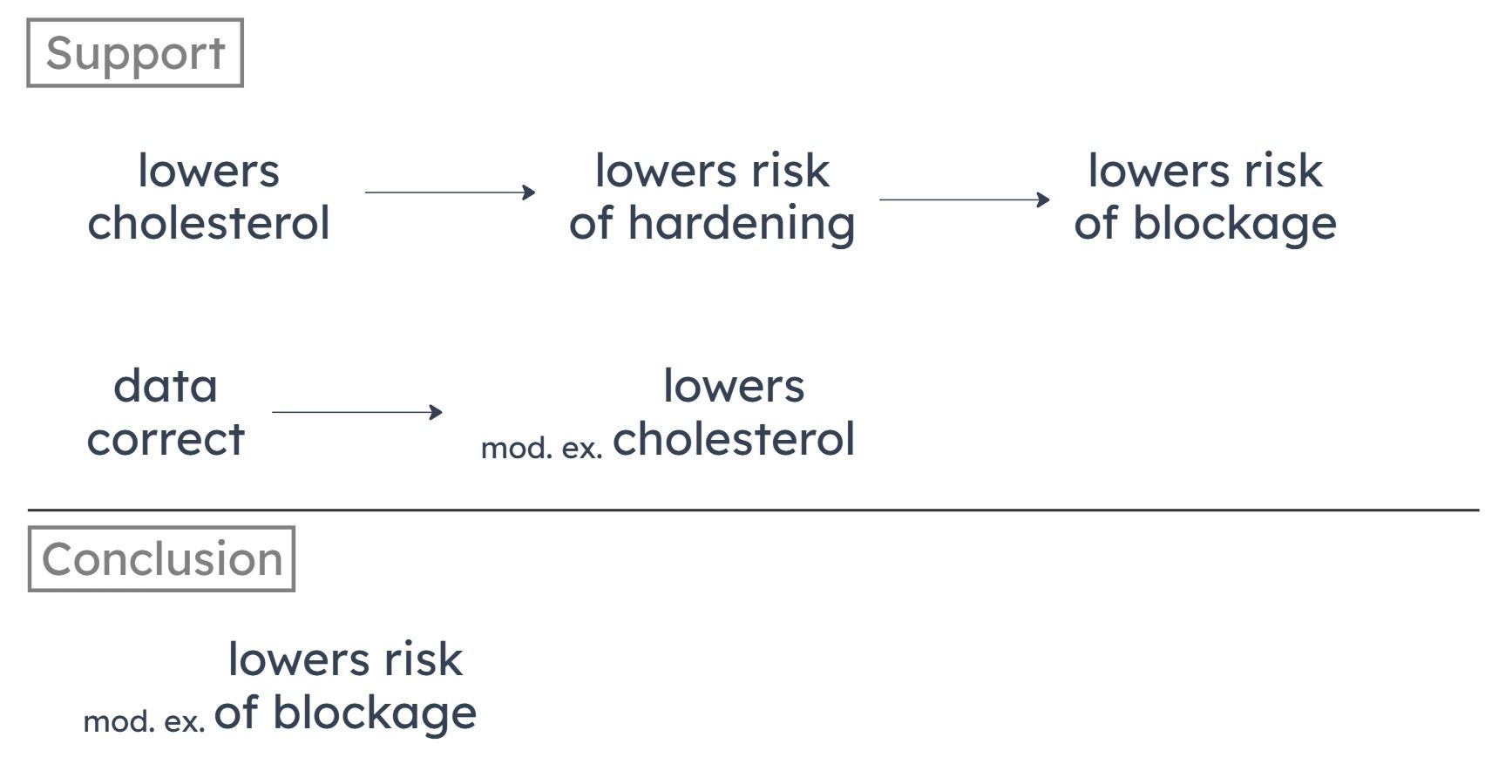
Moderate exercise lowers the risk of blockage of the arteries due to blood clots, since anything that lowers blood cholesterol levels also lowers the risk of hardening of the arteries, which in turn lowers the risk of arterial blockage due to blood clots; and, if the data reported in a recent study are correct, moderate exercise lowers blood cholesterol levels.
Summary
The author concludes that moderate exercise lowers the risk of blockage of arteries due to blood clots. This is based on the following:
If it lowers blood cholesterol levels, it lowers the risk of arterial blockage due to blood clots.
If the data reported in a recent study are correct, moderate exercise lowers blood cholesterol levels.

Missing Connection
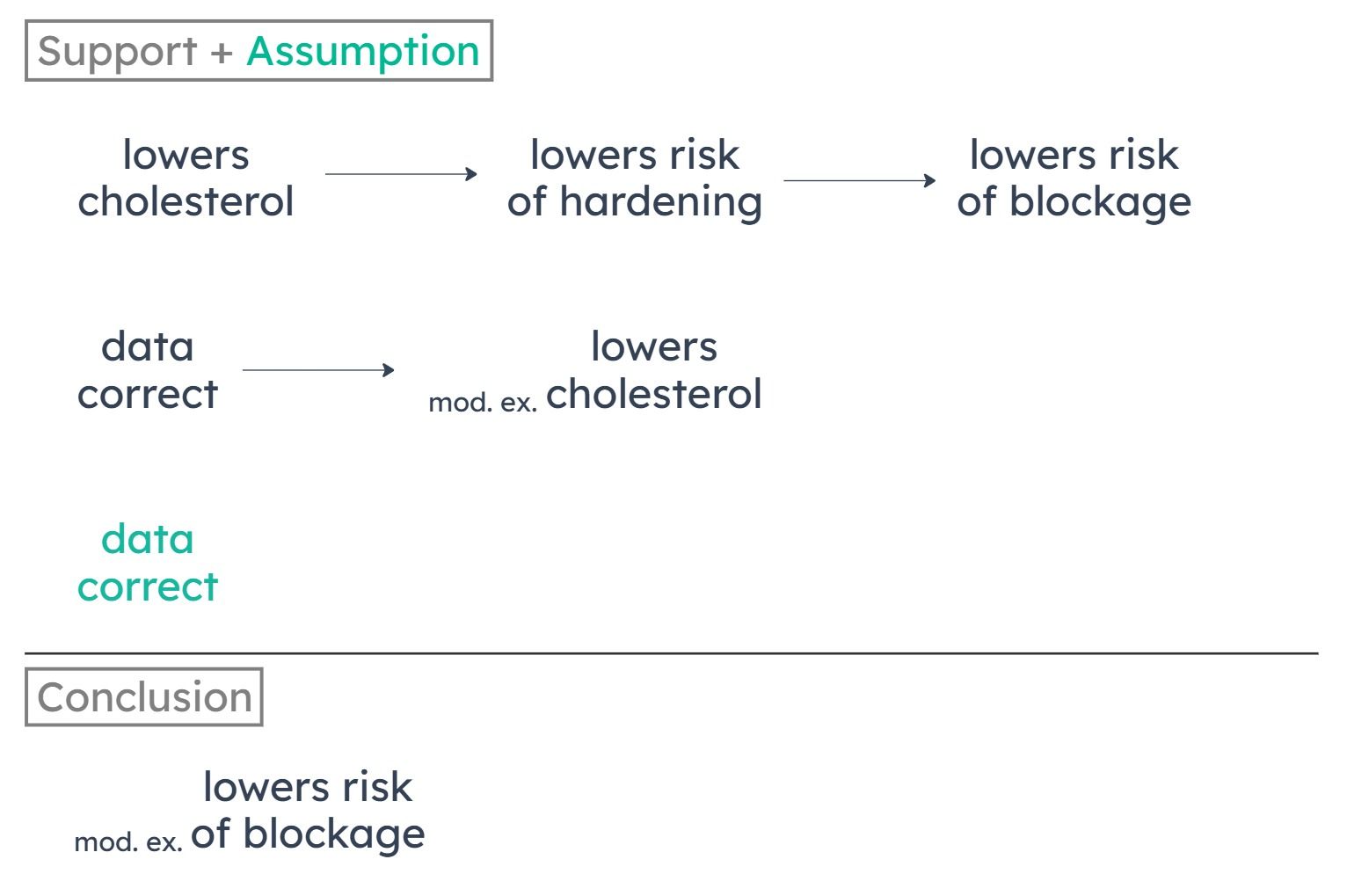
To prove that moderate exercise lowers the risk of blockage of arteries due to blood clots, we want to know that moderate exercise lowers blood cholesteral levels. There is a way to prove that — if the data reported in a recent study are correct, then moderate exercise lowers blood cholesterol levels. But do we know whether the data reported in the recent study is correct? No — that’s what’s missing. We want to know that the data is correct.

A
The recent study investigated the relationship between exercise and blood cholesterol levels.
We want to know that the data reported in the recent study is correct. Whether the study investigated the relationship between exercise and blood cholesterol levels doesn’t tell us anything about whether the data is correct.
B
Blockage of the arteries due to blood clots can be prevented.
The argument concerns lowering the risk of blockage of arteries due to blood clots. Whether such blockage can be completely prevented is a separate issue from whether the risk of such blockage can be decreased. In any case, we’re looking for an answer that establishes the data in the study is correct, and (B) doesn’t establish this.
C
Lowering blood cholesterol levels lowers the risk of blockage of the arteries.
This is supported by the premises, but it’s not new information that makes the argument valid. We want to know that the data reported in the study is correct, so that we can establish that moderate exercise lowers blood cholesterol. (C) doesn’t tell us anything about the data.
D
The data reported in the recent study are correct.
(D) allows us to infer that moderate exercise lowers blood cholesterol levels. This inference, combined with the premise establishing that anything that lowers blood cholesterol levels lowers risk of arterial blockage due to blood clots, establishes that moderate exercise lowers such risk of blockage.
E
Hardening of the arteries increases the risk of blockage of the arteries due to blood clots.
This may be supported by the premises, but it’s not new information that makes the argument valid. We want to know that the data reported in the study is correct, so that we can establish that moderate exercise lowers blood cholesterol. (E) doesn’t do this.

130 comments

Cotrell is, at best, able to write magazine articles of average quality. The most compelling pieces of evidence for this are those few of the numerous articles submitted by Cotrell that are superior, since Cotrell, who is incapable of writing an article that is better than average, must obviously have plagiarized superior ones.

Summarize Argument
The author concludes that Cotrell can only write average quality magazine articles. She supports this by saying that any superior articles by Cotrell must be plagiarized, because Cotrell can only write average quality articles.

Identify and Describe Flaw
This is the cookie-cutter flaw of circular reasoning, where the author’s conclusion is simply a restatement of a premise. In this case, the author concludes that Cotrell can only write average quality articles based on the premise that his superior articles must be plagiarized because he can only write average quality articles.

A
It simply ignores the existence of potential counterevidence.
The author actually discusses potential counterevidence: Cotrell’s few superior articles. She dismisses this evidence by saying that the articles must have been plagiarized, but she doesn’t ignore the existence of counterevidence.
B
It generalizes from atypical occurrences.
The author doesn’t generalize from atypical occurrences. Instead, she draws a specific conclusion about Cotrell based on all of Cotrell’s articles— the superior ones and the average ones.
C
It presupposes what it seeks to establish.
The author seeks to establish that Cotrell can only write average quality articles. In order to do so, she presupposes that he can only write average quality articles.
D
It relies on the judgment of experts in a matter to which their expertise is irrelevant.
The author never mentions or relies on the judgement of any experts.
E
It infers limits on ability from a few isolated lapses in performance.
The author does infer limits on Cotrell’s writing ability. But she does so based on his average work and the claim that his superior work was plagiarized, not based on “a few isolated lapses in performance.”

35 comments

Researchers have found that people who drink five or more cups of coffee a day have a risk of heart disease 2.5 times the average after corrections are made for age and smoking habits. Members of the research team say that, on the basis of their findings, they now limit their own daily coffee intake to two cups.

Summarize Argument
The researchers implicitly conclude that drinking just two cups of coffee per day gives them less risk of heart disease than drinking five or more cups per day. Why? Because their research found that people who drink five or more cups daily have an elevated risk of heart disease.

Notable Assumptions
The researchers assume that people who drink two cups of coffee per day have less risk of heart disease than those who drink five or more per day. They also assume there’s no factor besides age and smoking habits that is associated with coffee intake and would explain the health effect.

A
The study found that for people who drank three or more cups of coffee daily, the additional risk of heart disease increased with each extra daily cup.
This is irrelevant because it does not apply to people drinking two or fewer cups per day. It’s possible that people who drink two cups daily have an even higher risk of heart disease than people who drink five cups.
B
Per capita coffee consumption has been declining over the past 20 years because of the increasing popularity of soft drinks and also because of health worries.
The proportion of people in the world drinking coffee is not relevant to the researchers’ decision. Lots of coffee can have negative health effects even if it’s less popular than it used to be.
C
The study did not collect information that would show whether variations in level of coffee consumption are directly related to variations in level of stress, a major causal factor in heart disease.
This introduces an alternative explanation for the study’s results that challenges the researchers’ conclusion. If people who are stressed tend to consume lots of coffee, then simply reducing coffee intake may not reduce the risk of heart disease.
D
Subsequent studies have consistently shown that heavy smokers consume coffee at about 3 times the rate of nonsmokers.
The study controlled for smoking, so a relationship between smoking habits and coffee consumption should not have influenced the results.
E
Subsequent studies have shown that heavy coffee consumption tends to cause an elevated blood-cholesterol level, an immediate indicator of increased risk of heart disease.
This explains why drinking more coffee increases the risk of heart disease, without challenging the researchers’ conclusion. It does not imply that variations in blood-cholesterol levels confounded the study’s results.

14 comments

In a recent study, a group of subjects had their normal daily caloric intake increased by 25 percent. This increase was entirely in the form of alcohol. Another group of similar subjects had alcohol replace nonalcoholic sources of 25 percent of their normal daily caloric intake. All subjects gained body fat over the course of the study, and the amount of body fat gained was the same for both groups.

Summary
One group of subjects increased their daily caloric intake by 25 percent solely by consuming alcohol. Another group of subjects, instead of increasing their caloric intake, substituted 25 percent of their existing caloric intake solely by consuming alcohol. All subjects gained body fat, and the amount of body fat gained was the same for both groups.

Strongly Supported Conclusions
The number of calories a person consumes is not the only factor contributing to body fat gain.

A
Alcohol is metabolized more quickly by the body than are other foods or drinks.
This answer is unsupported. We don’t know from the stimulus how quickly alcohol is metabolized. Moreover, we don’t know from the stimulus how different rates of metabolization affect a person’s amount of body fat.
B
In the general population, alcohol is the primary cause of gains in body fat.
This answer is unsupported. We don’t know from the stimulus whether alcohol is the primary cause. We know that it may be a cause, but to say it is the primary cause is too strong.
C
An increased amount of body fat does not necessarily imply a weight gain.
This answer is unsupported. The stimulus does not mention the weight of any of the people in the groups. The stimulus solely focuses on amount of body fat, which may or may not correlate with weight gain.
D
Body fat gain is not dependent solely on the number of calories one consumes.
This answer is strongly supported. The first group increased their caloric intake and the second group’s caloric intake remained the same yet both groups gained body fat. Therefore, body fat gain is not dependent solely on a person’s caloric intake.
E
The proportion of calories from alcohol in a diet is more significant for body fat gain than are the total calories from alcohol.
This answer is anti-supported. Both groups in the stimulus gained the same amount of body fat.

79 comments

Twelve healthy volunteers with the Apo-A-IV-1 gene and twelve healthy volunteers who instead have the Apo-A-IV-2 gene each consumed a standard diet supplemented daily by a high-cholesterol food. A high level of cholesterol in the blood is associated with an increased risk of heart disease. After three weeks, the blood cholesterol levels of the subjects in the second group were unchanged, whereas the blood cholesterol levels of those with the Apo-A-IV-1 gene rose 20 percent.

Summary
Twelve healthy people with version 1 of a gene and twelve healthy people with version 2 of a gene at a standard diet supplemented with high-cholesterol food. High cholesterol is associated with increased risk of heart disease. After three weeks of this diet, people with version 1 of the gene had increased cholesterol, whereas people with version 2 of the gene did not have increased cholesterol.

Strongly Supported Conclusions
Version 2 of the gene might help remove cholesterol from the body. Eating high-cholesterol foods does not always lead to increased cholesterol in the body.

A
Approximately half the population carries a gene that lowers cholesterol levels.
Unsupported. We don’t know the proportion of the general population with version 2 of the gene. The stimulus never told us that the participants in the study were representative of the general population.
B
Most of those at risk of heart disease may be able to reduce their risk by adopting a low-cholesterol diet.
Unsupported. We know high cholesterol increases risk of heart disease, but most people with heart disease might not have high cholesterol. They might have heart disease for other reasons.
C
The bodies of those who have the Apo-A-IV-2 gene excrete cholesterol when blood cholesterol reaches a certain level.
Unsupported. We know the people with version 2 of the gene did not exhibit increased cholesterol. We don’t know whether this has anything to do with storing cholesterol before excreting it.
D
The presence of the Apo-A-IV-1 gene seems to indicate that a person has a lower risk of heart disease.
Unsupported. We don’t know the respective risks of heart disease among the two groups. In any case, people with version 1 of the gene ended up with increased cholesterol, so there’s evidence version 1 may be at higher risk of heart disease than version 2.
E
The presence of the Apo-A-IV-2 gene may inhibit the elevation of blood cholesterol.
Strongly supported. The people with version 2 of the gene didn’t end up with increased cholesterol, whereas people with version 2 did. This is evidence something about version 2 may be reducing cholesterol or counteracting the increased cholesterol we would expect to observe.

55 comments