In the last two sentences of the stimulus, the author actually introduces a completely new argument! The discussion in the last two sentences is not relevant for our understanding of the author’s perspective.
A
It is cited as evidence against the claim that the capacity for flight first developed in marine reptiles.
B
It is cited as evidence against the claim that the capacity for flight first developed in land-dwelling animals.
C
It is cited as evidence against the claim that the capacity for flight first developed in tree-dwelling reptiles.
D
It weakens the claim that tree-dwelling reptiles were the first kind of reptile to develop the capacity for flight.
E
It corroborates the observation that some mammals without scales, such as bats, developed the capacity to fly.
A year ago the government reduced the highway speed limit, and in the year since, there have been significantly fewer highway fatalities than there were in the previous year. Therefore, speed limit reduction can reduce traffic fatalities.
Summarize Argument: Phenomenon-Hypothesis
The author concludes that a speed limit reduction can reduce traffic fatalities. This is based on the fact that a year ago, the government reduced the highway speed limit, and in the year since that reduction, there have been fewer highway deaths than there were in the previous year.
Identify and Describe Flaw
The author assumes that the reduction in highway speed limit caused the decrease in highway fatalities. This overlooks the possibility that there are other explanations for the decrease in highway fatalities in the year following the speed limit reduction.
A
highway traffic has not increased over the past year
The negation of (A) doesn’t undermine the argument. If traffic has increased over the past year, that might strengthen the argument, because we’d expect to see more fatalities. Since the negation doesn’t hurt the argument, the author doesn’t have to assume (A).
B
the majority of drivers obeyed the new speed limit
The author doesn’t have to assume that most drivers obeyed the speed limit, because a speed limit reduction can still affect driving behavior even if most people don’t follow the speed limit. For example, the new limit can cause people to drive slower.
C
there is a relation between driving speed and the number of automobile accidents
The author’s conclusion concerns the number of highway deaths. This doesn’t commit the author to any belief about the number of accidents, which is different from the number of deaths.
D
the new speed limit was more strictly enforced than the old
If anything, the author assumes that the new speed limit was not more strictly enforced. More strict enforcement could have been an alternate explanation for the decline in fatalities. So the author assumes this didn’t happen, not that it did happen.
E
the number of traffic fatalities the year before the new speed limit was introduced was not abnormally high
This must be assumed because if the number of fatalities the year before the new limit was abnormally high, then that suggests the decrease in fatalities after the speed limit might just be a coincidence. It might be a return to the normal fatality rate.
A
offers no evidence that the individuals queried would have responded differently had they been asked the same questions in years prior to the survey
B
fails to specify the exact number of people who were telephoned as part of the survey
C
assumes without warrant that age is the main determinant of personal income and savings levels
D
assumes from the outset what it purports to establish on the basis of a body of statistical evidence
E
provides no reason to believe that what is true of a given age group in general is also true of all individuals within that age group
Social critic: The whole debate over the legal right of rock singers to utter violent lyrics misses the point. Legally, there is very little that may not be said. But not everything that may legally be said, ought to be said. Granted, violence predates the rise in popularity of such music. Yet words also have the power to change the way we see and the way we act.
Summary
The debate over the legal right of rock singers to say violent lyrics misses the point. There is legally very little that cannot be said. Not everything that can legally be said ought to be said. Violence came before the popularity of violent lyrics in music. Words can change how we see and how we act.
Strongly Supported Conclusions
There could be a relationship between violent song lyrics and violent views and actions.
A
If rock music that contains violent lyrics is morally wrong, then it should be illegal.
This is anti-supported because the author states that very little speech is illegal and that there is a difference between things that are legal and things that ought to be said. The author doesn’t advocate making any speech illegal.
B
The law should be changed so that the government is mandated to censor rock music that contains violent lyrics.
This is unsupported because the author does not advocate for a change in laws, and the author draws a distinction between what can be said legally versus what ought to be said.
C
Violent rock song lyrics do not incite violence, they merely reflect the violence in society.
This is anti-supported because the author states that words can influence how we act, meaning the author thinks it is possible for violent lyrics to lead to some violent acts.
D
If rock musicians voluntarily censor their violent lyrics, this may help to reduce violence in society.
This is strongly supported because the author states that words, exemplified by violent lyrics, can affect how people act. This means that choosing not to speak violent lyrics could reduce violent acts.
E
Stopping the production of rock music that contains violent lyrics would eliminate much of the violence within society.
This is unsupported because the author concedes that violent acts predate violent lyrics. While the author thinks there is a connection between words and actions, it is unclear that stopping these lyrics would eliminate “much” violence.
A
One of the various schools of paleontology adheres to an explanation for the disappearance of the dinosaurs that is significantly different from the comet theory.
B
Various species of animals from the same era as the dinosaurs and similar to them in physiology and habitat did not become extinct when the dinosaurs did.
C
It cannot be determined from a study of dinosaur skeletons whether the animals died from the effects of a dust cloud.
D
Many other animal species from the era of the dinosaurs did not become extinct at the same time the dinosaurs did.
E
The consequences for vegetation and animals of a comet colliding with Earth are not fully understood.
The desire for praise is the desire to obtain the favorable opinions of others.
If someone deserves praise for an action (”merit” = “deserve”), that action must be motivated by a desire to help others.
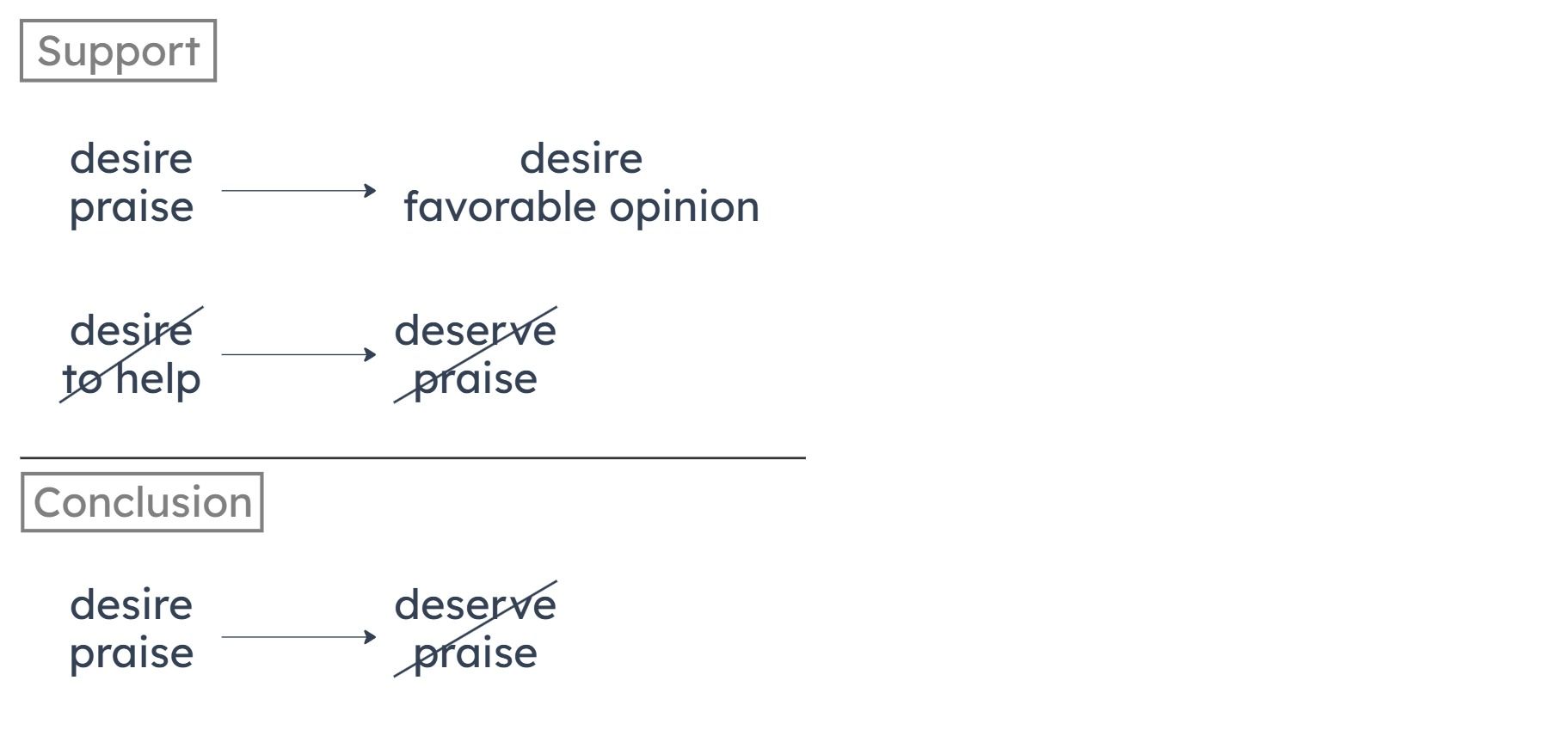
A
An action that is motivated by a desire for the favorable opinion of others cannot also be motivated by a desire to help others.
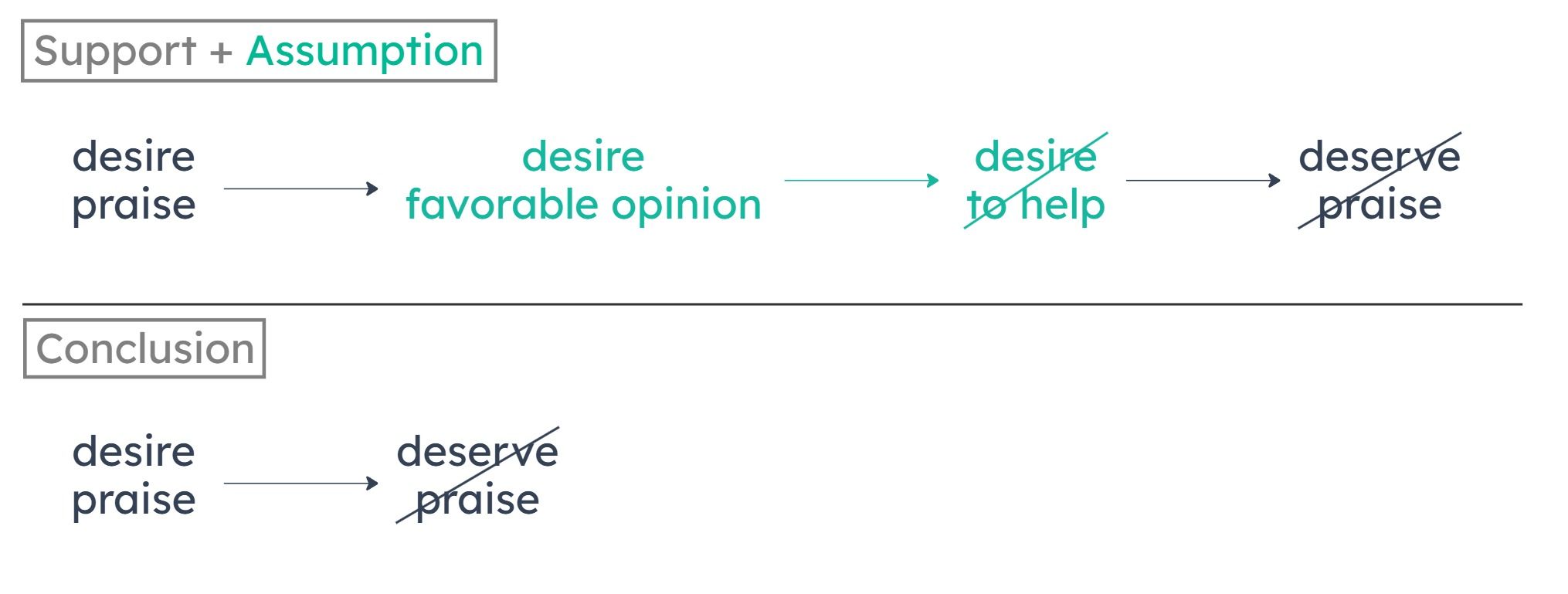
B
No action is worthy of praise if it is motivated solely by a desire for praise.
C
People who are indifferent to the welfare of others do not deserve praise.
D
One deserves praise for advancing one’s own interests only if one also advances the interests of others.
E
It is the motives rather than the consequences of one’s actions that determine whether one deserves praise for them.
Rosen: One cannot prepare a good meal from bad food, produce good food from bad soil, maintain good soil without good farming, or have good farming without a culture that places value on the proper maintenance of all its natural resources so that needed supplies are always available.
Summary
Good meal → NOT bad food
Good food → NOT bad soil
Good soil → Good farming
Good farming → culture that places value on maintaining natural resources
Very Strongly Supported Conclusions
Normally, I wouldn’t think “NOT bad food” implies “good food,” since there might be something that’s just not bad and not good — just middle-of-the-road food. Same thing with “NOT bad soil” and “good soil.”
But, the stimulus seems to be set up in order for us to draw a conditional chain connecting every statement.
Good meal → good food → good soil → good farming → culture that places value on maintining natural resources.
I know this seems inappropriate, but consider this problem unusual, and don’t draw too many lessons from it. Think of this problem as an exception.
A
The creation of good meals depends on both natural and cultural conditions.
Supported, if we accept the conditional chain starting with “good meal” and ending with “culture that maintains natural resources.” A good meal depends on natural conditions, such as soil. And it depends on cultural conditions, such as a culture’s view of natural resources.
B
Natural resources cannot be maintained properly without good farming practices.
We know good farming is necessary for good soil. But there’s no support for the claim that good farming is necessary for maintaining natural resources. There are many other kinds of natural resources besides soil, and we don’t know whether good farming is related to those other resources.
C
Good soil is a prerequisite of good farming.
We know good farming is necessary for good soil. But this doesn’t mean good soil is necessary (prerequisite) for good farming.
D
Any society with good cultural values will have a good cuisine.
We don’t know anything about good “cuisine.” A cuisine is different from a meal. We also don’t know that “good cultural values” is sufficient for anything.
E
When food is bad, it is because of poor soil and, ultimately, bad farming practices.
Food might be bad for other reasons besides poor soil and bad farming. We know that good food requires good soil and good farming, but it might also require other things. So we might have good soil and good farming, but still end up with bad food.