Antonia: The stock market is the best place to invest your money these days; although it is often volatile, it provides the opportunity to make a large profit quickly.

Maria: I agree that the stock market provides the opportunity to make large profits quickly, but one is just as likely to take a huge loss. I think it is better to invest in savings bonds, which provide a constant, reliable income over many years.

Speaker 1 Summary
The stock market is the best place to invest your money. Why? Because you can make a large profit quickly in the stock market.

Speaker 2 Summary
I think savings bonds are the best place to invest your money. Why? Because they provide constant, reliable income over many years.

Objective
We need a statement that Antonia and Maria disagree on. They disagree about what is the best place to invest money. Antonia thinks the best place is the stock market because you could make a large profit quickly. Maria thinks the best place is through savings bonds because they provide reliable income.

A
the stock market is often volatile but provides the opportunity to make a large profit quickly
Both speakers agree with this statement. This is the reason why Antonia concludes that the stock market is the best place to invest. Maria also agrees that a person could profit quickly in the stock market, but does not think it is the best place to invest.
B
savings bonds can provide a large return on one’s investment
Antonia does not express an opinion on this statement. Antonia only speaks to the stock market being able to turn a large profit quickly.
C
the stock market provides the opportunity for an investor to make a constant, reliable income over many years
Neither speaker expresses an opinion on this statement. We only know from the stimulus that both speakers believe the stock market could turn a large profit quickly.
D
it is safer to invest in savings bonds than to invest in the stock market
Antonia does not express an opinion on this statement. We don’t know what Antonia’s beliefs are about savings bonds from the stimulus.
E
it is preferable to pick an investment offering a reliable income over a riskier opportunity to make a large profit quickly
Antonia and Maria disagree on this statement. Antonia would disagree and conclude that the stock market is preferable. Maria would agree and conclude that savings bonds are preferable.

</section


4 comments

In an experiment, tennis players who were told that their performance would be used to assess only the quality of their rackets performed much better than an equally skilled group of tennis players who were told that their tennis-playing talent would be measured.

Summary
Some tennis players were told that their performance would be used to assess only the quality of their rackets. Others who were equally skilled as the first group of tennis players were told that their tennis-playing talent would be measured. The first group performed better than the second.

Strongly Supported Conclusions
What one believes is being assessed in one’s own performance can influence that performance.

A
People do less well on a task if they have been told that they will be closely watched while doing it.
Unsupported. The stimulus doesn’t tell us that either of the groups was told they would be closely watched. They were told the performance would be assessed for different things, but that doesn’t indicate a difference in how closely the two groups were told they would be watched.
B
People execute a task more proficiently when they do not believe their abilities are being judged.
Strongly supported. The group that was told only the rackets would be assessed performed better than the group that was told their own talent (ability) was being assessed.
C
People perform a task more proficiently when they have confidence in their abilities.
Unsupported. We don’t know whether there was any difference in the confidence level of the two groups.
D
People who assess their talents accurately generally perform near their actual level of proficiency.
Unsupported. We don’t know anything about the tennis players’ own assessment of their own talent and how that compared to actual performance.
E
People who think that a superior performance will please those who are testing them generally try harder.
Unsupported. We don’t know where there was any difference in the groups’ perceptions regarding whether a superior performance would please the people evaluating the performances.

7 comments

The Fenwicks returned home from a trip to find two broken bottles on their kitchen floor. There was no sign of forced entry and nothing in the house appeared to have been taken. Although the Fenwicks have a pet cat that had free run of the house while they were away, the Fenwicks hypothesized that they had left a back door unlocked and that neighborhood children had entered through it, attempted to raid the kitchen, and left after breaking the bottles.

Summarize Argument: Phenomenon-Hypothesis
The Fenwicks hypothesize that they’d left the back door open and had their home disturbed by local children, who broke bottles in the process. No evidence is offered for this claim.

Notable Assumptions
The Fenwicks assume that there must be some reason why this rather unusual explanation is superior to the more obvious one: that their cat broke the bottles.

A
A neighbor thought he had seen the Fenwicks’ back door closing while the Fenwicks were away.
A neighbor saw the Fenwicks’ back door close. Thus, the Fenwicks have reason to believe someone went into their home.
B
When the Fenwicks returned home, they found children’s footprints on the back porch that had not been there before their trip.
Children had evidently been to their home. Perhaps they took their shoes off at the door before attempting to raid the kitchen.
C
The two bottles that the Fenwicks found broken on their kitchen floor had been in the refrigerator when the Fenwicks left on vacation.
The bottles hadn’t been left out, so the cat couldn’t have broken the bottles. Someone else must’ve broken them.
D
There have been several recent burglaries in the Fenwicks’ neighborhood in which neighborhood children were suspected.
Local children are known to break into houses. It’s not ridiculous to suspect them in yet another break-in.
E
The Fenwicks returned home from their trip later than they had planned.
Irrelevant. We don’t care when they came home from their trip. We care about who broke the bottles in their kitchen.

8 comments

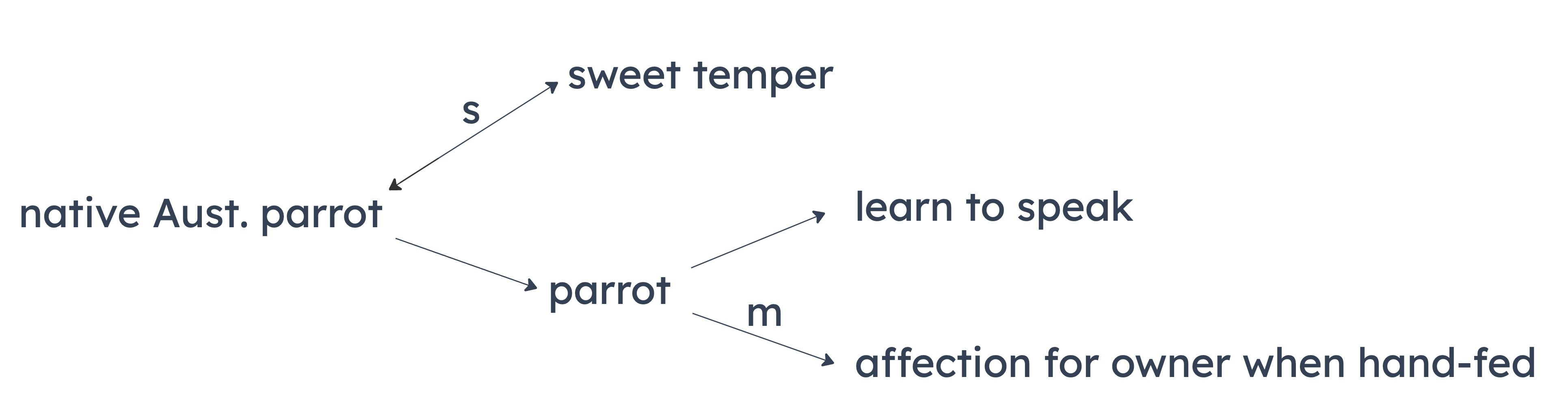
All parrots can learn to speak a few words and phrases. Not all parrots have equally pleasant dispositions, though some of those native to Australia can be counted on for a sweet temper. Almost any parrot, however, will show tremendous affection for an owner who raised the bird from a chick by hand-feeding it.

Summary

All parrots can learn to speak a few words and phrases. Most parrots will show tremendous affection for an owner who raised the bird from a chick by hand-feeding it. Some parrots native to Australia can be counted on for a sweet temper, but not all parrots have equally pleasant dispositions.
Notable Valid Inferences

Some parrots that can learn to speak a few words and phrases can be counted on for a sweet temper.

Some parrots that can learn to speak a few words and phrases show tremendous affection for an owner who raised the bird from a chick.

A
Some parrots that can learn to speak are sweet tempered.

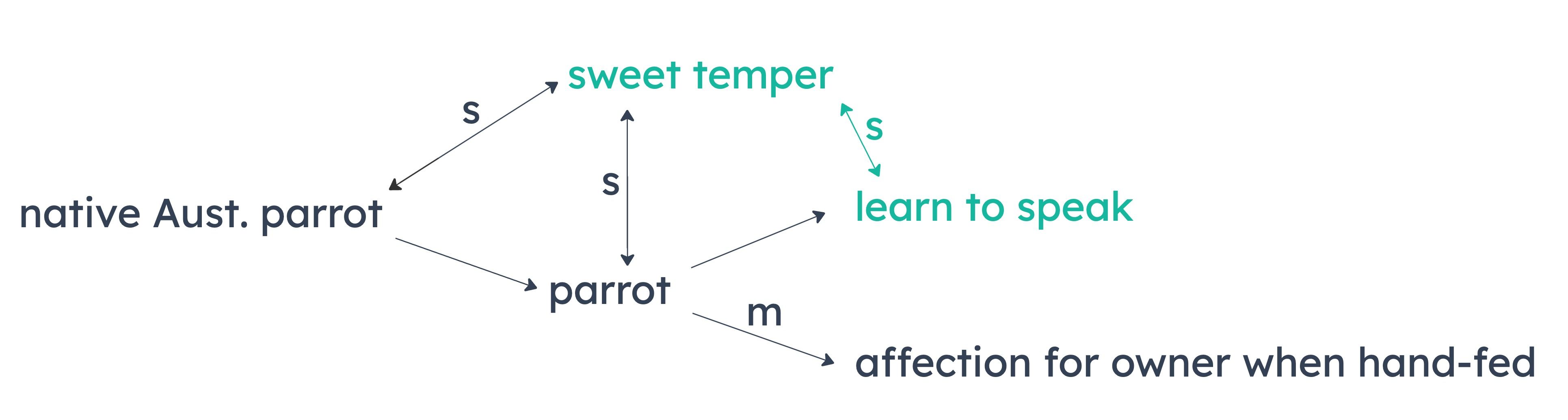
Must be true. As shown below, if all parrots can learn to speak and some parrots are sweet tempered, then there must be some overlap between parrots that can learn to speak and parrots that are sweet tempered.
B
If a parrot is not native to Australia, then it will be sweet tempered only if it is hand-fed as a chick.

Could be false. We only have a condition about some parrots that are native to Australia. Moreover, as shown in our diagram, being hand-fed is not a necessary condition for being sweet tempered.

C
The sweetest-tempered parrots are those native to Australia.

Could be false. We only know that some parrots native to Australia are sweet-tempered, but we don’t know which ones are the sweetest.

D
Australia is the only place where one can find birds that can both learn to speak and be relied on for a sweet temper.

Could be false. We know that there are parrots native to Australia with these characteristics, but to say that Australia is the only place is too extreme.

E
All species of pet birds that are native to Australia can be counted on for a sweet temper.

Could be false. We only know that some parrots native to Australia can be counted on for a sweet temper. All species of pet birds is too broad of a statement to be supported by the stimulus.


3 comments

Toxicologist: Recent research has shown that dioxin causes cancer in rats. Although similar research has never been done on humans, and probably never will be, the use of dioxin should be completely banned.

Summarize Argument
The toxicologist concludes that the use of dioxin should be completely banned. The support for this recommendation is that research has shown that dioxin causes cancer in rats.

Identify Argument Part
The claim in the question stem is used to support the toxicologist’s recommendation that dioxin be completely banned.

A
It is presented as the hazard that the researcher is concerned with preventing.
The hazard that the researcher is concerned with preventing is cancer in humans, not cancer in rats.
B
It is presented as a benefit of not acting on the recommendation in the conclusion.
The claim in the question stem is used as support for the recommendation in the conclusion, not as a benefit of not acting on the recommendation in the conclusion.
C
It is presented as evidence for the claim that similar research will never be done on humans.
The argument does not provide evidence for the claim that similar research will never be done on humans.
D
It is presented as a finding that motivates the course of action advocated in the conclusion.
The research mentioned in the question stem is used to support the recommendation in the conclusion to ban dioxin.
E
It is presented as evidence for the claim that similar research has never been done on humans.
The argument does not provide evidence for the claim that similar research has never been done on humans.

4 comments