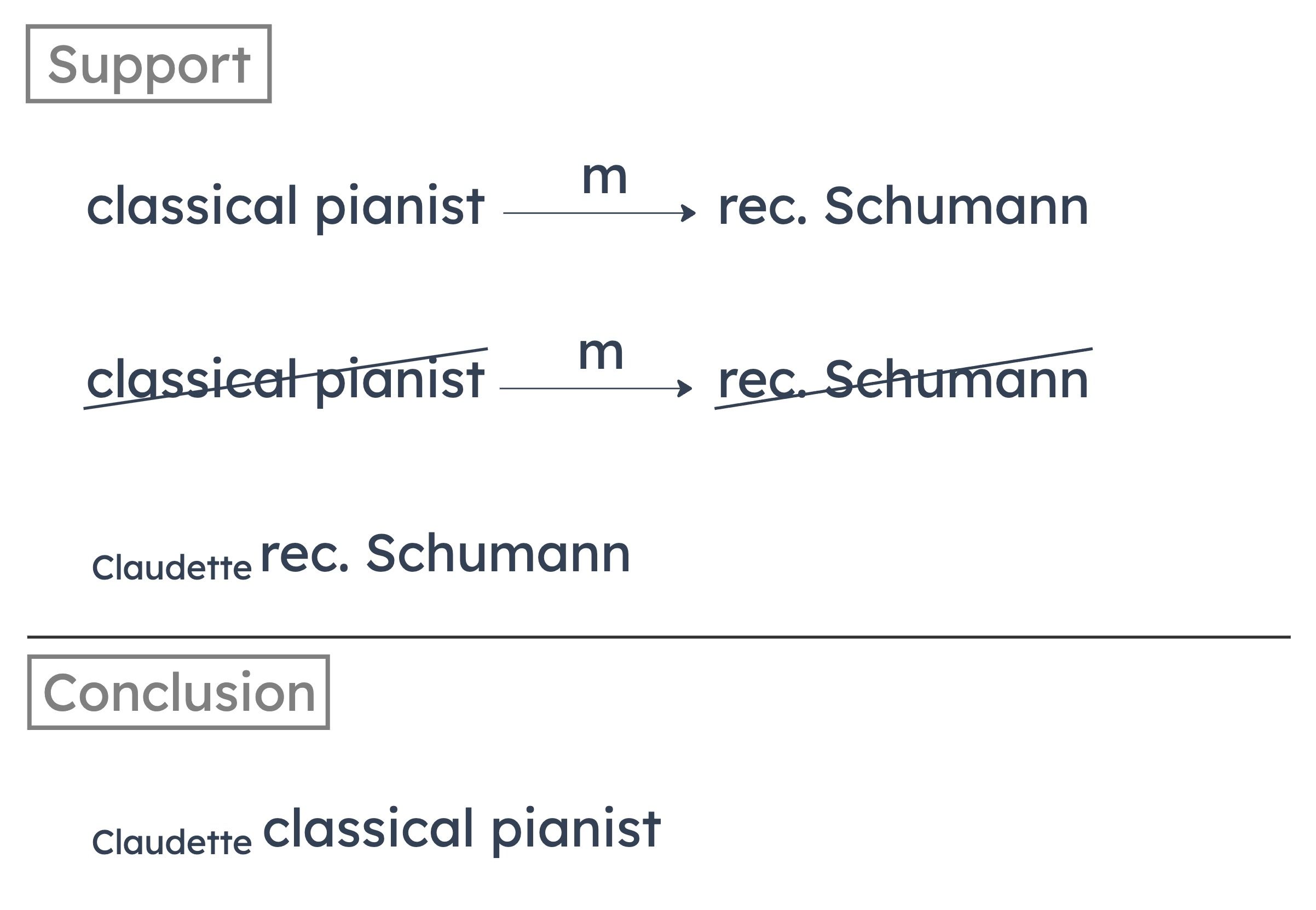
It is highly likely that Claudette is a classical pianist. Like most classical pianists, Claudette recognizes many of Clara Schumann’s works. The vast majority of people who are not classical pianists do not. In fact, many people who are not classical pianists have not even heard of Clara Schumann.

Summarize Argument
The argument claims that Claudette is probably a classical pianist. This is because most classical pianists recognize Schumann's works, and Claudette happens to also recognize them. Further, most people who aren’t classical pianists would not have recognized them.

Identify and Describe Flaw
These two ‘most’ relationships only tell us how likely someone may be to recognize or not recognize Schumann’s works. They say nothing about how likely someone is to be a classical pianist. It’s entirely possible that most people who recognize her works aren’t classical pianists. The argument’s flaw lies in the mistaken assumption that, among everyone in the world who recognizes Schumann's works, most of them are classical pianists. This flaw amounts to the author interpreting a ‘most’ relationship in the wrong direction.

A
ignores the possibility that Claudette is more familiar with the works of other composers of music for piano
This is irrelevant. The argument claims that she’s probably a classical pianist because she recognizes Schumann’s works. This claim is unaffected by how many other works she does or doesn’t recognize.
B
presumes, without providing justification, that people who have not heard of Clara Schumann do not recognize her works
This is irrelevant. Whether these other people recognize Schumann or not has no bearing on whether Claudette is likely to be a classical pianist.
C
presumes, without providing justification, that classical pianists cannot also play other musical instruments
The argument doesn’t presume this, and even if it were to, it wouldn’t matter. Whether classical pianists play other instruments or not is irrelevant to whether Claudette is likely to be one.
D
relies for its plausibility on the vagueness of the term “classical”
The term “classical” is not vague since it consistently refers to a specific kind of pianist.
E
ignores the possibility that the majority of people who recognize many of Clara Schumann’s works are not classical pianists
This describes the fact that while most classical pianists may recognize Schumann’s works, many other kinds of people may recognize them as well. Claudette could easily be one of those other people who recognize the works without being a classical pianist.

30 comments

It is unlikely that the world will ever be free of disease. Most diseases are caused by very prolific microorganisms whose response to the pressures medicines exert on them is predictable: they quickly evolve immunities to those medicines while maintaining their power to infect and even kill humans.

Summarize Argument
The author concludes that it is unlikely that disease will be eradicated. As support for this conclusion, the author states that most diseases are caused by prolific microorganisms that respond to medicines by quickly evolving immunities while maintaining their ability to infect and kill humans. In other words, a byproduct of the use of medicines is the evolution of potentially harmful microorganisms.

Identify Argument Part
The claim in the question stem is the main conclusion of the argument.

A
It is a conclusion that is claimed to follow from the premise that microorganisms are too numerous for medicines to eliminate entirely.
While (A) correctly identifies the claim in the question stem as a conclusion, the conclusion does not follow from the premise that microorganisms are too numerous for medicines to eliminate them entirely. Rather, the problem is that microorganisms quickly evolve immunities.
B
It is a conclusion for which a description of the responses of microorganisms to the medicines designed to cure the diseases they cause is offered as support.
(B) correctly identifies the claim in the question stem as the conclusion, and shows the correct relationship between the conclusion and the support. It is the response of microorganisms to medicines––their ability to evolve immunities––that supports the conclusion.
C
It is a premise offered in support of the claim that most disease-causing microorganisms are able to evolve immunities to medicines while retaining their ability to infect humans.
The claim in the question stem is the conclusion, not a premise.
D
It is a generalization used to predict the response of microorganisms to the medicines humans use to kill them.
The claim in the question stem is the conclusion; it is not a generalization. Further, the claim in the question stem is a claim about the existence of disease in the world, not a prediction about how microorganisms respond to medicine.
E
It is a conclusion that is claimed to follow from the premise that most microorganisms are immune to medicines designed to kill them.
(E) does correctly identify the claim in the question stem as a conclusion. However, the problem with medicines isn’t that the microorganisms that they are designed to kill are immune to them; instead, the problem with medicines is that microorganisms respond by becoming immune.

7 comments

For many centuries it was believed that only classical Euclidean geometry could provide a correct way of mathematically representing the universe. Nevertheless, scientists have come to believe that a representation of the universe employing non-Euclidean geometry is much more useful in developing certain areas of scientific theory. In fact, such a representation underlies the cosmological theory that is now most widely accepted by scientists as accurate.

Summary
Traditionally people believed only classical Euclidean geometry could correctly represent the universe mathematically. However, scientists now believe that non-Euclidean geometrical representations of the universe are much more useful. In fact, non-Euclidean representations underly the cosmological theory most widely accepted by scientists.

Strongly Supported Conclusions
Modern scientists do not believe that classical Euclidean geometry is the only method for representing the universe mathematically.

A
Scientists who use Euclidean geometry are likely to believe that progress in mathematical theory results in progress in natural science.
This answer is unsupported. We don’t know from the stimulus anything about the beliefs of scientists who subscribe to Euclidean theory. We only know that nowadays most scientists subscribe to a non-Euclidean theory.
B
Scientists generally do not now believe that classical Euclidean geometry is uniquely capable of giving a correct mathematical representation of the universe.
This answer is strongly supported. We know from the stimulus that modern scientists believe that non-Euclidean representations are more useful than classical Euclidean theory.
C
Non-Euclidean geometry is a more complete way of representing the universe than is Euclidean geometry.
This answer is unsupported. We don’t know from the stimulus which theory more completely represents the universe. We only know that the non-Euclidean theory is more useful for developing certain areas of scientific theory.
D
An accurate scientific theory cannot be developed without the discovery of a uniquely correct way of mathematically representing the universe.
This answer is unsupported. The stimulus does not conclude that the non-Euclidean theory is uniquely correct. We only know that most scientists have found it more useful than classical Euclidean theory.
E
The usefulness of a mathematical theory is now considered by scientists to be more important than its mathematical correctness.
This answer is unsupported. We don’t know what qualities scientists think are more important in any theory.

15 comments

Before their larvae hatch, each parental pair of Nicrophorus beetles buries the carcass of a small vertebrate nearby. For several days after the larvae hatch, both beetles feed their voracious larvae from the carcass, which is entirely consumed within a week. Since both parents help with feeding, larvae should benefit from both parents’ presence; however, removing one parent before the hatching results in larvae that grow both larger and heavier than they otherwise would be.

"Surprising" Phenomenon

Why do the larva grow larger and heavier when one parent is present, even though both parents help with feeding by bringing a food source to the larva before they hatch?

Objective

The correct answer should help explain why having one parent present present is better for the larva’s growth than having two parents. Perhaps, for example, having two parents takes away from the amount of food available to the larva, or causes some kind of biological reaction in the larva that inhibits their growth. Or perhaps there’s something about having one parent present that leads larva to eat more.

A
Two beetles can find and bury a larger carcass than can a single beetle.

This makes the discrepancy harder to explain, because it’s something positive about having two parents present compared to only one.

B
Both parents use the carcass as their own food supply for as long as they stay with the larvae.

If both parents use the carcass for their own food, that leave less food available for the larva when both parents are present compared to when only one is present. That could explain why the larva grow larger with only one present.

C
Beetle parents usually take turns feeding their larvae, so that there is always one provider available and one at rest.

This doesn’t tell us why having both parents present would lead to less food for the larva. If anything, it suggests having both present would help the larva feed, which makes the discrepancy harder to explain.

D
After a week, the larvae are capable of finding other sources of food and feeding themselves.

But why would having two parents around be worse for larva growth than having only one present? This doesn’t differentiate between having both parents around compared to only one.

E
Two parents can defend the carcass from attack by other insects better than a single parent can.

This is a reason to think larva should have more food available when both parents are present than when only one is present. This makes the discrepancy harder to explain.


1 comment

Most plants have developed chemical defenses against parasites. The average plant contains about 40 natural pesticides—chemical compounds toxic to bacteria, fungi, and other parasites. Humans ingest these natural pesticides without harm every day. Therefore, the additional threat posed by synthetic pesticides sprayed on crop plants by humans is minimal.

Summarize Argument
The author argues that using synthetic pesticides on crops causes minimal harm to humans. As support, the author says that the average plant contains around 40 natural pesticides, and humans consume these natural pesticides safely.

Notable Assumptions
The author assumes that, because consuming natural pesticides in naturally occurring quantities is not harmful, consuming synthetic pesticides won’t be harmful. It could be that either the quantity or process of using synthetic pesticides is harmful for humans in a way that the natural pesticides are not.

A
Humans have been consuming natural plant pesticides for millennia and have had time to adapt to them.
This weakens the argument because it introduces a significant difference between natural and synthetic pesticides. Humans haven’t had millennia to adapt to synthetic pesticides, so these synthetic pesticides could be harmful even though we regularly eat natural pesticides.
B
The concentrations of natural pesticides in plants are typically much lower than the concentrations of synthetic pesticides in sprayed crop plants.
(B) weakens the argument because it introduces a difference in the way that natural and synthetic pesticides are used. It could be that pesticides become dangerous at a certain concentration, so the higher concentration of pesticides from synthetic pesticide use could cause harm.
C
Natural plant pesticides are typically less potent than synthetic pesticides, whose toxicity is highly concentrated.
(C) introduces another point of distinction between natural and synthetic pesticides––if the toxicity in synthetic pesticides is highly concentrated, then it makes sense that the synthetic pesticides could be harmful while natural pesticides aren’t harmful.
D
Natural plant pesticides generally serve only as defenses against specific parasites, whereas synthetic pesticides are often harmful to a wide variety of organisms.
This is another difference between natural and synthetic pesticides––natural pesticides are targeted against specific parasites, so they wouldn’t damage humans. If synthetic pesticides are more broadly harmful, they could be harmful to humans.
E
The synthetic pesticides sprayed on crop plants by humans usually have chemical structures similar to those of the natural pesticides produced by the plants.
The argument based on assumed similarities between natural and synthetic pesticides, so to weaken the argument, we need to demonstrate some distinction between the two types of pesticides that could mean that natural pesticides are safe, while synthetic pesticides aren’t.

8 comments

Increases in the occurrence of hearing loss among teenagers are due in part to their listening to loud music through stereo headphones. So a group of concerned parents is recommending that headphone manufacturers include in their product lines stereo headphones that automatically turn off when a dangerous level of loudness is reached. It is clear that adoption of this recommendation would not significantly reduce the occurrence of hearing loss in teenagers, however, since almost all stereo headphones that teenagers use are bought by the teenagers themselves.

Summarize Argument
The author concludes that headphone manufacturers would not help stop teen hearing loss by adding a line of headphones that turn off when a dangerous level of loudness is reached. This is because teens buy headphones themselves.

Notable Assumptions
The author assumes teens would not buy the headphones that turn off when a dangerous level of loudness is reached.

A
Loud music is most dangerous to hearing when it is played through stereo headphones.
We don’t care when loud music is most dangerous. We need to strengthen the claim that the new line of headphones wouldn’t help stop teen hearing loss.
B
No other cause of hearing loss in teenagers is as damaging as their listening to loud music through stereo headphones.
Like (A), we don’t care how bad loud music is. We need to strengthen the claim that the new line of headphones wouldn’t help stop teen hearing loss.
C
Parents of teenagers generally do not themselves listen to loud music through stereo headphones.
Irrelevant. We care about what the teens are doing.
D
Teenagers who now listen to music at dangerously loud levels choose to do so despite their awareness of the risks involved.
Teens know listening to loud music is bad for their hearing, but they do it anyway. Therefore, they wouldn’t buy a line of headphones that prevents them from this risk by not allowing them to listen to loud music.
E
A few headphone manufacturers already plan to market stereo headphones that automatically turn off when a dangerous level of loudness is reached.
According to the author, those headphones won’t make a difference. We’re trying to strengthen that claim.

10 comments

Chai: The use of the word “tree” to denote both deciduous and coniferous plant forms, while acceptable as a lay term, is scientifically inadequate; it masks the fact that the two plant types have utterly different lineages.

Dodd: But the common name highlights the crucial fact that both are composed of the same material and have very similar structures; so it is acceptable as a scientific term.

Speaker 1 Summary
Chai claims that using the term “tree” to include both coniferous and deciduous plants isn’t sufficient for scientific use, even though it’s fine for day-to-day conversations. Why? Because the common term obscures the different origins of coniferous and deciduous plants.

Speaker 2 Summary
Dodd argues that using “tree” to mean both coniferous and deciduous plants is scientifically acceptable. Why? Because using the same term for both highlights their similarities in structure and material makeup.

Objective
We want to find something that Chai and Dodd disagree about. They disagree over whether it’s scientifically acceptable to include both coniferous and deciduous plants in the term “tree”.

A
it is advisable to use ordinary terms as names for biological forms in scientific discourse
Neither speaker makes this argument. Chai and Dodd are only talking about whether the specific term “tree” is scientifically acceptable, and neither comments on whether there’s a general rule about using ordinary names in science.
B
using the same term for two biological forms with different lineages can be scientifically acceptable
Chai disagrees with this, but Dodd agrees: this is the point of disagreement. Chai claims that “tree” is a scientifically unacceptable term specifically because it includes plants with different lineages. Dodd argues that it’s acceptable regardless.
C
both deciduous and coniferous plant forms evolved from simpler biological forms
Neither speaker directly makes this claim. Chai’s reference to “lineages” does imply that Chai agrees, though—but there’s no reason to think that Dodd would disagree.
D
it is important that the lay terms for plant forms reflect the current scientific theories about them
Neither speaker discusses this idea. Neither Chai nor Dodd talks about what goals lay terminology should accomplish, or whether or not those goals are related to science.
E
biological forms with similar structures can have different lineages
Both speakers likely agree with this. Although Chai doesn’t directly talk about structures, and Dodd doesn’t discuss lineages, neither one disputes the other’s factual claims about trees. This means they likely agree that trees have similar structures but different lineages.

4 comments