James: People have always been critical of the art of their own time. They forget all but the greatest art from past eras. Since inferior contemporary artworks have not yet been forgotten, people today mistakenly think that contemporary art is generally inferior to earlier art.
Speaker 1 Summary
Rachel concludes that artists’ freedom from the constraints of their predecessors has caused a decline the quality of art. This is because great art requires that artists struggle against external constraints.
Speaker 2 Summary
James concludes that there hasn’t been a decline in the quality of art. People only think there’s been a decline, because people only remember the best artwork of the past, and have not get forgotten the inferior artwork of the present.
Objective
We’re looking for a point of disagreement. The speakers disagree about whether art today is worse than the art of the past. Rachel thinks today’s art is worse. James thinks it’s not worse.
A
contemporary art is of lower quality than earlier art
This is a point of disagreement. Rachel thinks contemporary art is worse than the art of the past. James calls that belief a mistake.
B
contemporary artists are bound by the same constraints as their predecessors
James doesn’t express an opinion about this. He doesn’t discuss constraints or whether the artists of today have the same constraints as artists of the past.
C
great art is produced only when an artist struggles against limitations
James doesn’t express an opinion. He doesn’t discuss requirements for great art or the struggles of artists.
D
inferior art from past eras is generally forgotten
Rachel doesn’t express an opinion. She doesn’t discuss inferior art of the past and whether people remember it.
E
one can correctly assess the quality of art only if it was produced in past eras
The speakers share the same opinion about this. Both assess the quality of contemporary art. This suggests they both think that we can correctly assess the quality of modern art.
Summary
The use of phrases like “as so-and-so said” or “as the saying goes” suggests that the following quote has just been illustrated. Such phrases are inappropriately used when an apparent counterexample has just been given.
Notable Valid Inferences
We’re looking for an answer choice where the quoted phrase directly contradicts the scenario previously described in the stimulus.
A
Fatima was a mathematician who often thought about unsolved problems of mathematics, although it was unpleasant to be reminded that most would probably remain unsolved in her lifetime. As the saying goes, “Strange how much you’ve got to know before you know how little you know.”
Could be true. The quoted phrase does not directly contradict Fatima’s experience. By being reminded most problems would probably remain unsolved in her lifetime, it’s possible that Fatima knows how little she knows.
B
Harold’s friends were surprised when he revealed that he had left his wallet at home and asked that someone lend him money. But he had done the same thing many times before. As Halliard said, “The force of selfishness is as inevitable and as calculable as the force of gravitation.”
Could be true. The quoted phrase does not directly contradict Harold’s experience. It is possible that Harold was being selfish when repeatedly leaving his wallet at home.
C
The best model of vacuum cleaner was the most expensive on the market, but it would have made Roger unhappy to purchase it. For although he never wanted anything but the best, he was also quite frugal, and would never have forgiven himself for spending the money. As the saying goes, “A penny saved is a penny earned.”
Could be true. The quoted phrase does not directly contradict Roger’s experience. Even though Roger wants the best, it is possible that he is still frugal because he believes in spending money wisely.
D
Sharon loved cats, but her husband was allergic to them. Still, he was occasionally willing to accompany her to cat shows. As the saying goes, “Shared lives mean shared loves.”
Could be true. The quoted phrase does not directly contradict Sharon’s husband’s experience. Even though he is allergic to cats, it is possible that he attends the cat shows because he wants to share the experience with Sharon.
E
Raoul spent a year planning and preparing for a fantastic ski trip. He enjoyed his ski trip greatly until he broke his leg and had to spend two weeks in the hospital. As the saying goes, “All’s well that ends well.”
Must be false. The quoted phrase directly contradicts Raoul’s experience. Raoul’s ski trip did not end well, he suffered a broken leg and spent significant time in the hospital.
Summary
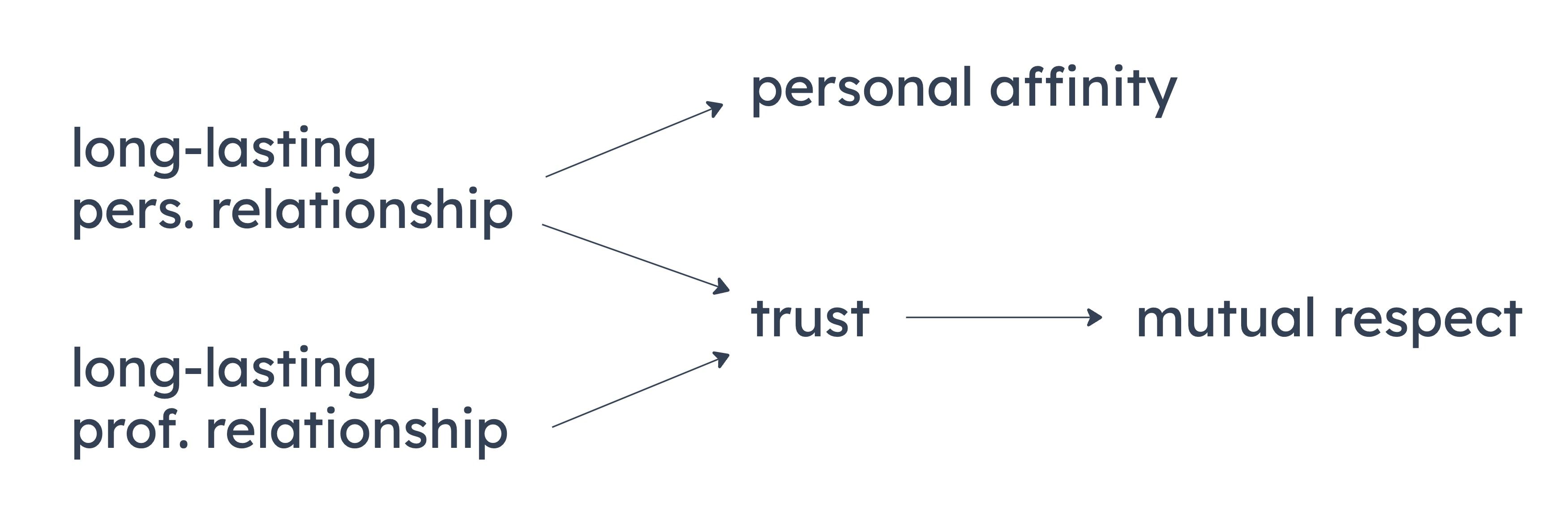
Trust requires mutual respect. Moreover, trust is essential to any long-lasting relationship, personal or professional. Personal relationships, such as marriage or friendship, additionally require natural affinity. If a personal relationship is to last, it must be supported by mutual respect and affinity.
Notable Valid Inferences
A personal relationship supported only by trust and mutual respect will not be long lasting.
A personal relationship supported only by natural affinity will not be long lasting.
A personal relationship supported only by natural affinity will not be long lasting.
A
A friendship supported solely by trust and mutual respect will not be long-lasting.
Must be true. As shown below, a long-lasting personal relationship requires natural affinity in addition to trust and mutual respect. 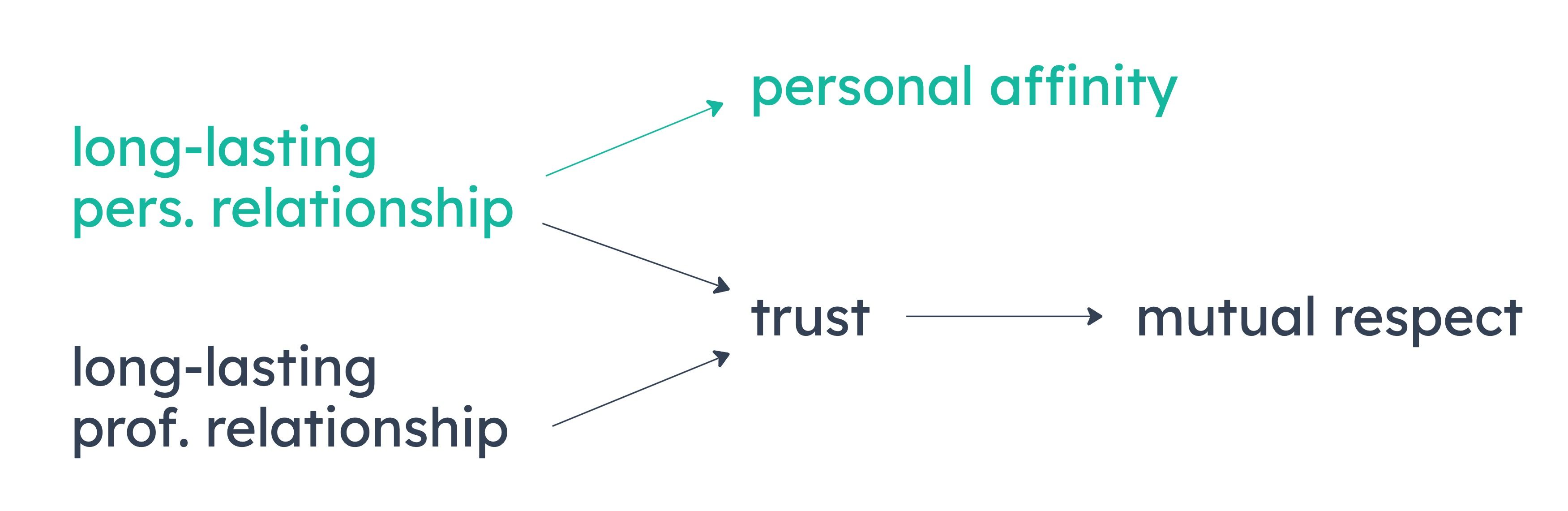
B
In the context of any professional relationship, mutual respect presupposes trust.
Could be false. This answer choice confuses sufficiency for necessity. We know that mutual respect is a necessary condition for trust. It is possible for a necessary condition to occur without the sufficient condition.
C
If a personal relationship is supported by mutual respect and affinity, it will last a long time.
Could be false. This answer choice confuses sufficiency for necessity. We know that mutual respect and affinity are necessary conditions for a personal relationship to be long-lasting. It is possible for a necessary condition to occur without the sufficient condition.
D
Personal relationships, such as marriage or friendship, are longer-lasting than professional relationships.
Could be false. The stimulus tells us several necessary conditions for these relationships to be long-lasting, but the stimulus does not give us any information to infer which relationships are longer-lasting than others.
E
Basing a marriage on a natural affinity will ensure that it will endure.
Must be false. The stimulus tells us that personal relationships, such as marriage, require mutual respect in addition to natural affinity.
Summarize Argument: Counter-Position
The columnist concludes that analysts who think that stock prices will rise as baby boomers start saving for retirement are being too optimistic. The columnist accepts that boomers will start consuming less to plan for retirement, but claims that lower consumption will hurt corporate earnings. This will lower stock prices, which will lead boomers to invest their savings elsewhere. So, the analysts’ prediction of an ongoing stock boom is unjustified.
Describe Method of Reasoning
The columnist argues based on the same initial factual premises as the analysts: that boomers will start saving more and consuming less as they prepare to retire. However, the columnist draws a different conclusion from these premises based on a different prediction of how boomers’ changing habits will affect the economy.
A
attempts to undermine the analysts’ argument by questioning the truth of its premises
The columnist doesn’t question the truth of the analysts’ premises that boomers will start planning for retirement, thus saving more and consuming less. The columnist just makes a different prediction based on these premises.
B
attempts to undermine the analysts’ argument by suggesting that the analysts present it for self-serving reasons
The columnist never suggests that the analysts’ argument is wrong because it’s self-serving. Sure, if the analysts were correct, they would “stand to gain,” but that doesn’t mean that they benefit from just making the argument.
C
attempts to undermine the analysts’ argument by drawing an alternative conclusion from the analysts’ premises
The columnist’s alternative conclusion, that boomers will probably not invest heavily in stocks, is indeed drawn from the analysts’ same premises. These premises are that boomers will soon start retirement planning, leading them to consume less and save more.
D
argues that the analysts’ conclusion is basically right, but suggests that it is somewhat too optimistic
The columnist doesn’t agree that the analysts are basically right. The columnist’s claims that stock prices will stay low and boomers will invest elsewhere are totally opposed to the analysts’ conclusion that boomers’ investment in stocks will create ongoing gains.
E
argues in favor of the analysts’ conclusion, but does so on the basis of a different body of evidence
The columnist simply doesn’t argue in favor of the analysts’ conclusion; nor do the two use different evidence. In fact, the columnist uses the same body of evidence to argue against the analysts’ conclusion.
Summarize Argument: Counter-Position
The author concludes that lawmakers’ proposal to have milk labels list the artificial substances used in milk production should not be implemented. This is supported by some examples of unexpected information these labels would have to include, like fertilizer used to grow the cows’ feed. The examples imply that it would be too impractical to list all of the many artificial substances used in the many steps of milk production.
Describe Method of Reasoning
The author counters the lawmakers’ proposal by pointing out unforeseen consequences of the proposal that would make implementing the proposal unreasonable.
A
proposing an alternative course of action for achieving the objectives of the proposal being argued against
The author doesn’t propose any alternatives, but is simply arguing against the feasibility of the entire proposal.
B
raising considerations in order to show that the proposal being argued against, if strictly implemented, would lead to absurd consequences
The author raises the consideration that a consequence of the proposal would be the absurd requirement to list substances like fertilizers and fungicides, which are technically part of the process of milk production.
C
using specific examples in order to show that an alternative to the proposal being argued against would better achieve the ends to which the original proposal was directed
The author doesn’t suggest any alternatives to the proposal being argued against, and only argues against the proposal on the grounds of the likely consequences of its implementation.
D
introducing a case analogous to the one under consideration to show that a general implementation of the proposal being argued against would be impossible
The author doesn’t make any analogies about a general case, and only argues that implementing the proposal would be highly unreasonable, not impossible.
E
questioning the motivation of those who made the proposal being argued against
The author doesn’t address the motivations of the lawmakers who made the proposal at any point, and only argues based on the likely consequences of the proposal itself.
Summarize Argument
The commentator concludes that there is no reason to think that chlorofluorocarbons (CFCs) in the atmosphere are harming humans by damaging the ozone layer and allowing excess ultraviolet (UV) radiation to reach Earth. As support, the commentator cites a supernova 300,000 years ago that damaged the ozone layer much more than CFCs are estimated to be damaging the ozone layer today. Since our earliest ancestors were not impacted by this damage 300,000 years ago, the commentator says that humans today won’t be harmed by the damage caused by CFCs.
Notable Assumptions
The commentator assumes that humans are similar enough to “our earliest ancestors” to conclude that something that didn’t damage our ancestors won’t damage us. The commentator also assumes that there have not been changes in the past 300,000 years that may augment the harm of a damaged ozone layer.
A
Extraterrestrial influences on the ozone layer tend to occur less often than terrestrial ones.
We don’t care about other influences on the ozone layer; the argument is specifically focused on whether or not damage to the ozone layer caused by CFCs will be harmful for humans. Furthermore, the quantity of these extraterrestrial influences definitely isn’t relevant.
B
Natural events, such as the eruption of volcanoes, continue to damage the ozone layer today.
Similar to (A), for this argument, we only care about the impact that CFCs have on the ozone layer; other influences on the ozone layer are irrelevant to the commentator’s argument.
C
Our earliest ancestors possessed genetic characteristics making them more resistant than we are to the harmful effects of ultraviolet radiation.
(C) widens the gap between the premises and conclusion. It’s great that our earliest ancestors weren’t harmed by the damage to the ozone layer, but if they were more resistant than we are to UV radiation, then we cannot use their experience as a basis for this claim about humans.
D
The ozone layer regenerates at a slow rate, barring counteractive processes.
The argument is about damage to the ozone layer, not repairing the ozone layer, so this is outside of the scope of the argument. We don’t know if any counteractive processes are happening.
E
Scientists have discovered that genetic changes occurred in our ancestors during the period in which the supernova affected Earth.
This is too vague––without any indication of what kind of genetic changes occurred, this is not enough information to weaken the argument. It could be the case that all of these genetic changes are completely independent from reactions to UV radiation.
Theo: Popular music is not supposed to reflect reality; it performs other artistic functions, such as providing consoling fantasies and helping people create some romance in their often difficult lives. You should understand popular music before you condemn it.
Speaker 1 Summary
Popular music is bad art. Why? Because it fails to represent reality accurately by greatly exaggerating the role love plays in everyday life.
Speaker 2 Summary
Popular music serves other artistic functions, it is not supposed to reflect reality. You should understand popular music before you criticize it.
Objective
We need a statement that Maria and Theo disagree on. They disagree whether art needs to represent reality accurately to be considered good art. Maria thinks popular music is bad art because it does not represent reality. Theo thinks an accurate representation is not required because popular music serves other artistic functions.
A
most good art creates consoling illusions
Neither speaker expresses an opinion on this statement. Both speakers limit their arguments to popular music. We don’t know what Maria or Theo believe about most good art.
B
some bad art exaggerates the role love plays in everyday life
Theo does not express an opinion on this statement. We don’t know from the stimulus what Theo thinks bad art does.
C
art should always represent reality as it could be, not as it is
Neither speaker expresses an opinion on this statement. We don’t know what Maria or Theo think art should always do.
D
art need not represent reality accurately to be good art
Maria and Theo disagree on this statement. Maria disagrees because she concludes popular music is bad art for the sole reason that it does not accurately represent reality. Theo would agree because popular music serves other artistic purposes.
E
popular music should not be considered to be an art form
Neither speaker expresses an opinion on this statement. Maria thinks that popular music is bad art, but that does not mean that she thinks popular music should not be considered art at all.
</section
Summary
Economist’s obsession with consumption as a measure of economic well-being prevents us from understanding true economic well-being. Why? Because we are not very satisfied by the fact that some things must be replaced.
Strongly Supported Conclusions
There is more to economic well-being than consumption.
A
economic well-being cannot be defined solely in terms of consumption
We should not define economic-well being solely in terms of consumption because we don’t get much satisfaction from replacing things we have consumed.
B
satisfaction is possible without consumption
We don’t know whether the author believes satisfaction is possible without consumption. Rather, the author is making an argument that there’s more to satisfaction than consumption.
C
valid measures of consumption cannot be devised
We don’t know whether the author believes that we cannot measure consumption accurately.
D
modern products are designed for early obsolescence
We don’t know whether the author believes modern products are designed to be discarded early.
E
satisfaction can provide an adequate quantitative measure of economic well-being
We don’t know whether the author believes satisfaction can accurately measure economic well-being. We only know that the author believes that there’s more to economic well-being than consumption.