Summary
Students asked to tell a lie in a discussion group overestimated how many people in the group could tell that they were lying. Similarly, volleyball players that perform unusually poorly expect teammates to notice this more than the teammates actually do. Finally, a student wearing a funny T-shirt was noticed only by a small number of people in a room, contrary to what the student expected.
Strongly Supported Conclusions
People tend to think that their appearance is noticed by others more often than what actually happens.
A
People tend to be far less aware of their own appearance and behavior than are other people.
This answer is anti-supported. We know from the stimulus that people tend to be more aware of their own appearance, not less aware.
B
People tend not to notice the appearance or behavior of others.
This answer is unsupported. It’s not that people in these experiments didn’t notice the appearance or behavior of others, it’s that there is a significant difference in perception. People perceive others to be aware of their appearance more often than others actually are.
C
We are actually less observant of the appearance and behavior of others than we think ourselves to be.
This answer is unsupported. This answer gets it “backwards” and is from the other perspective of whether a person accurately assesses how aware they are of other people.
D
People will notice the appearance or behavior of others only if it is specifically highlighted in some way.
This answer is unsupported. We don’t know from the stimulus what is necessary in order for others to notice a person’s appearance or behavior.
E
People tend to believe their appearance and behavior are noticed by others more often than is actually the case.
This answer is strongly supported. People generally over-expect others to notice their appearance or behavior.
Mathematics professor: I disagree. My applied statistics course covers much of the same material taught in the applied statistics courses in social science departments. In fact, my course uses exactly the same textbook as those courses!
Summarize Argument: Counter-Position
The math professor concludes that non-social science departments should teach applied statistics. This in contrast to the psychologist, who thinks that social science departments are best at teaching their students how to apply statistics to their disciplines. The math professor disagrees, because his applied statistics course covers the exact same content as those taught by the social science departments.
Identify and Describe Flaw
Even if the math professor’s statistics course covers the same material, it may not teach students to apply it to a social science as effectively as a course taught by an expert in the field. That was the point made by the psychology professor, and the math professor didn’t address it.
A
The response gives no evidence for its presumption that students willing to take a course in one department would choose a similar course in another.
Student preference is never mentioned in the response, so this can’t be the flaw.
B
The response gives no evidence for its presumption that social science students should have the same competence in statistics as mathematics students.
The math professor never says anything about student competence, so this can’t be the flaw.
C
The response does not effectively address a key reason given in support of the psychology professor’s position.
The psychology professor’s main claim—that a social science expert is best suited to teach students how to apply statistics in that field—is never addressed.
D
The response depends for its plausibility on a personal attack made against the psychology professor.
No personal attack is made, so this can’t be the flaw.
E
The response takes for granted that unless the course textbook is the same the course content will not be the same.
This is saying: If the content is the same, then the textbook is the same. The math professor doesn’t take this for granted. At most, he’s saying that, if the textbook is the same, the course is the same.
Summary
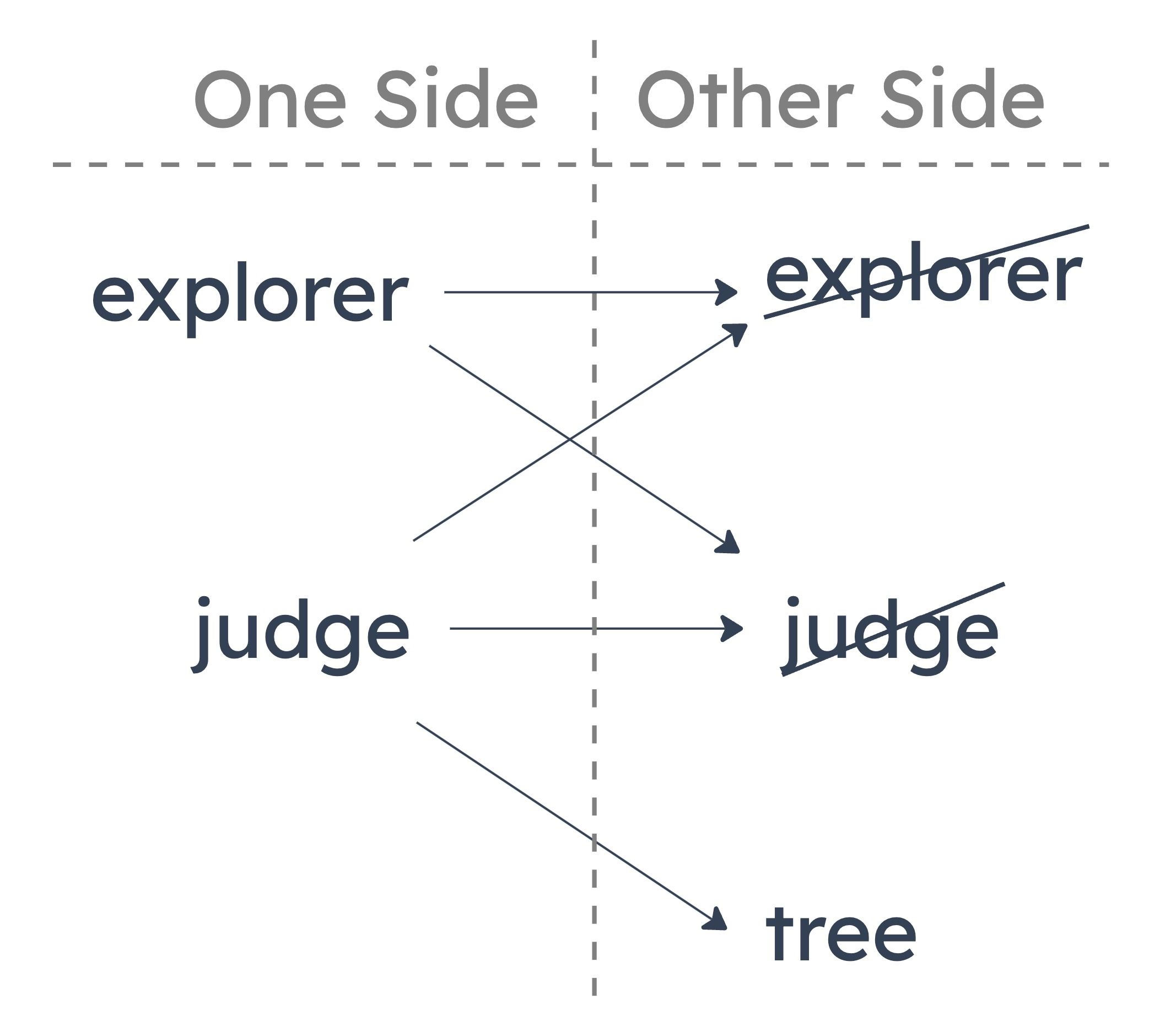
The stimulus can be diagrammed as follows:
Notable Valid Inferences
If you have a judge’s head on one side, you must have a tree on the other side.
If you have an explorer’s head on one side, you can have a building or a tree on the other side.
If you have a building on one side, you can have a building, a tree, or an explorer’s head on the other side.
If you have a tree on one side, you can have a tree, a judge’s head, an explorer’s head, or a building on the other side.
If you have an explorer’s head on one side, you can have a building or a tree on the other side.
If you have a building on one side, you can have a building, a tree, or an explorer’s head on the other side.
If you have a tree on one side, you can have a tree, a judge’s head, an explorer’s head, or a building on the other side.
A
All those with an explorer’s head on one side have a building on the other.
This could be false. A coin with an explorer’s head on one side could have a building OR a tree on the other side.
B
All those with a tree on one side have a judge’s head on the other.
This could be false. Any coin with a tree on one side could have a tree, a building, an explorer’s head, or a judge’s head on the other side. (We know JH→T, but it would be confusing the sufficient and necessary conditions to claim that T→ JH).
C
None of those with a tree on one side have an explorer’s head on the other.
This could be false. A coin with a tree on one side can have a tree, a building, an explorer’s head, or a judge’s head on the other side.
D
None of those with a building on one side have a judge’s head on the other.
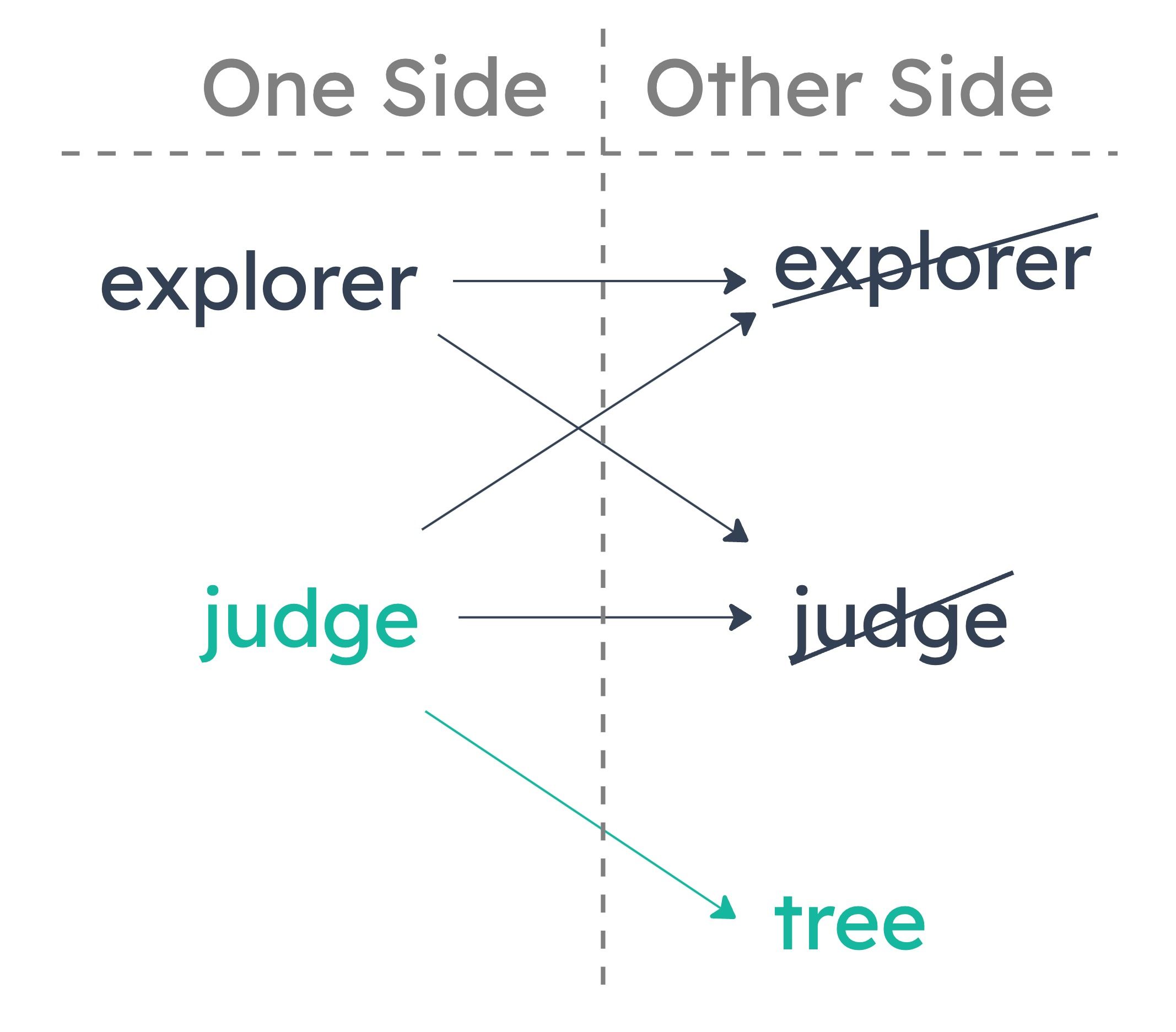
This must be true. Any coin with a judge’s head on one side must have a tree on the other side, so a coin with a judge’s head on one side would not have a building or an explorer’s head on the other side.
E
None of those with an explorer’s head on one side have a building on the other.
This could be false. A coin with an explorer’s head on one side could have a building or a tree on the other side.
Summary
Since 1989, importing ivory from African elephants into the US and Canada has been illegal. But, importing ivory from ancient mammoths is legal. Following the 1989 ban on importing elephant ivory, there was a sharp uptick in ivory imports labeled as mammoth ivory. However, once a technique was developed to reliably distinguish between elephant and mammoth ivory, there was a dramatic decline in the amount of imported ivory labeled as mammoth ivory.
Strongly Supported Conclusions
Before the technique to distinguish between the two types of ivory was introduced, much of the ivory labeled mammoth ivory was actually elephant ivory.
A
Customs officials still cannot reliably distinguish elephant ivory from mammoth ivory.
This is antisupported. The stimulus says that a technique was discovered and widely known.
B
Most of the ivory currently imported into the U.S. and Canada comes from neither African elephants nor mammoths.
The stimulus does not provide information about the current sources of most ivory imports.
C
In the period since the technique for distinguishing elephant ivory from mammoth ivory was implemented, the population of African elephants has declined.
The stimulus does not give any information about the population of elephants. You need a few assumptions to make this work.
D
Much of the ivory imported as mammoth ivory just after the ban on ivory from African elephants went into effect was actually elephant ivory.
The stimulus explains that following the ban, there was a significant increase in mammoth ivory imports and a massive decrease once a technique to distinguish between the two ivories was implemented. You can assume that many ivory imports were mislabeled to get around the law.
E
Shortly after the importation of ivory from African elephants was outlawed, there was a sharp increase in the total amount of all ivory presented for importation into the U.S. and Canada.
The stimulus says that there was a massive increase in mammoth-labeled ivory, not an overall increase in the *total* amount of ivory imported.
Summarize Argument: Phenomenon-Hypothesis
The author hypothesizes that REM sleep relieves stress. This is based on the phenomenon that people who don’t get REM sleep become grumpy.
Notable Assumptions
The author assumes causation from correlation. In other words, the author assumes that a lack of REM sleep makes REM sleep-deprived individuals cranky, and there isn’t some other factor that causes the crankiness.
A
Test subjects who are chronically deprived of non-REM sleep also become irritable during waking life.
This weakens the argument. It attacks the author’s assumption that a lack of REM sleep makes REM sleep-deprived individuals cranky, as people deprived of non-REM sleep also become cranky. This weakens the causal relationship between a lack of REM sleep and crankiness.
B
Chronically having bad dreams can cause stress, but so can chronically having pleasant but exciting dreams.
This does not affect the argument. The nature of the dreams one has in REM sleep does not affect the phenomenon the author seeks to explain, which is that a lack of REM sleep makes people more irritable.
C
During times of increased stress, one’s REM sleep is disturbed in a way that prevents one from dreaming.
This does not affect the argument. While we know that dreams only occur during REM sleep, we don't know how, or whether, a lack of dreams impacts the stress relief process the author claims occurs during REM sleep.
D
Only some people awakened during REM sleep can report the dreams they were having just before being awakened.
This does not affect the argument. We don't know how, or whether, remembering the dreams that occur during REM sleep affects the stress relief process the author claims occurs during REM sleep.
E
Other factors being equal, people who normally have shorter periods of REM sleep tend to experience more stress.
This strengthens the argument. It offers more evidence to support the causal relationship the author assumes exists. In other words, it supports the author’s assumption that a lack of REM sleep (as opposed to some other factor) makes REM sleep-deprived individuals cranky.
Summarize Argument: Counter-Position
The author concludes that the results of a recent election poll are questionable. The support for this comes from the idea that the poll was conducted in high-priced shopping malls. Because Perkins’s policies support the upper-middle class, it is likely that her supporters are overrepresented at the expensive malls. This means that the sample for the poll was biased, so the results of the poll are probably not representative of the views of eligible voters in general.
Identify Conclusion
The conclusion is that the results of the election poll may not be accurate: “the results of that poll are dubious.”
A
The poll was intentionally designed to favor Perkins over Samuels.
There is no indication in the argument that the problematic design of the poll was intentional, so this is not the conclusion.
B
Samuels’s supporters believe that they were probably not adequately represented in the poll.
There is no discussion of what the supporters of Samuels believe, so this is not the main conclusion.
C
The poll’s results probably do not accurately represent the opinions of the voters in the coming election.
This is the main conclusion. This is a paraphrase of the part of the argument that was identified as the conclusion. Further, the rest of the argument acts as support for this claim.
D
Samuels is quite likely to have a good chance of winning the coming election.
The argument does not give any indication of the accurate polling numbers; we just know that the poll discussed in the argument might not be accurate. This is unsupported from the argument, so it is not the main conclusion.
E
Those who designed the poll should have considered more carefully where to conduct the survey.
This kind of value judgement (what poll designers “should have considered”) is not included in the argument, so this is not the main conclusion.
Summarize Argument
The author concludes that there are no endangered species of ants. Why? Because insects in general are so successful that they spread into virtually every ecosystem, and ants are the most successful insect.
Identify and Describe Flaw
This is the cookie-cutter flaw of confusing part v. whole. The author observes that the biological family of ants is successful, and concludes that every individual ant species must be successful.
But some qualities can be true of a whole without being true of every part, or vice versa. Ants in general could be very successful, but some species of ants could still be endangered.
But some qualities can be true of a whole without being true of every part, or vice versa. Ants in general could be very successful, but some species of ants could still be endangered.
A
the Arctic Circle and Tierra del Fuego do not constitute geographically isolated areas
The author doesn’t presume that either is isolated; they’re used to demonstrate wide geographic range (extreme north vs. extreme south).
B
because ants do not inhabit only a small niche in a geographically isolated area, they are unlike most other insects
The author says that insects are definitely not the kind of animals limited to small niches, so this can’t be the flaw.
C
the only way a class of animal can avoid being threatened is to spread into virtually every ecosystem
This goes beyond what the argument states. The author says that two options for animal species are to go extinct or spread into virtually every ecosystem. He doesn’t indicate that those are the only two options.
D
what is true of the constituent elements of a whole is also true of the whole
This describes the part-to-whole flaw, but this is the reverse of what the author does. Instead, he commits a whole-to-part flaw; he attributes a property true of a whole (ants as a family) to each of its individual parts (individual species of ants).
E
what is true of a whole is also true of its constituent elements
This is the cookie-cutter whole-to-part flaw. The author takes for granted that a property true of a whole (ants as a whole are successful) is also true of the parts making up that whole (every individual ant species is successful). But that's flawed reasoning. Even if ants are generally successful, individual ant species could be endangered.