Researcher: People with certain personality disorders have more theta brain waves than those without such disorders. But my data show that the amount of one’s theta brain waves increases while watching TV. So watching too much TV increases one’s risk of developing personality disorders.

Summarize Argument
The researcher concludes that watching too much TV increases the risk of developing personality disorders. He supports this by saying that people with certain personality disorders have more theta brain waves, and watching TV increases theta brain waves.

Identify and Describe Flaw
This is the cookie-cutter flaw of assuming that correlation proves causation. The researcher points out a correlation between theta brain waves and personality disorders, then assumes that theta brain waves cause those disorders. He concludes that since TV increases theta brain waves, it must also increase the risk of personality disorders.

In reality, personality disorders might cause the increase in theta waves, or another factor could be causing both. In either of these cases, the researcher’s link between watching TV and developing personality disorders falls apart.

A
uses the phrase “personality disorders” ambiguously
The researcher uses the phrase “personality disorders” clearly and consistently. Its meaning doesn’t shift throughout his argument.
B
fails to define the phrase “theta brain waves”
The researcher doesn't define “theta brain waves,” but he doesn’t need to. (B) doesn’t describe why his reasoning is questionable.
C
takes correlation to imply a causal connection
The author takes the correlation between theta brain waves and certain personality disorders to imply that theta brain waves cause those disorders. It’s possible, however, that the personality disorders cause theta brain waves or that some other factor causes them both.
D
draws a conclusion from an unrepresentative sample of data
We don’t know the sample size of the researcher’s data and we can’t simply assume that his data is unrepresentative.
E
infers that watching TV is a consequence of a personality disorder
Actually, the researcher infers that developing a personality disorder could be a consequence of watching TV. (E) has this backward.

4 comments

The water of Lake Laberge, in Canada, currently contains high levels of the pesticide toxaphene. Authorities are puzzled because toxaphene was banned in North America in the early 1980s and now is used only in a few other parts of the world.

"Surprising" Phenomenon
Why does Lake Laberge, in Canada, contain high levels of toxaphene when toxaphene was banned in North America in the 1980s and is now used only in a few other parts of the world?

Objective
The correct answer must help explain why Lake Laberge contains high levels of toxaphene even though the substance was banned in Canada in the 1980s. The correct answer will either discuss how toxaphene from the past has remained in the lake, is still being produced in or near the lake, or is being introduced to the lake from somewhere else.

A
Levels of pesticides in the environment often continue to be high for decades after their use ends.
If (A) is true, the high levels of toxaphene currently found in Lake Laberge could just be left over from before Canada’s toxaphene ban.
B
Lake Laberge’s water contains high levels of other pesticides besides toxaphene.
We’re not concerned with other pesticides. We just want to know why there are high levels of toxaphene in the lake when toxaphene has been banned in Canada since the early 1980s.
C
Toxic chemicals usually do not travel large distances in the atmosphere.
It doesn’t matter how far toxic chemicals usually travel. The distance toxic chemicals travel doesn’t help explain why Lake Laberge currently contains high levels of toxaphene when the substance has been banned in Canada since the early 1980s.
D
North American manufacturers opposed banning toxaphene.
Whether North American manufacturers supported or opposed the ban is irrelevant. We want to know why Lake Laberge contains high levels of toxaphene all these years after the ban.
E
Toxic chemicals become more readily detectable once they enter organisms the size of fish.
The stimulus never discusses fish. It only discusses how a lake in Canada contains high levels of toxaphene even though toxaphene was banned in Canada in the early 1980s.

1 comment

Although Samantha likes both oolong and green tea, none of her friends likes both. However, all of her friends like black tea.

Summary
The stimulus can be diagrammed as follow:

Notable Valid Inferences
Samantha’s friends can either like green tea, like oolong tea, or like neither.

A
Samantha likes black tea.
This could be true. We don’t know Samantha’s opinion on black tea.
B
None of Samantha’s friends likes green tea.
This could be true. Oolong and green tea have a “not both” relationship, meaning that Samantha’s friends can like oolong tea, green tea, or neither.
C
Samantha’s friends like exactly the same kinds of tea as each other.
This could be true. It could be the case that all of Samantha’s friends like green tea and black tea, for example.
D
One of Samantha’s friends likes neither oolong nor green tea.
This could be true. Oolong and green tea have a “not both” relationship, meaning that Samantha’s friends can like oolong tea, green tea, or neither.
E
One of Samantha’s friends likes all the kinds of teas that Samantha likes.
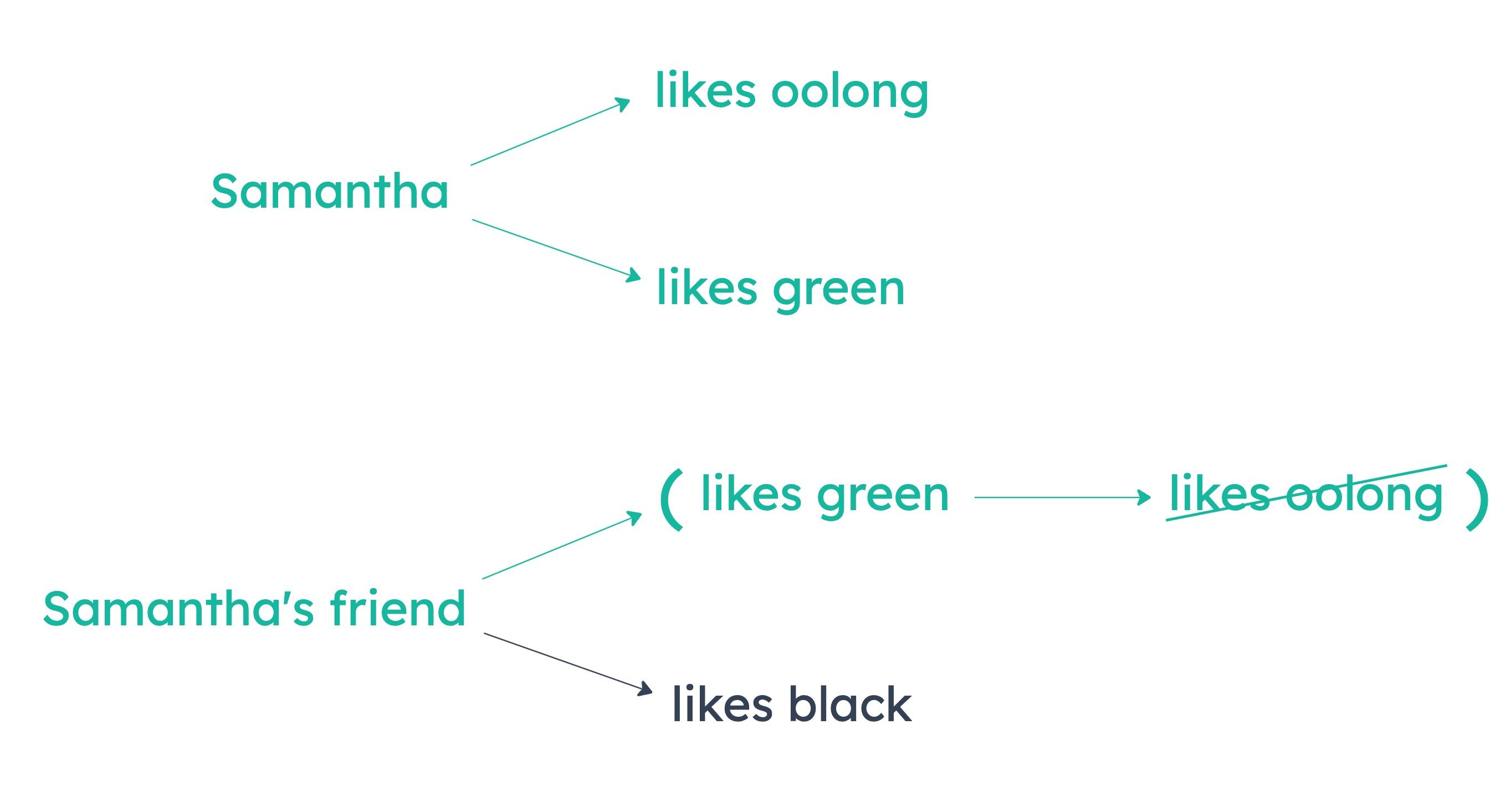
This must be false. As shown below, we know that Samantha’s friends can’t like both oolong and green tea, and Samantha likes both of these kinds of tea.

7 comments

Because it permits a slower and more natural rhythm of life, living in the country is supposed to be more healthy and relaxed than living in the city. But surveys show that people living in the country become ill as often and as seriously as people living in the city, and that they experience an equal amount of stress.

Summary
The stimulus tells us that the country allows a slower and more natural life than the city. This suggests that country life should be more healthy and relaxed than city life. However, surveys show that country and city dwellers experience equal levels of illness and stress.

Strongly Supported Conclusions
These facts allow us to infer that:
A slower and more natural rhythm of life does not necessarily decrease rates of illness and stress.
The common wisdom that country life is healthier and more relaxed than city life is not supported by data.

A
Living in the country is neither healthier nor more relaxing than living in the city.
This is strongly supported. The facts given show that there’s no real difference between the country and the city in illness frequency and severity (i.e. health), nor in stress (i.e. relaxation). Thus, country living is not healthier or more relaxing than city living.
B
Living in the country does not in fact permit a slower and more natural rhythm of life than living in the city.
This is not supported. The stimulus doesn’t contradict that living in the country offers a slower and more natural rhythm of life. The issue is just that that rhythm doesn’t appear to improve health or stress levels.
C
People whose rhythm of life is slow and natural recover quickly from illness.
This is not supported. The facts suggest nothing about how fast people recover from illness, either in the country (with a slow and natural rhythm of life) or otherwise. We just can’t say.
D
Despite what people believe, a natural rhythm of life is unhealthy.
This is anti-supported. Based on what we know, a natural rhythm of life just doesn’t make a difference to health. That means it’s neither particularly healthy nor unhealthy.
E
The amount of stress a person experiences depends on that person’s rhythm of life.
This is anti-supported. The stimulus shows us that having a slow and natural rhythm of life makes no difference to people’s stress levels. This indicates that stress does not depend on someone’s rhythm of life.

5 comments

Industrialist: Environmentalists contend that emissions from our factory pose a health risk to those living downwind. The only testimony presented in support of this contention comes from residents of the communities surrounding the factory. But only a trained scientist can determine whether or not these emissions are dangerous, and none of the residents are scientists. Hence our factory’s emissions present no health risk.

Summarize Argument: Counter-Position
The industrialist concludes that his factory’s emissions are not a health risk to nearby residents. He supports this by saying that the only testimony about the emissions comes from local residents, but only a trained scientist can assess the danger, and none of the residents are scientists.

Identify and Describe Flaw
The industrialist’s reasoning is flawed because he fails to provide any evidence for his conclusion. Even if the residents’ testimonies cannot prove that the emissions are a health risk, the industrialist still needs to provide evidence for the conclusion that the emissions are not a health risk.

In other words, he assumes that the environmentalists’ conclusion is false simply because their support is weak.

A
impugns the motives of the residents rather than assessing the reasons for their contention
This is the cookie-cutter “ad hominem” flaw, where the author attacks the person or group making the argument, rather than the argument itself. The industrialist doesn’t make this mistake. He attacks his opponents’ support and doesn’t make any assumptions about their motives.
B
does not consider the safety of emissions from other sources in the area
The argument is only about the safety of emissions from the industrialist’s factory. Emissions from any other sources are irrelevant.
C
presents no testimony from scientists that the emissions are safe
The industrialist fails to provide any evidence for his conclusion that the emissions are safe. He claims that only scientists can testify that the emissions are safe, but he never actually presents any scientists’ testimonies.
D
fails to discuss the benefits of the factory to the surrounding community
The industrialist only concludes that the factory’s emissions do not present a health risk. He doesn’t need to discuss any benefits of the factory to the community.
E
equivocates between two different notions of the term “health risk”
The industrialist doesn’t make this mistake. He uses the term “health risk” clearly and consistently throughout his argument.

7 comments

In the city of Glasgow, Scotland, trade doubled between 1750, when the first bank opened there, and 1765, when government regulations on banking were first implemented in Scotland.

"Surprising" Phenomenon
Why did trade double in Glasgow between 1750 and 1765?

Objective
The correct answer will be the only answer that doesn’t help explain why trade doubled in Glasgow between 1750 and 1765. The correct answer could give irrelevant information that fails to help explain the doubling or information that makes the doubling seem more confusing.

A
The technological revolution that started in the early eighteenth century in England resulted in increased trade between England and Scotland.
If (A) is true, trade doubling in Glasgow between 1750 and 1765 could have resulted from a general increase in trade between Scotland and England because of the technological revolution.
B
Reductions in tariffs on foreign goods in 1752 led to an increase in imports to Glasgow.
Imports are part of trade, so if (B) is true, the increase in imports to Glasgow because of the reductions in tariffs could help explain why trade doubled in Glasgow between 1750 and 1765.
C
The establishment of banking in Glasgow encouraged the use of paper money, which made financial transactions more efficient.
Financial transactions becoming more efficient could make trade easier to complete and, therefore, help explain why trade doubled in Glasgow between 1750, when its first bank was established, and 1765.
D
Improvements in Scottish roads between 1750 and 1758 facilitated trade between Glasgow and the rest of Scotland.
If (D) is true, the ease of transportation afforded by improvements made to roads in Scotland between 1750 and 1758 could help explain the increase in trade in Glasgow between 1750 and 1765.
E
The initial government regulation of Scottish banks stimulated Glasgow’s economy.
The initial government regulation of Scottish banks didn’t occur until 1765. We’re focused on why trade doubled in Glasgow between 1750 and 1765, so (E) is irrelevant.

23 comments

Editorial: Contrary to popular belief, teaching preschoolers is not especially difficult, for they develop strict systems (e.g., for sorting toys by shape), which help them to learn, and they are always intensely curious about something new in their world.

Summarize Argument
The editorialist concludes that teacher preschoolers isn’t especially difficult. This is because preschoolers develop strict learning systems and are very curious about new things.

Notable Assumptions
The editorialist assumes that preschoolers aren’t difficult to teach so long as they’re curious and have strict learning systems. This means the editorialist thinks that these two things are sufficient for children to be “not especially difficult to teach,” rather than simply necessary factors. Thus, the editorialist believes there’s no outside factor that can make preschoolers difficult to teach.

A
Preschoolers have a tendency to imitate adults, and most adults follow strict routines.
We don’t care why preschoolers follow strict routines. We care about whether or not they’re especially difficult to teach.
B
Children intensely curious about new things have very short attention spans.
Even though preschoolers’ curiosity might be helpful on one hand, those same preschoolers also have terrible attention spans. Thus, they may well be “especially difficult” to teach.
C
Some older children also develop strict systems that help them learn.
The editorialist isn’t arguing about older children. We only care about preschoolers.
D
Preschoolers ask as many creative questions as do older children.
Like (C), we’re not interested in comparing preschoolers with older children. We need to weaken the idea that preschoolers aren’t difficult to change due to their curiosity and strict systems.
E
Preschool teachers generally report lower levels of stress than do other teachers.

This doesn’t tell us that preschoolers themselves aren’t difficult to teach. Maybe preschool teachers generally manage their stress better than other teachers.

7 comments

An editor is compiling a textbook containing essays by several different authors. The book will contain essays by Lind, Knight, or Jones, but it will not contain essays by all three. If the textbook contains an essay by Knight, then it will also contain an essay by Jones.

Summary
The stimulus can be diagrammed as follows:

Notable Valid Inferences
If there is an essay by Knight, then there won’t be an essay by Lind.

There can be a maximum of two authors in the textbook.

A
If the textbook contains an essay by Lind, then it will not contain an essay by Knight.
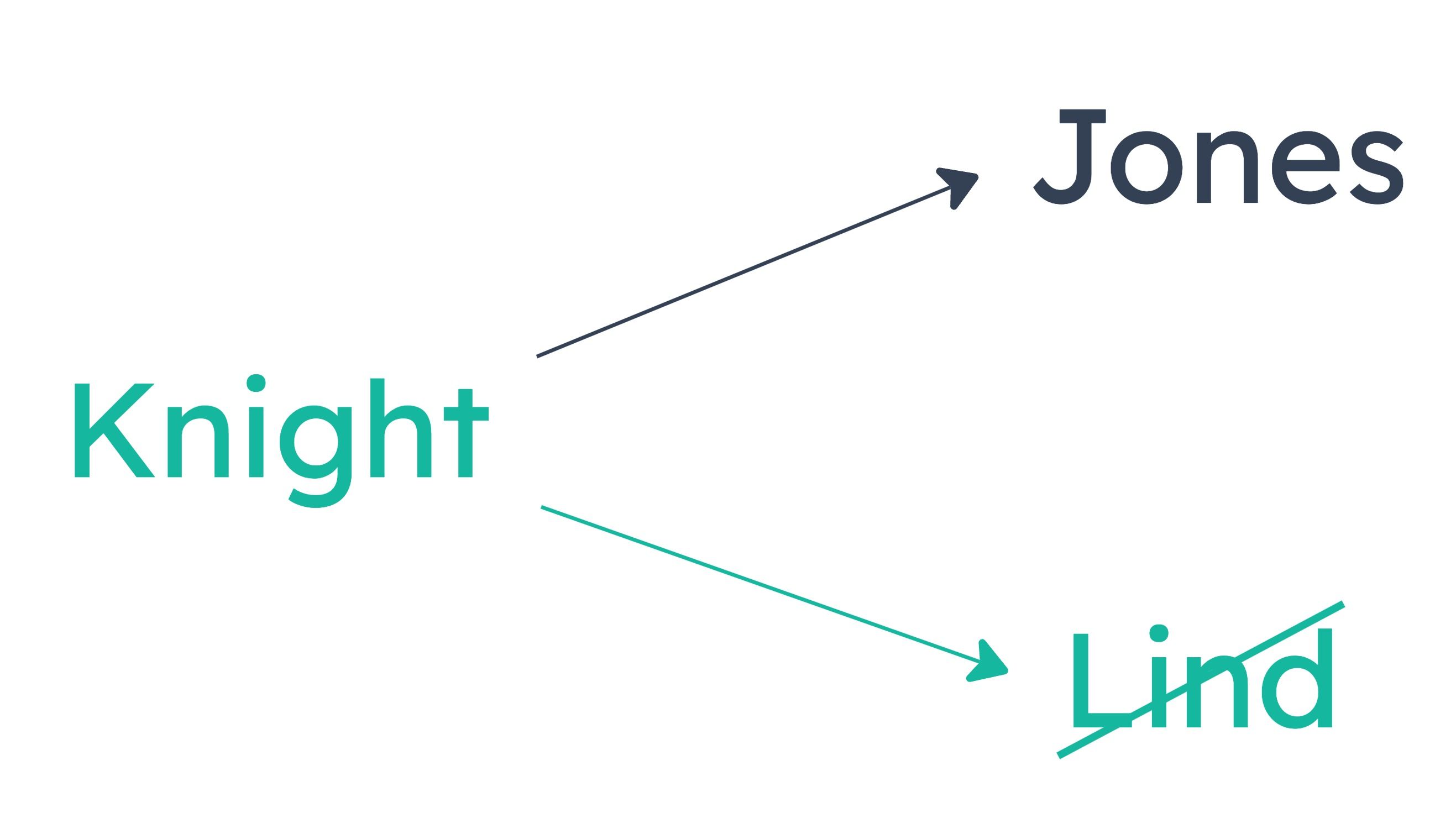
This must be true. As shown in the diagram, Knight and Lind cannot both be included in the textbook. Including Knight means we must also include Jones. This implies that we cannot include Lind, since we cannot include all three authors.
B
The textbook will contain an essay by only one of Lind, Knight, and Jones.
This could be false. It could be the case that two authors are included in the textbook.
C
The textbook will not contain an essay by Knight.
This could be false. The textbook could contain an essay by Knight and Jones.
D
If the textbook contains an essay by Lind, then it will also contain an essay by Jones.
This could be false. The textbook could contain an essay by only Lind.
E
The textbook will contain an essay by Lind.
This could be false. It could be the case that only Knight and Jones are in the textbook.

13 comments

Lawyer: A body of circumstantial evidence is like a rope, and each item of evidence is like a strand of that rope. Just as additional pieces of circumstantial evidence strengthen the body of evidence, adding strands to the rope strengthens the rope. And if one strand breaks, the rope is not broken nor is its strength much diminished. Thus, even if a few items of a body of circumstantial evidence are discredited, the overall body of evidence retains its basic strength.

A
takes for granted that no items in a body of circumstantial evidence are significantly more critical to the strength of the evidence than other items in that body
If there were some items of evidence that were much more important to the overall strength, then losing even just a few of these items might reduce the overall strength significantly. So the author must assume that there’s no items that are much more important than the others.
B
presumes, without providing justification, that the strength of a body of evidence is less than the sum of the strengths of the parts of that body
The author assumes the opposite — that the strength of a body of evidence is more than the sum of the individual strengths of items in that body. This is why the author thinks losing a few items won’t affect the overall strength.
C
fails to consider the possibility that if many items in a body of circumstantial evidence were discredited, the overall body of evidence would be discredited
The author’s conclusion concerns what happens if “a few” items of evidence are discredited. This doesn’t imply any belief about what happens is “many” items are discredited. “Many” means a lot — “a few” doesn’t necessarily encompass “many.”
D
offers an analogy in support of a conclusion without indicating whether the two types of things compared share any similarities
The author does indicate that the two things compared are similar. Just as adding strands to a rope strengthens the rope, adding items of evidence strengthens the body of evidence.
E
draws a conclusion that simply restates a claim presented in support of that conclusion
(E) describes circular reasoning. The conclusion is not a restatement of any of the premises. The conclusion concerns what happens if a few items of evidence are discredited; none of the premises refer to this situation.

The question stem reads: The reasoning in the lawyer's argument is most vulnerable to criticism on the grounds that the argument… This is a Flaw question.

The lawyer begins by making an analogy. He claims that a body of circumstantial evidence is similar to a rope. He claims that each piece of evidence is like a strand in that rope: just as adding more strings to the rope makes a rope stronger, adding more pieces of evidence strengthens the body of evidence. He then describes how if a strand of a rope is broken, the rope does not break, and it still retains much of its strength. He concludes that, similarly, if you discredit ("break") a few pieces of evidence, the overall body of evidence is still strong.

When analyzing an argument that uses an analogy, a good first step is to ask yourself, "Are the two things being compared actually similar?" As you increase the points of difference between the two things being compared, the analogy's strength diminishes. In this case, we want to determine where the lawyer's analogy between ropes and bodies of evidence frays apart. The idea that adding pieces of evidence to the body increases the strength of the body, like adding strands to a rope, makes sense and seems like a pretty good point of comparison. However, the analogy fails when we consider the fact that strands of rope are all the same. However, not all pieces of evidence are equal: some add much more strength than others. You have experience with this on the LSAT. Take away a premise that strengthens the argument, and the argument can survive. Take away a premise necessary to the argument, and the argument falls apart. So if we took away a few pieces of necessary evidence, the body would fall apart. However, that is contrary to the lawyer's conclusion. If you didn't see this, that is ok! When doing POE, prioritize answer choices that draw a distinction between ropes and bodies of evidence.

Correct Answer Choice (A) is what we discussed. The lawyer takes for granted that no evidence is more important to the body than others.

Answer Choice (B) is wrong. If you picked (B), you likely had trouble determining what (B) means. (B) says to take the strength of each piece of evidence independently and add them up. That will be greater than the strength of the evidence if you take the pieces altogether. If anything, the opposite is true: adding many pieces of circumstantial evidence together tends to count as better evidence than taking each individually.

Answer Choice (C) is not a problem for the argument. If you interpret "many = few": The point of the lawyer's argument is to show that if you take away some strands of evidence, then the body retains its strength, so the possibility is addressed. If you interpret "many"> few": then sure, the possibility is ignored. However, that is not a problem for the argument because the lawyers' conclusion is limited to taking away a few pieces of evidence. Either way, the argument is not flawed because of (C).

Answer Choice (D) is tempting, but we run into problems with the word "any." The lawyer has indicated that bodies of evidence share similarities to ropes. Adding more pieces of evidence or strands increases the strength of both.

Answer Choice (E) is incorrect. The lawyer does not use his own premise as a conclusion.


26 comments