Legal commentator: The goal of a recently enacted law that bans smoking in workplaces is to protect employees from secondhand smoke. But the law is written in such a way that it cannot be interpreted as ever prohibiting people from smoking in their own homes.

Summary

A recently enacted law bans smoking in workplaces.

The law was created in order to protect employees from secondhand smoke.

The law does not ever prohibit people from smoking in their homes, and it cannot be interpreted as doing such.

Notable Valid Inferences

The law does not protect people from secondhand smoke when they are in someone else’s home.

A
The law will be interpreted in a way that is inconsistent with the intentions of the legislators who supported it.

Could be true. While we know one way that the law will not be interpreted (it will not prohibit people from smoking in their own homes), we know nothing about how it will be interpreted.

B
Supporters of the law believe that it will have a significant impact on the health of many workers.

Could be true. We have no information about what supporters of the law believe, so we can’t reach any valid conclusions about that.

C
The law offers no protection from secondhand smoke for people outside of their workplaces.

Could be true. We know that the law protects people from secondhand smoke in their workplaces, and that could very well be the only place where it offers protection.

D
Most people believe that smokers have a fundamental right to smoke in their own homes.

Could be true. The stimulus gives us no information about what most people believe, so we can’t draw any valid conclusions about that.

E
The law will protect domestic workers such as housecleaners from secondhand smoke in their workplaces.

Must be false. The law doesn’t prohibit people from smoking in their own homes, and that’s the workplace of domestic workers. So it must be false that the law will protect domestic workers from secondhand smoke in their workplaces.


15 comments

University president: Our pool of applicants has been shrinking over the past few years. One possible explanation of this unwelcome phenomenon is that we charge too little for tuition and fees. Prospective students and their parents conclude that the quality of education they would receive at this institution is not as high as that offered by institutions with higher tuition. So, if we want to increase the size of our applicant pool, we need to raise our tuition and fees.

Summary
The author concludes that if we want to increase the size of our applicant pool, we need to raise our tuition and fees.
Why does the author think this?
Because one possible explanation for the shrinking applicant pool is that tuition and fees are too low. It’s possible that prospective students and their parents see the low tuition/fees and think that the education they receive is not as good that provided by a university with higher tuition/fees.

Notable Assumptions
The author assumes that the “possible” explanation is in fact applicable. Although the premises established that low tuition/fees MIGHT be the reason for a shrinking applicant pool, the author never established that it was actually a cause.

A
the proposed explanation for the decline in applications applies in this case
Necessary, because if it were not true — if the proposed explanation does NOT apply in this case — then we’d have no reason to think that raising tuition/fees would help increase the applicant pool size.
B
the quality of a university education is dependent on the amount of tuition charged by the university
The argument concerns perceptions of education quality — what people THINK about the quality of education that they’ll get. The author doesn’t have to assume anything about the ACTUAL quality of education.
C
an increase in tuition and fees at the university would guarantee a larger applicant pool
Not necessary, because the conclusion only asserts that raising tuition/fees is NECESSARY for increasing the applicant pool size. The author never asserts that it would be sufficient to increase applicant pool size.
D
there is no additional explanation for the university’s shrinking applicant pool
Not necessary, because even if there is an additional explanation for the university’s shrinking pool, what matters is which explanation is the correct one — which one actually applies to the situation?
E
the amount charged by the university for tuition has not increased in recent years
Not necessary, because even if the tution HAS increased, it can still be too low to make students/parents confident in the quality of the education offered.

61 comments

Researcher: Over the course of three decades, we kept records of the average beak size of two populations of the same species of bird, one wild population, the other captive. During this period, the average beak size of the captive birds did not change, while the average beak size of the wild birds decreased significantly.

"Surprising" Phenomenon

Why did the average beak size of wild birds shrink while the average beak size of captive birds stayed constant?

Objective

Any hypothesis explaining these findings must state a difference between the birds in the wild and the birds in captivity that explains why the beaks of the wild birds apparently shrunk. It may be a physical difference between the bird populations or it may be a difference in the way the birds were apprehended and measured.

A
The small-beaked wild birds were easier to capture and measure than the large-beaked wild birds.

This does not explain why the average beak size of wild birds decreased. It would explain why wild birds had smaller beaks than captive birds, but does not state that they became any less difficult to capture over time.

B
The large-beaked wild birds were easier to capture and measure than the small-beaked wild birds.

This does not explain why the average beak size of wild birds decreased. Even if more large-beaked wild birds were captured, it remains a mystery why their average beak size decreased over time.

C
Changes in the wild birds’ food supply during the study period favored the survival of small-beaked birds over large-beaked birds.

This explains why wild birds’ beaks shrunk over the study period. Birds with smaller beaks were favored by natural selection, so they became more prominent in the wild, while captive birds did not experience that change.

D
The average body size of the captive birds remained the same over the study period.

This consistency among captive birds does not explain why the wild birds’ beaks decreased in size. It is possible the average body size of wild birds remained the same as well.

E
The researcher measured the beaks of some of the wild birds on more than one occasion.

This does not explain why the wild birds’ beak measurements decreased. It is not implied that the birds measured repeatedly had beaks that were any larger or smaller than average.


10 comments

University administrator: Any proposal for a new department will not be funded if there are fewer than 50 people per year available for hire in that field and the proposed department would duplicate more than 25 percent of the material covered in one of our existing departments. The proposed Area Studies Department will duplicate more than 25 percent of the material covered in our existing Anthropology Department. However, we will fund the new department.

Summary

The stimulus can be diagrammed as follows:
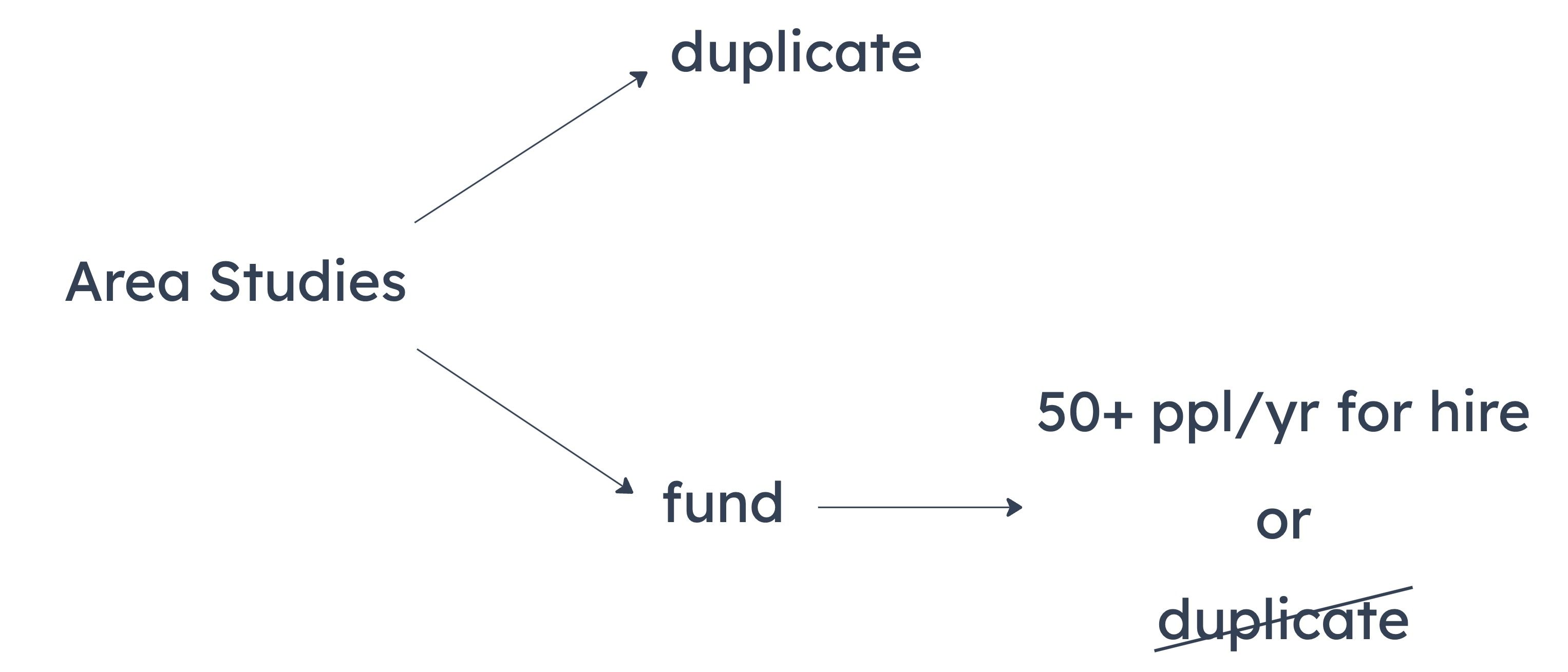
Notable Valid Inferences

Some proposals duplicate more than 25% of the material covered in an existing department and are still funded.

There are 50+ people per year available for hire in the field of Area Studies.

A
The field of Area Studies has at least 50 people per year available for hire.

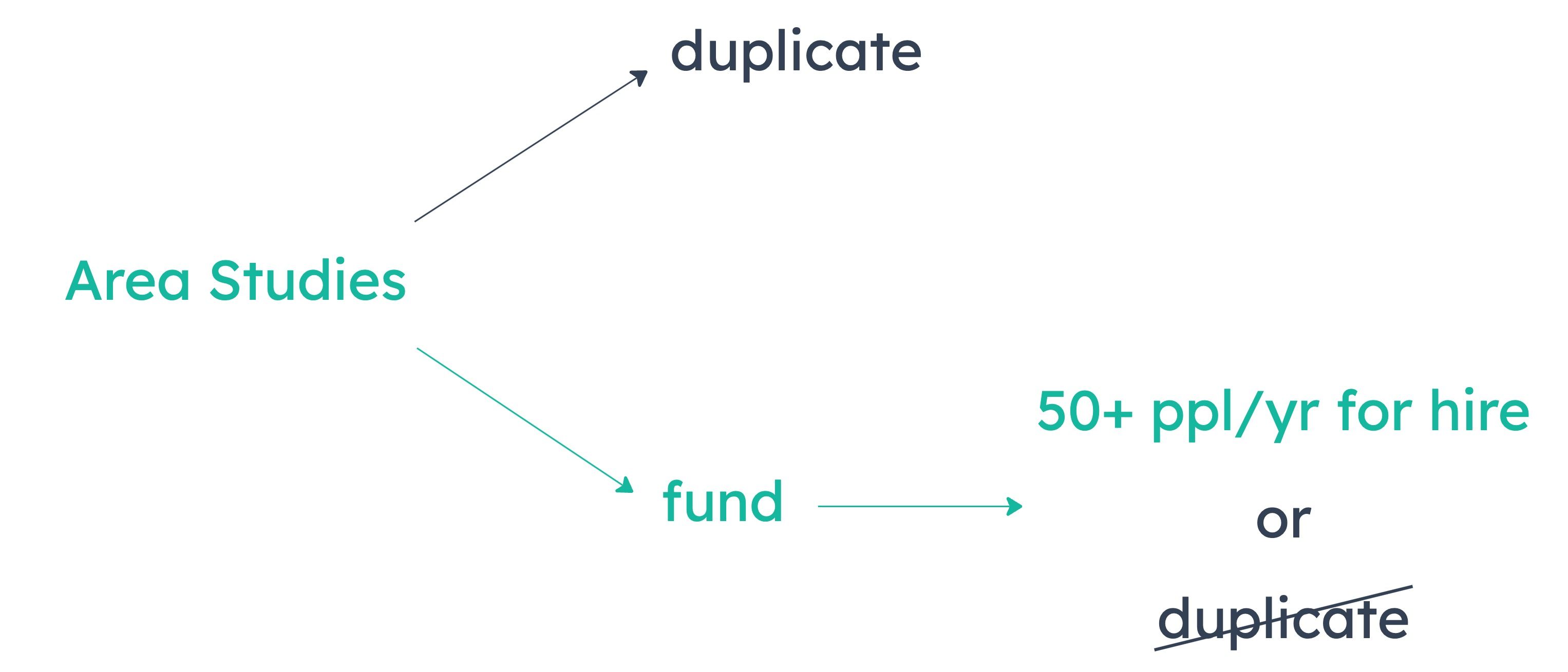
Must be true. The necessary condition for funding is: the department must not duplicate >25% of an existing department’s material, or the hiring availability threshold of 50/year must be met. The proposal duplicates >25% and will be funded, so the hiring condition must be true.
B
The proposed Area Studies Department would not duplicate more than 25 percent of the material covered in any existing department other than Anthropology.

Could be false. We have no information about whether the proposed Area Studies Department duplicates material covered in any existing department other than Anthropology, and the stimulus gives us no way to draw this inference.

C
If the proposed Area Studies Department did not duplicate more than 25 percent of the material covered in Anthropology, then the new department would not be funded.

Could be false. “/Duplicate” is not a sufficient condition for funding, so we can’t infer anything about whether the Area Studies Department would be funded if it did not duplicate more than 25% of the material covered in Anthropology (or any other department).

D
The Anthropology Department duplicates more than 25 percent of the material covered in the proposed Area Studies Department.

Could be false. If there’s more material covered in the proposed Area Studies Department than there is in the Anthropology Department, it’s possible that the Anthropology material could fail to duplicate more than 25% of the Area Studies material.

E
The field of Area Studies has fewer than 50 people per year available for hire.

Must be false. The necessary condition for funding is: the department must not duplicate >25% of an existing department’s material, or the hiring availability threshold of 50/year must be met. The proposal duplicates >25%, so there must be 50+ people available to hire per year.


24 comments

Researchers announced recently that over the past 25 years the incidence of skin cancer caused by exposure to harmful rays from the sun has continued to grow in spite of the increasingly widespread use of sunscreens. This shows that using sunscreen is unlikely to reduce a person’s risk of developing such skin cancer.

Summarize Argument
The author concludes that using sunscreen probably won’t reduce the risk of skin cancer. She bases this on research showing that skin cancer has increased over the same 25-year time frame sunscreen use has increased.

Notable Assumptions
Based on a positive correlation between sunscreen use and skin cancer, the author assumes the former isn’t preventing or mitigating the latter. She evidently doesn’t believe rates of skin cancer would’ve been even higher without sunscreen. The author also believes that the 25-year time frame in question is adequate to draw conclusions about the effects of sunscreen on skin cancer rates. She must believe skin cancer develops fairly quickly, rather than as a latent effect of too much sun exposure.

A
Most people who purchase a sunscreen product will not purchase the most expensive brand available.
The author doesn’t care about how much sunscreens cost.
B
Skin cancer generally develops among the very old as a result of sunburns experienced when very young.
The study doesn’t account for most instances of skin cancer: those that develop over a lifetime. Thus, the increased use of sunscreen in the last 25 years will only show up in skin cancer data much further down the road.
C
The development of sunscreens by pharmaceutical companies was based upon research conducted by dermatologists.
Perhaps dermatologists missed the mark. The study shows skin cancer and sunscreen use increasing over the same time frame.
D
People who know that they are especially susceptible to skin cancer are generally disinclined to spend a large amount of time in the sun.
We need to weaken the connection between sunscreen use and skin cancer that shows up in the study. This simply says a particularly vulnerable group is unlikely to be out in the sun.
E
Those who use sunscreens most regularly are people who believe themselves to be most susceptible to skin cancer.
We don’t know if these people end up getting skin cancer or not. This doesn’t tell us sunscreen is in fact likely to help prevent skin cancer, which is what would weaken the author’s claim.

34 comments

Paleontologists recently excavated two corresponding sets of dinosaur tracks, one left by a large grazing dinosaur and the other by a smaller predatory dinosaur. The two sets of tracks make abrupt turns repeatedly in tandem, suggesting that the predator was following the grazing dinosaur and had matched its stride. Modern predatory mammals, such as lions, usually match the stride of prey they are chasing immediately before they strike those prey. This suggests that the predatory dinosaur was chasing the grazing dinosaur and attacked immediately afterwards.

Summarize Argument
The argument concludes that the predatory dinosaur likely chased and attacked a grazing dinosaur. This is supported by an analogy drawn to other predatory animals who also match their prey’s stride just prior to attacking.

Identify Argument Part
This is the key feature that links the behavior of the dinosaurs with the analogy drawn to modern mammals.

A
It helps establish the scientific importance of the argument’s overall conclusion, but is not offered as evidence for that conclusion.
This *does* serve as evidence for the conclusion. The fact that they have matching strides is used to draw the analogy to other predators
B
It is a hypothesis that is rejected in favor of the hypothesis stated in the argument’s overall conclusion.
This is not rejected by the author. The author believes this is true and uses it to draw an analogy to support their conclusion.
C
It provides the basis for an analogy used in support of the argument’s overall conclusion.
This statement is used as a point of comparison between other predatory mammals in the dinosaur. Thus, it is the basis for this analogy to support the conclusion
D
It is presented to counteract a possible objection to the argument’s overall conclusion.
This does not anticipate or counteract an objection. It is part of the reasoning that creates the analogy and supports the conclusion.
E
It is the overall conclusion of the argument.
This is not the conclusion of the argument. This is used to support the main conclusion that the predator dinosaur attacked the grazing dinosaur.

7 comments

A recent study of perfect pitch—the ability to identify the pitch of an isolated musical note—found that a high percentage of people who have perfect pitch are related to someone else who has it. Among those without perfect pitch, the percentage was much lower. This shows that having perfect pitch is a consequence of genetic factors.

Summarize Argument: Phenomenon-Hypothesis
The author concludes that perfect pitch is a result of genetics. She supports this hypothesis by pointing to a correlation: those with perfect pitch tend to also have relatives with perfect pitch.

Notable Assumptions
The author assumes that perfect pitch is something that can be inherited genetically. She also assumes that there are no alternative hypotheses to explain the observed correlation—that is, she assumes that there are no other, non-genetic factors that could lead to sets of relatives all sharing perfect pitch.

A
People who have relatives with perfect pitch generally receive no more musical training than do others.
This rules out the alternative hypothesis that musical training, rather than genetics, is the reason why perfect pitch tends to run in the family.
B
All of the researchers conducting the study had perfect pitch.
Irrelevant. The argument centers on whether the results of the study suggest that perfect pitch is due to genetic factors. Whether the researchers also had perfect pitch has no bearing on the study’s results or the conclusions that can be drawn from those results.
C
People with perfect pitch are more likely than others to choose music as a career.
This fails to address why perfect pitch tends to run in families, or to suggest that genetics are indeed the cause.
D
People with perfect pitch are more likely than others to make sure that their children receive musical training.
This weakens the argument by suggesting an alternative hypothesis: musical training, rather than genetics, may be the reason why perfect pitch tends to be shared by certain relatives.
E
People who have some training in music are more likely to have perfect pitch than those with no such training.
This fails to address why perfect pitch tends to run in families, or to suggest that genetics are indeed the cause.

2 comments

Marine biologist: Scientists have long wondered why the fish that live around coral reefs exhibit such brilliant colors. One suggestion is that coral reefs are colorful and, therefore, that colorful fish are camouflaged by them. Many animal species, after all, use camouflage to avoid predators. However, as regards the populations around reefs, this suggestion is mistaken. A reef stripped of its fish is quite monochromatic. Most corals, it turns out, are relatively dull browns and greens.

Summarize Argument: Counter-Position
The marine biologist claims the suggestion that the fish who live around coral reefs are colorful because the coral reefs are colorful, and it allows them to camouflage, is mistaken. It is the fish, not the coral, that are colorful. The coral itself is monochromatic and made up of dull browns and greens.

Identify Conclusion
The conclusion is the marine biologist’s refutation of the hypothesis about colorful reefs and camouflage: “this suggestion is mistaken.”

A
One hypothesis about why fish living near coral reefs exhibit such bright colors is that the fish are camouflaged by their bright colors.
This rephrases the suggestion in the context that the marine biologist refutes. She is saying this is inaccurate because the reefs are not actually brightly colored.
B
The fact that many species use camouflage to avoid predators is one reason to believe that brightly colored fish living near reefs do too.
This is context for the mistaken argument. It is reasoning that supports the use of camouflage, but it ultimately does not apply because the reefs are not brightly colored.
C
The suggestion that the fish living around coral reefs exhibit bright colors because they are camouflaged by the reefs is mistaken.
This accurately rephrases the conclusion. “It” - the suggeston that the fish are brightly colored because they camouflage with brightly colored reefs - “is mistaken”
D
A reef stripped of its fish is relatively monochromatic.
This is support for why the bright colors of the fish would not actually be camouflaged by the reefs.
E
It turns out that the corals in a coral reef are mostly dull hues of brown and green.
This is more support that shows why the reef is monochromatic and not brightly colored. This further supports that the brightly colored fish would not be camouflaged by the reefs.

2 comments