A
The drug company has invested heavily in its newest product, and losses due to this product would be harmful to the company’s profits.
B
Many new products fail whether or not they are supported by marketing campaigns.
C
The drug company should not undertake a new marketing campaign for its newest product if the campaign has no chance to succeed.
D
Undertaking a new marketing campaign would endanger the drug company’s overall position by necessitating cutbacks in existing marketing campaigns.
E
Consumer demand for the drug company’s other products has been strong in the time since the company’s newest product was introduced.
Large nurseries -most-> guarantee disease-free plants.
If Wally’s plants is a large nursery, it probably broke its guarantee.
A
If Johnson is a commercial raspberry grower and Wally’s Plants is not a large nursery, then the shipment of raspberry plants that Johnson received was probably guaranteed to be disease-free.
B
Johnson is probably not a commercial raspberry grower if the shipment of raspberry plants that Johnson received from Wally’s Plants was not entirely as it was guaranteed to be.
C
If Johnson is not a commercial raspberry grower, then Wally’s Plants is probably not a large nursery.
D
Wally’s Plants is probably not a large, well-run nursery if it sells its raspberry plants primarily to commercial raspberry growers.
E
If Wally’s Plants is a large nursery, then the raspberry plants that Johnson received in the shipment were probably not entirely as they were guaranteed to be.
Astronomer: Earlier estimates of the distances of certain stars from Earth would mean that these stars are about 1 billion years older than the universe itself, an impossible scenario. My estimates of the distances indicate that these stars are much farther away than previously thought. And the farther away the stars are, the greater their intrinsic brightness must be, given their appearance to us on Earth. So the new estimates of these stars’ distances from Earth help resolve the earlier conflict between the ages of these stars and the age of the universe.
"Surprising" Phenomenon
Why does knowing these stars are farther from Earth resolve the discrepancy between their age and the age of the universe?
Objective
Any hypothesis explaining why this conflict is resolved must imply that the stars are younger than previously estimated or that the universe is older than previously estimated. Correcting the distances of these stars from Earth was enough to resolve the conflict, so the correct answer must imply that more distant stars imply an older universe or that knowing stars are more distant allows scientists to know they are younger.
A
The stars are the oldest objects yet discovered in the universe.
This does not state that the universe is older than previously estimated, nor does it provide a reason for concluding so. It remains unexplained why updating the stars’ distances resolves the apparent conflict between the age of the stars and the age of the universe.
B
The younger the universe is, the more bright stars it is likely to have.
This makes the resolution more surprising. Since the stars are more distant, they have a greater inherent brightness to achieve the same apparent brightness here on Earth. Therefore, this suggests the universe should be younger than previously estimated, not older.
C
The brighter a star is, the younger it is.
This explains why correcting the stars’ distances resolves the conflict. If the stars are more distant than believed, they must have a greater intrinsic brightness to achieve the same apparent brightness. This means they are younger than the earlier estimates suggest.
D
How bright celestial objects appear to be depends on how far away from the observer they are.
This is not enough information to explain why the conflict is resolved. It is a generalization of the astronomer’s claim that farther stars must have a greater intrinsic brightness to achieve the same apparent brightness on Earth.
E
New telescopes allow astronomers to see a greater number of distant stars.
This is irrelevant information. Improved telescopes may explain how the stars’ distances were corrected, but not how that correction resolves the conflict regarding their age.
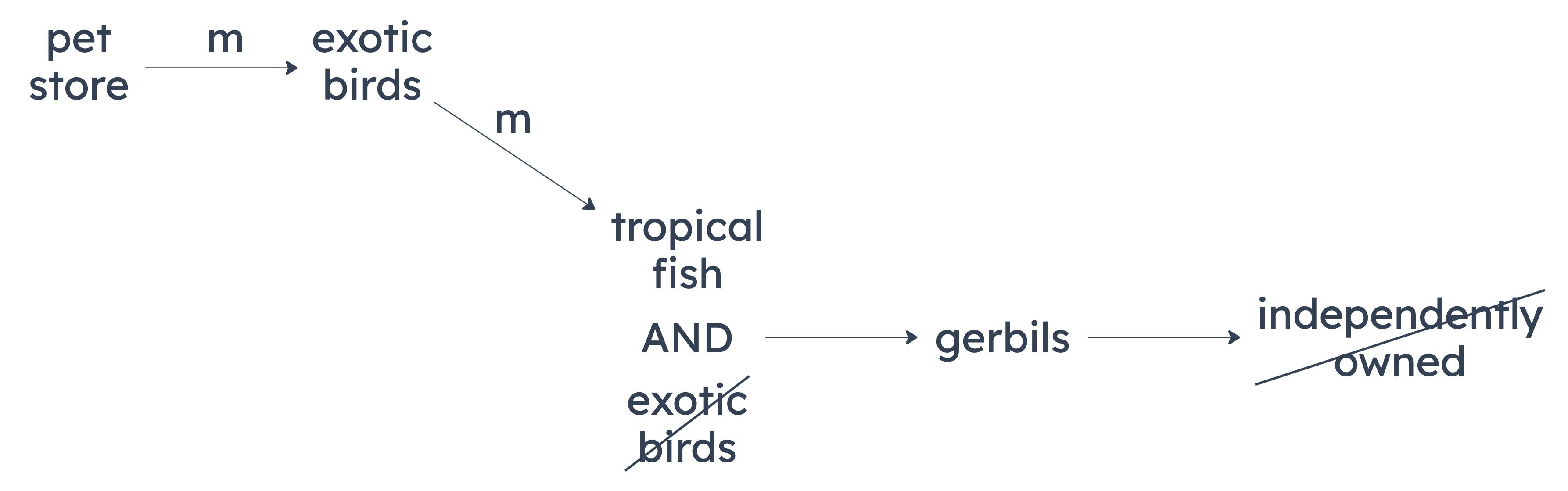
In West Calverton, most pet stores sell exotic birds, and most of those that sell exotic birds also sell tropical fish. However, any pet store there that sells tropical fish but not exotic birds does sell gerbils; and no independently owned pet stores in West Calverton sell gerbils.
Summary
The stimulus can be diagrammed as follows:
Notable Valid Inferences
No West Calverton pet store that sells tropical fish but not exotic birds is independently owned.
All independently owned West Calverton pet stores either sell exotic birds or don’t sell tropical fish.
A
Most pet stores in West Calverton that are not independently owned do not sell exotic birds.
Could be false. The stimulus never has “pet stores in West Calverton that are not independently owned” as a sufficient condition, so we can’t make any valid inferences about the percentage of those stores that do or don’t sell exotic birds.
B
No pet stores in West Calverton that sell tropical fish and exotic birds sell gerbils.
Could be false. As shown below, answer choice (B) is a conditional statement that uses “tropical fish and exotic birds” as its sufficient condition. But the stimulus doesn’t say anything about pet stores that sell tropical fish and exotic birds!

C
Some pet stores in West Calverton that sell gerbils also sell exotic birds.
Could be false. All we know about pet stores in West Calverton that sell gerbils is that they’re not independently owned. We have no information about whether or not some might also sell exotic birds!
D
No independently owned pet store in West Calverton sells tropical fish but not exotic birds.
Must be true. As shown below, by chaining the conditional claims, we see that “not selling tropical fish or selling exotic birds” is a necessary condition of being an independently owned pet store in West Calverton.

E
Any independently owned pet store in West Calverton that does not sell tropical fish sells exotic birds.
Could be false. Any independently owned pet store in West Calverton must either not sell tropical fish or sell exotic birds, but that means these stores could do any of the following: not sell tropical fish, sell exotic birds, or both sell exotic birds AND not sell tropical fish.
Vanessa: All computer code must be written by a pair of programmers working at a single workstation. This is needed to prevent programmers from writing idiosyncratic code that can be understood only by the original programmer.
Jo: Most programming projects are kept afloat by the best programmers on the team, who are typically at least 100 times more productive than the worst. Since they generally work best when they work alone, the most productive programmers must be allowed to work by themselves.
Summary
Vanessa believes that all computer code must be written by two programmers who collaborate at the same work station.
Vanessa’s belief is based on her assertion that collaboration prevents programmers from writing code that only they can understand.
Jo believes that the most productive programmers must be allowed to work by themselves.
Jo’s belief is based on two assertions: that the best programmers keep most programming projects afloat through their prolificness, and that these most productive programmers generally work better solo.
Notable Valid Inferences
The correct answer will describe an assignment that violates either Jo’s principle, Vanessa’s principle, or both principles. To violate Jo’s principle, the right answer would have to describe an assignment in which the most productive programmer on a team is forced to work collaboratively. To violate Vanessa’s principle, the right answer would have to describe an assignment wherein computer code is produced by someone other than a pair of programmers working at the same work station.
A
Olga and Kensuke are both programmers of roughly average productivity who feel that they are more productive when working alone. They have been assigned to work together at a single workstation.
Consistent with both principles. Because Olga and Kensuke are assigned to work together at a single workstation, the assignment satisfies Vanessa’s principle. Because they’re not the most productive programmers, Jo’s principle doesn’t mandate that they be permitted to work solo.
B
John is experienced but is not among the most productive programmers on the team. He has been assigned to mentor Tyrone, a new programmer who is not yet very productive. They are to work together at a single workstation.
Consistent with both principles. Because John and the new programmer are assigned to work together at a single workstation, the assignment satisfies Vanessa’s principle. Because they’re not the most productive programmers, Jo’s principle doesn’t apply.
C
Although not among the most productive programmers on the team, Chris is more productive than Jennifer. They have been assigned to work together at a single workstation.
Consistent with both principles. Because Chris and Jennifer are assigned to work together at a single station, the assignment satisfies Vanessa’s principle. Because they’re not the most productive programmers, Jo’s principle doesn’t mandate that they be permitted to work solo.
D
Yolanda is the most productive programmer on the team. She has been assigned to work with Mike, who is also very productive. They are to work together at the same workstation.
Inconsistent with Jo’s principle. Because Yolanda is the most productive programmer on the team, any assignment that is consistent with Jo’s principle must allow her to work alone.
E
Kevin and Amy both have a reputation for writing idiosyncratic code; neither is unusually productive. They have been assigned to work together at the same workstation.
Consistent with both principles. Because Kevin and Amy are assigned to work together at a single workstation, the assignment satisfies Vanessa’s principle. Because they’re not the most productive programmers, Jo’s principle doesn’t mandate that they be permitted to work solo.
Ultimately the argument can be diagrammed, although most would find it difficult to translate the conclusion:
Premise: happiness → health
Conclusion: acquire money → NOT sacrifice health (in other words, have health)
Missing link: acquire money → happiness
A
Money should be acquired only if its acquisition will not make happiness unobtainable.
B
In order to be happy one must have either money or health.
C
Health should be valued only as a precondition for happiness.
D
Being wealthy is, under certain conditions, conducive to unhappiness.
E
Health is more conducive to happiness than wealth is.
This is a tough SA question that doesn't make itself easily translatable into Lawgic.
The argument in the stimulus:
(Premise) without health, happiness is not obtainable
(Premise, using Group 3 translation) happiness --> not sacrifice health [meaning you have health or you are healthy]
___________
(Conclusion) never sacrifice health to acquire money
(Conclusion, using Group 4 translation) acquire money --> not sacrifice health
So what's missing?
(sufficient assumption) acquire money --> happiness
(sufficient assumption) acquire money only if not make happiness unobtainable. The double negation "not" and "un" cancel out.
Together, we get:
acquire money --> happiness --> not sacrifice health
___________
acquire money --> not sacrifice health
A
The study relied on the subjects’ self-reporting to determine whether or not they snored frequently.
B
The patients’ throat surgery was not undertaken to treat abnormalities in their throat muscles.
C
All of the test subjects were of similar age and weight and in similar states of health.
D
People who have undergone throat surgery are no more likely to snore than people who have not undergone throat surgery.
E
The abnormalities in the throat muscles discovered in the study do not cause snoring.
A
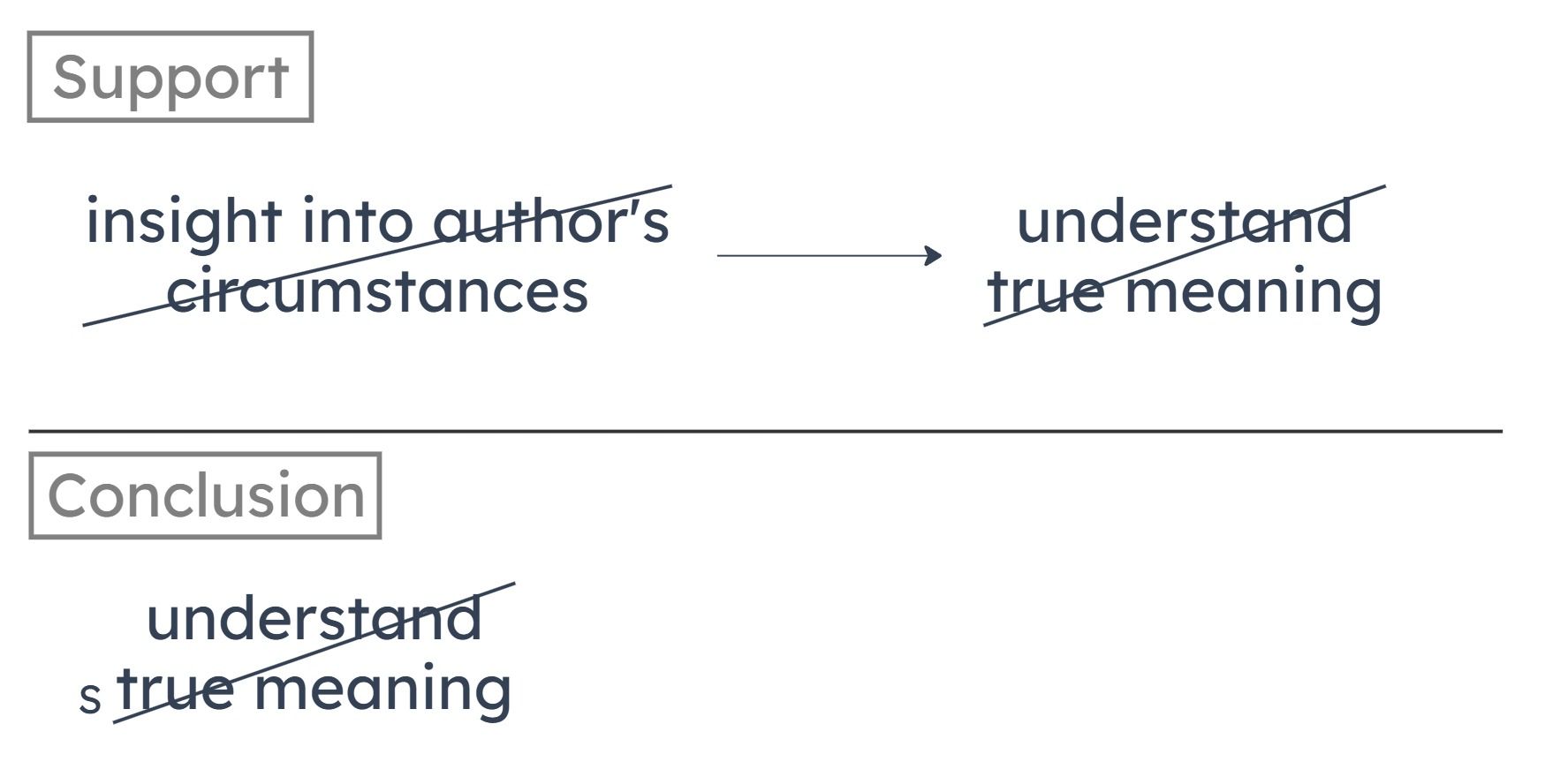
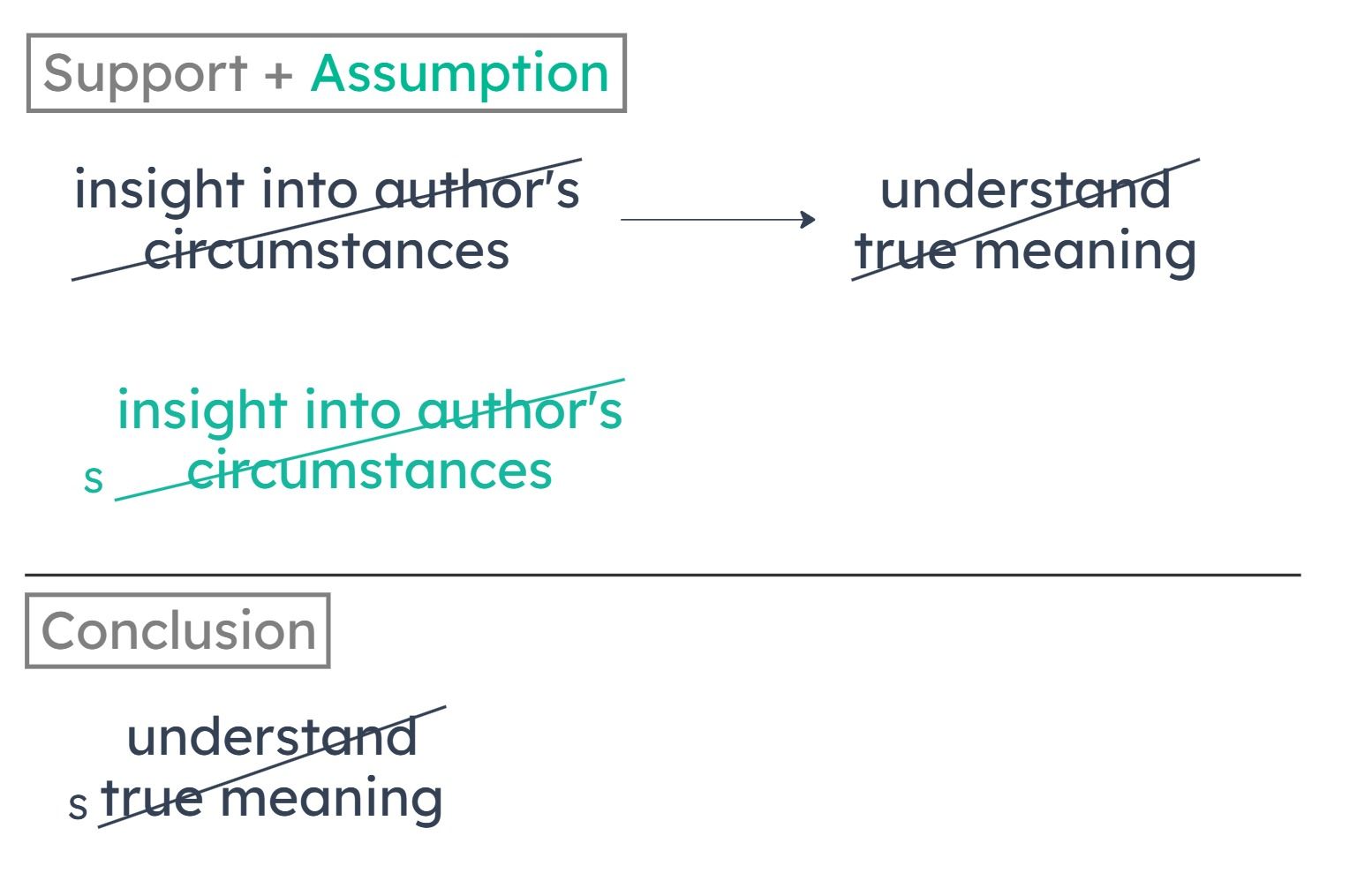
Insight into the intended meaning of an author’s work is not as important as insight into its true meaning.
B
Smith lacks insight into her own social circumstances.
C
There is just one meaning that Smith intends her work to have.
D
Smith’s theory about the relation of social circumstances to the understanding of meaning lacks insight.
E
The intended meaning of an author’s work is not always good evidence of its true meaning.
Music critic: But rap appeals to tradition by using bits of older songs. Besides, the themes and styles of rap have developed into a tradition. And successful rap musicians do not perform purely idiosyncratically but conform their work to the preferences of the public.