Summarize Argument
The author concludes that parents should not trust their own abilities to rate the educational value of children’s shows if educational psychologists rate them accurately. This is because, in a relevant study, parents largely ignored the views of such psychologists when rating the shows.
Identify and Describe Flaw
The problem with this argument is that it assumes that the parents’ ratings differ from those of the psychologists. If the parents’ ratings of the value of children’s shows are similar to the psychologists’, then the psychologists’ views being sound actually gives parents a reason to trust their own judgment.
A
relies on a sample that is likely to be unrepresentative of the population with which the conclusion is concerned
Both the study and the conclusion are focused on parents, so there’s no reason to believe that the sample in the study is unrepresentative.
B
takes for granted that parents do not enjoy the same sort of children’s television shows that children themselves enjoy
This is irrelevant. The conclusion is just that parents shouldn’t trust their own abilities to rate shows if the psychologists rate them accurately, so it doesn’t matter what children enjoy.
C
takes for granted that the educational value of a television show should be the only consideration for a parent trying to decide whether a child should watch the show
The conclusion is only concerned with parents’ ability to rate the educational value of children’s shows, so reasons why children should or shouldn’t watch a show are irrelevant.
D
fails to rule out the possibility that parents’ ratings of the shows based on their own enjoyment coincide closely with the educational psychologists’ views of the shows’ educational values
This describes how the argument fails to establish that the psychologists give different ratings than the parents do. If they rate shows similarly, then psychologists having accurate ratings would mean that parents do too.
E
takes for granted that educational psychologists are the only people who can judge the educational value of children’s television shows with a high degree of accuracy
The argument doesn’t assume that psychologists can judge children’s shows’ value accurately, let alone that they’re the only ones who can. The conclusion only claims that if psychologists’ ratings are accurate, then parents shouldn’t trust their own ratings.
Summarize Argument
The claim that there’s no connection between astrological signs and personality types is scientifically unjustified. Why? Well, science can’t precisely distinguish personality types, so scientific studies can’t prove or disprove anything about personality types. We don’t know enough about personality types to use them in any legitimate scientific process.
Identify Argument Part
The referenced text supports the conclusion. Why is the claim scientifically unjustified? Because scientific studies can’t be used to disprove a correlation between astrological signs and personality types.
A
It is a claim offered as support for a conclusion that is in turn offered as support for the overall conclusion drawn in the argument.
The referenced text only supports the main conclusion. It’s supported by another premise.
B
It is a conclusion for which support is offered and that in turn is offered as support for the overall conclusion drawn in the argument.
The referenced text is supported by another premise—that science doesn’t have precise criteria for distinguishing personality types—which makes it a conclusion. And it supports the main conclusion, which makes it a sub-conclusion. This is perfect.
C
It is the overall conclusion drawn in the argument.
The overall conclusion is that the claim about astrology and personality types is unjustified. The referenced text supports that claim.
D
It summarizes a position that the argument as a whole is directed toward discrediting.
The argument is trying to discredit the theory that astrology has no correlation to personality types. The referenced text isn’t summarizing that position.
E
It provides a specific instance of the general principle that the argument as a whole is directed toward establishing.
The referenced text isn’t a specific instance of anything. It’s a claim about whether or not science can draw conclusions about personality types.
Summarize Argument
If scientists keep focusing only on making artificial intelligence really good at solving problems, they won't be able to create truly smart machines. Right now, scientists are focusing solely on computational ability and ignoring other abilities. A machine that can only compute but does nothing else won't be truly intelligent, just like a person with no emotions wouldn't be fully smart.
Identify Conclusion
The argument’s main conclusion is that if the focus of artificial intelligence research is not broadened beyond improving machines' computational ability, then such research will not produce truly intelligent machines.
A
The current focus of research into artificial intelligence will produce devices no more capable of displaying true intelligence than a person would be who lacked emotions and other noncognitive responses.
This is a premise. It supports the conclusion by highlighting the limitations of focusing only on computational ability in AI research. It suggests that ignoring other skills will result in devices as limited as a person lacking emotions, underscoring the need for broader focus.
B
If the current focus of research into artificial intelligence is not radically changed, this research will not be able to produce machines capable of true intelligence.
This captures the argument’s main conclusion. It paraphrases its central point: without a significant shift in the current focus of artificial intelligence research, which is too narrowly centered on computational ability, researchers will not create truly intelligent machines.
C
Despite progress in creating machines of great computational sophistication, current research into artificial intelligence has failed to fulfill its objectives.
The stimulus doesn't make this argument. It only states that current research has not created true intelligence but does not discuss the objective of AI research. While the author might agree with this goal, the author doesn’t make this claim in the stimulus.
D
The capacity to express noncognitive responses such as emotion is at least as important for true intelligence as is computational sophistication.
The stimulus doesn’t make this claim. It states that truly intelligent machines need more than computational ability, like humans need more than cognitive responses, but it doesn’t compare their importance or argue that true machine intelligence requires noncognitive responses.
E
If a machine is not capable of producing humanlike noncognitive responses, then it cannot be regarded as truly intelligent.
The stimulus does not make this claim. The stimulus states that truly intelligent machines need more than computational ability, like humans need more than cognitive responses, but the stimulus does not argue that true machine intelligence requires noncognitive responses.
Summary
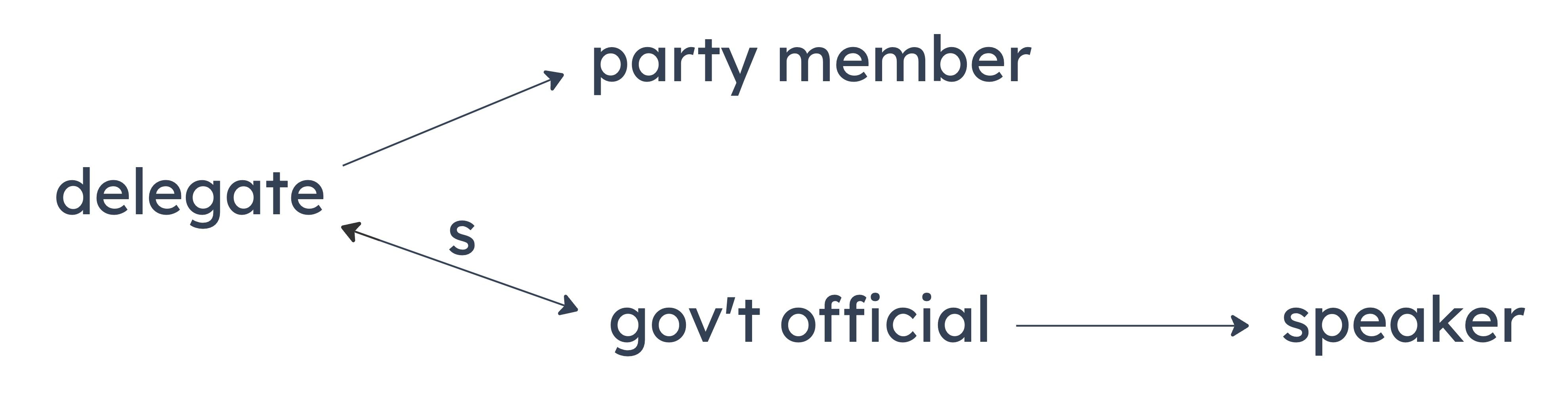
The stimulus can be diagrammed as follows:
Notable Valid Inferences
Some party members are government officials.
Some party members are speakers at the convention.
Some delegates to the convention are speakers at the convention.
Some party members are speakers at the convention.
Some delegates to the convention are speakers at the convention.
A
Every party member at the convention is a delegate to the convention.
Could be false. While we know that every delegate is a party member, we do not know whether every party member is a delegate. There might be more party members than delegates! (A) confuses the necessary and sufficient conditions.
B
At least some speakers at the convention are neither delegates nor party members.
Could be false. We know that some speakers at the convention are delegates and party members, and those speakers could easily constitute the entire lineup! There could also be other speakers, but there don’t have to be.
C
At least some speakers at the convention are delegates to the convention.
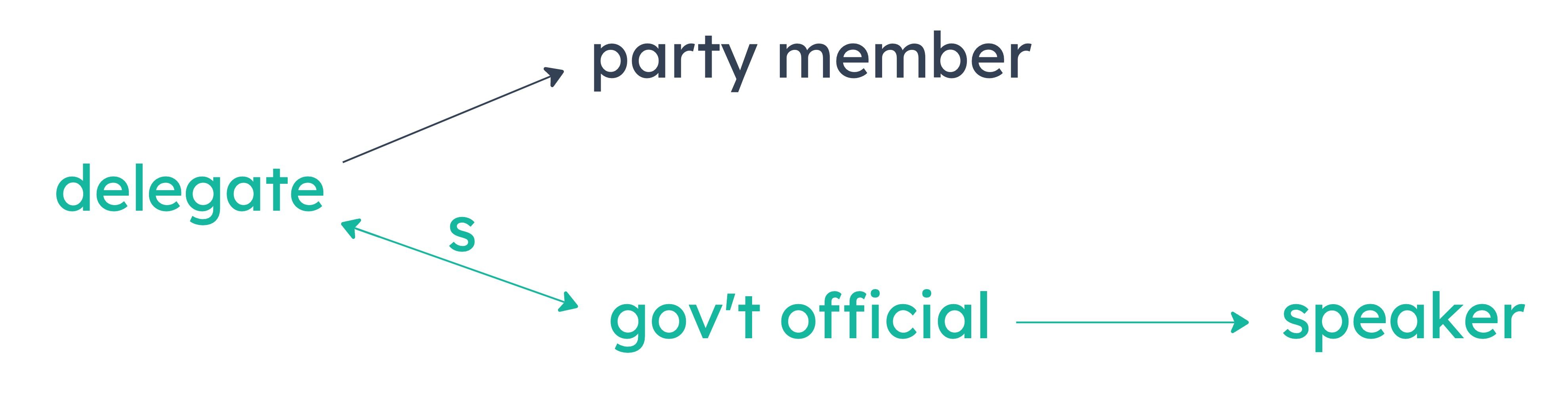
Must be true. As shown below, by chaining the conditional claims, we see that there is a “some before all” relationship between “delegate” and “speaker”. This yields the valid conclusion that at least some delegates are speakers and vice versa.
D
All speakers at the convention are government officials.
Could be false. While we know that every government official at the convention is a speaker, we do not know whether every speaker is a government official. There might be more speakers than government officials! (D) confuses the necessary and sufficient conditions.
E
Every government official at the convention is a party member.
Could be false. We know that some government officials at the convention are party members, because all delegates are party members and some delegates are government officials. Yet it’s possible that there are also government officials at the convention who are not party members.
Summarize Argument: Causal Explanation
It would have been smarter to buy a tree last summer instead of this summer. The tree we bought this summer is struggling to survive because of the drought, but if we had bought it last summer, it would have received enough water from last summer’s normal rainfall to grow strong roots, which can better survive droughts.
Identify Conclusion
The conclusion is Brianna’s opinion that it would have been better to buy a tree last summer rather than waiting until this summer.
A
It would have been better to buy a tree last summer rather than this summer.
This statement captures Brianna’s conclusion that buying the tree last summer would have been smarter. The rest of her argument explains why: the tree would have developed strong roots with the previous summer’s normal rainfall, making it more resilient to this summer’s drought.
B
The tree purchased this summer is struggling to survive this summer’s drought.
This is a premise. It supports the conclusion by showing the downside of buying the tree this summer. The tree’s struggle highlights that if they had bought it last summer, it would have developed stronger roots with the normal rainfall, helping it survive this summer's drought.
C
If a tree had been purchased last summer, it would be better able to survive this summer’s drought.
This premise supports the conclusion by highlighting the benefit of buying the tree last summer. It suggests that a tree bought last summer would have grown stronger roots and better survived this summer's drought, reinforcing that buying it last summer would have been wiser.
D
A tree purchased last summer would have established roots.
This is a premise. It supports the conclusion by highlighting the benefit of buying the tree last summer. A tree with more established roots would have better survived this summer's drought, reinforcing that buying a tree last summer would have been wiser.
E
Trees with established roots can better withstand droughts.
This premise supports the main conclusion by explaining why buying the tree last summer would have been smarter. With established roots from last summer, the tree would be stronger and more resilient to this summer's drought. Thus, buying it last summer was the wiser choice.
Summarize Argument
The cartographer concludes that we shouldn’t think people aren’t misled by maps, even though they’re rarely misled by words. People are taught to be cautious about language, but there’s virtually no education about maps.
Identify Argument Part
The referenced text supports the conclusion. It’s part of a distinction that shows why conclusions about how people process language can’t be applied to how people process maps.
A
It is offered as an analogical case that helps to clarify the meaning of the argument’s conclusion.
The cartographer is arguing that a conclusion can’t be drawn from the analogy between maps and language. The referenced text doesn’t clarify the meaning of the argument’s conclusion—it helps spell out why maps and language are dissimilar cases.
B
It is a conclusion drawn from the claim that education in the sophisticated use of maps is almost nonexistent.
The referenced text isn’t a conclusion. There’s no support for the claim that people are taught to be cautious interpreters of language.
C
It is part of a distinction drawn in order to support the argument’s conclusion.
The referenced text distinguishes how people are educated in language from how people are educated in maps. In turn, this distinction supports the conclusion that we shouldn’t assume people won’t be misled by maps simply because they’re not misled by language.
D
It is offered as support for the contention that maps have certain relevant similarities to language.
We don’t have relevant similarities here. Instead, we have relevant dissimilarities in how people are educated. The referenced text helps demonstrate those.
E
It is the conclusion drawn in the argument.
There’s no support for the referenced text, so it can’t be a conclusion. Instead, it’s support for the linguist’s main conclusion—we shouldn’t believe most people aren’t susceptible to being misled by maps.