Editorial: The legislature is considering allowing oil drilling in the Cape Simmons Nature Preserve. Supporters claim that, because modern drilling methods will be used, there will be no damage to the environment. However, that claim is easily disproven by looking at nearby Alphin Bay, where oil drilling began five years ago. The land there is marred by industrial sprawl, drilling platforms, and thousands of miles of roads and pipelines.

Summarize Argument
The editorialist concludes that, despite using modern drilling methods, oil drilling will cause environmental damage in Cape Simmons Nature Preserve. This claim is backed up by a comparison to an analogous case in Alphin Bay, where drilling which began five years ago has caused significant damage.

Notable Assumptions
The editorialist assumes that Cape Simmons and Alphin Bay are relevantly analogous. In other words, the land in Cape Simmons would suffer similar effects to Alphin Bay. This includes the assumption that modern oil drilling methods were used in Alphin Bay.

A
The Cape Simmons Nature Preserve is one of the few areas of pristine wilderness in the region.
The number of other areas of pristine wilderness in the region is irrelevant to whether the Cape Simmons Nature Preserve will suffer environmental damage from oil drilling.
B
The companies drilling for oil at Alphin Bay never claimed that drilling there would not cause any environmental damage.
Oil drilling companies’ claims about the effects of drilling in Alphin Bay are irrelevant to the editorialist’s argument about the effects of drilling in Cape Simmons.
C
The editorialist believes that oil drilling should not be allowed in a nature preserve unless it would cause no environmental damage.
The editorialist makes no claims about whether oil drilling should or should not be allowed due to causing environmental damage, only whether it will cause environmental damage in the first place.
D
There have been no significant changes in oil drilling methods in the last five years.
This justifies the editorialist’s assumption that the likely effects of oil drilling in Cape Simmons can be predicted from its effects in Alphin Bay, as the same modern drilling methods would be used in both cases.
E
Oil drilling is only one of several industrial activities that takes place at Alphin Bay.
This claim would potentially weaken the argument, as it provides possible alternate explanations for the environmental damage at Alphin Bay—namely, the other industrial activities taking place there. It certainly doesn’t strengthen.

7 comments

Columnist: An information design expert has argued that using the popular presentation-graphics software GIAPS, with its autopresentation wizard and simplistic premade templates, leads people to develop ineffective presentations. But that is absurd. GIAPS is just a tool, so it cannot be responsible for bad presentations. The responsibility must lie with those who use the tool poorly.

Summarize Argument: Counter-Position
The author concludes that the responsibility for bad presentations that use GIAPS lies with the users, not with GIAPS. This is based on the fact that GIAPS is just a software tool. The author believes this supports the subsidiary conclusion that GIAPS can’t be responsible for bad presentations.

Identify and Describe Flaw
The author assumes that a tool can’t be responsible for bad presentations. This overlooks the possibility that a tool might lead people into making bad presentations. A tool can be hard to use or poorly designed, causing users to use it ineffectively.

A
bases its conclusion on claims that are inconsistent with each other
The claim that GIAPS is a tool does not contradict the claim that GIAPS can’t be responsible for bad presentations. The supporting claims are not inconsistent with each other.
B
takes for granted that any presentation that is not ineffective is a good presentation
The author arguably assumes that presentations that are ineffective are bad. But this doesn’t imply that the author believes presentations that are not ineffective are good. The author doesn’t make any assumptions about what constitutes good presentations.
C
bases an endorsement of a product entirely on that product’s popularity
The author’s conclusion is not an “endorsement” of a product. The author doesn’t say that GIAPS is good or that people should buy GIAPS. The conclusion is only that GIAPS is not responsible for bad presentations.
D
fails to consider that a tool might not effectively perform its intended function
The author overlooks the possibility that tools might not do what they’re supposed to. Perhaps GIAPS is poorly designed and causes people to make ineffective presentations. This is why the fact GIAPS is a tool does not absolve it of potential responsibility for bad presentations.
E
rejects a claim because of its source rather than its content
The author doesn’t reject the claim of the information expert because of some character/background feature of the expert. The author’s conclusion is based on the fact GIAPS is a tool.

14 comments

The television star Markus Hermann refuses to grant interviews with newspapers unless he is given the right to approve the article before publication. The Greyburg Messenger newspaper refuses to do anything that its editors believe will compromise their editorial integrity. So the Messenger will not interview Hermann, since _______.

Summary

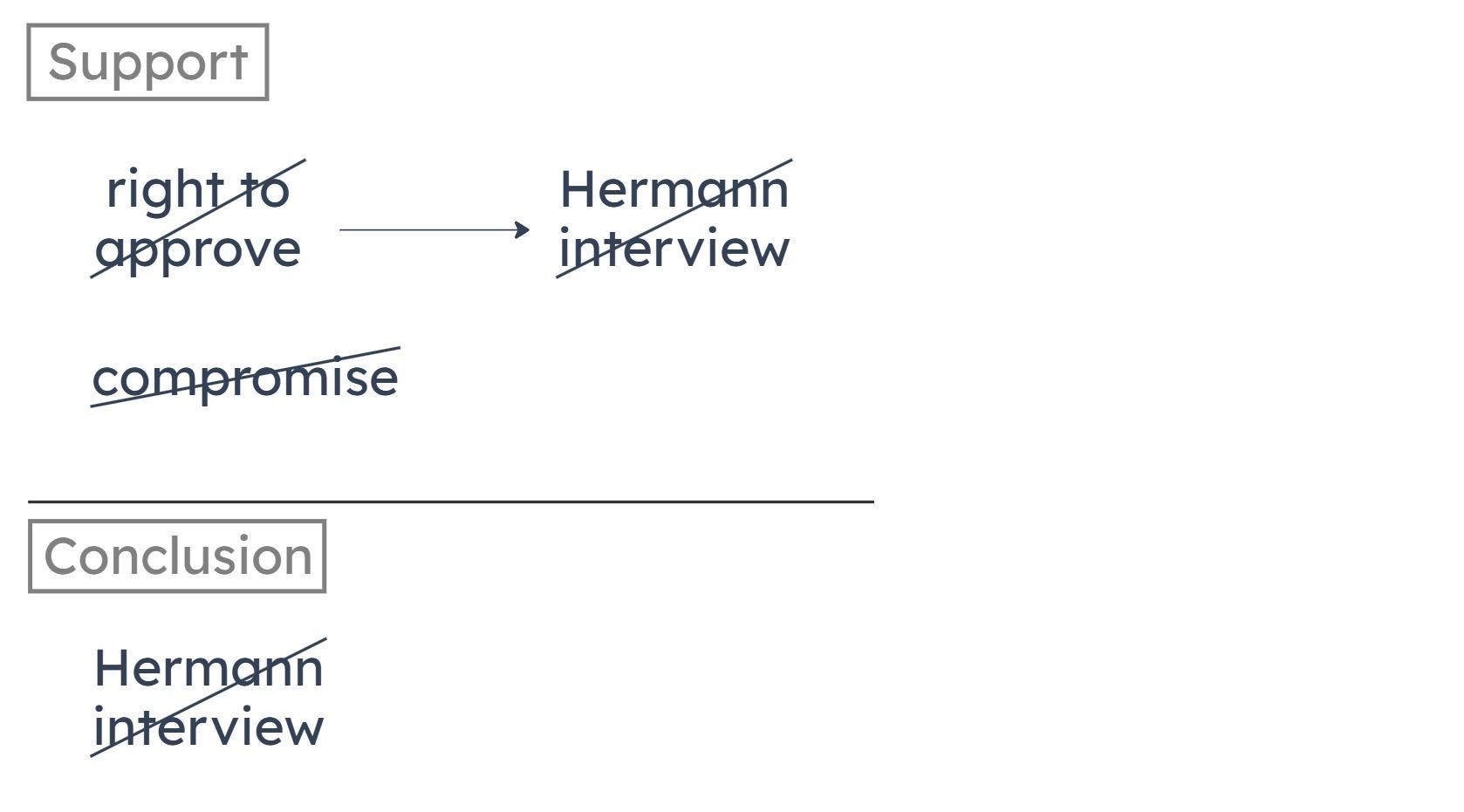
The author concludes that the Messenger will not interview Hermann. This is based on the fact that the Messenger won’t do anything that its editors believe will compromise their editorial integrity. In addition, in order to interview Hermann, he must be given the right to approve the article before publication.
Missing Connection

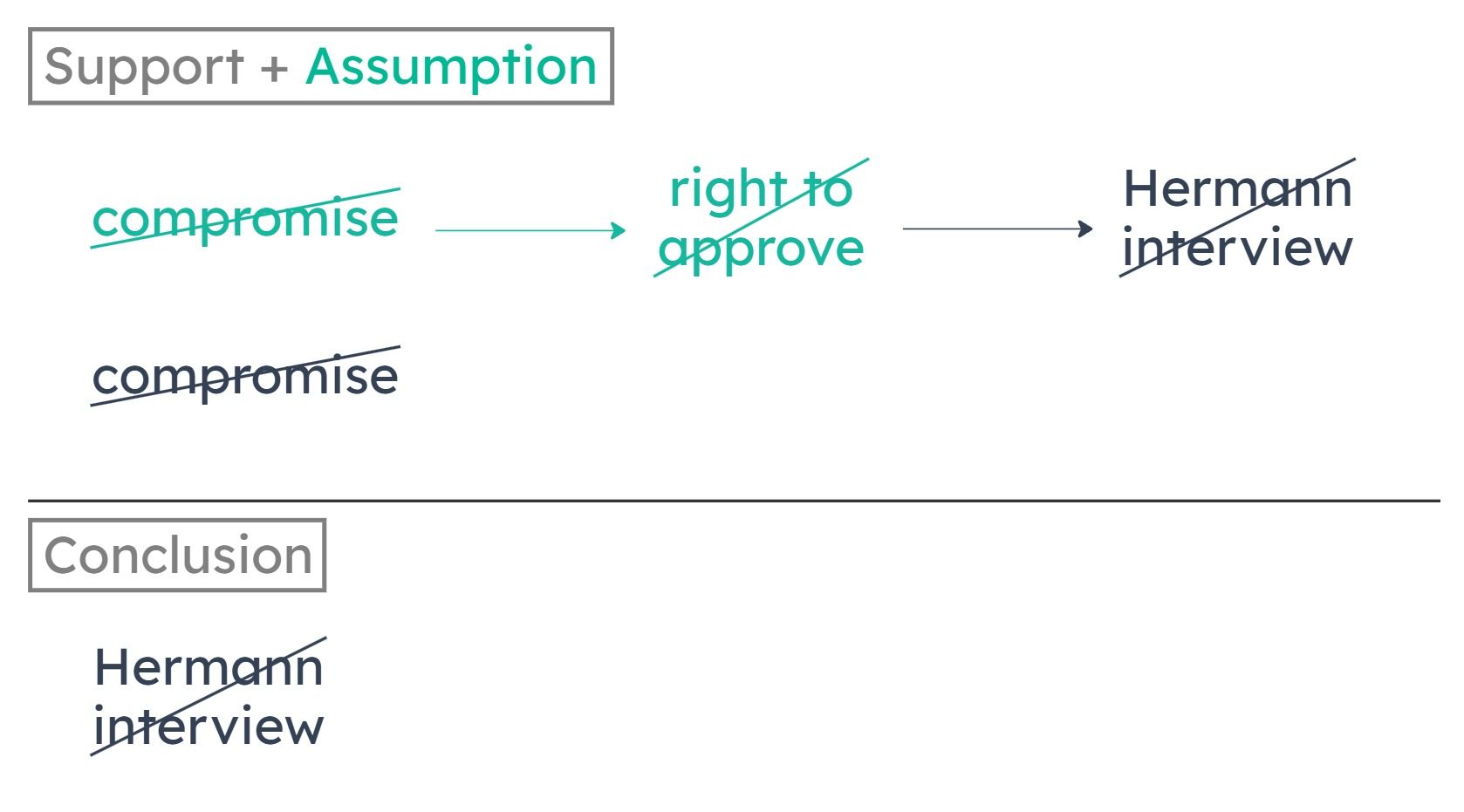
We know that if the editors think something will compromise their editorial integrity, the Messenger won’t do it. So to conclude that the Messenger won’t interview Hermann, we want to know that the editors think interviewing Hermann will compromise their editorial integrity, or that they think that what Hermann requires in order to conduct the interview (the right to approve the article before publication) will compromise their editorial integrity.

A
the editors of the Messenger believe that giving an interviewee the right to approve an article before publication would compromise their editorial integrity

(A), in connection with one of the premises, establishes that the Messenger will not grant Hermann the right to approve the article. Then, since Hermann won’t grant an interview unless he is given the right, (A) establishes that Hermann won’t grant the interview.
B
the Messenger has never before given an interviewee the right to approve an article before publication

(B) doesn’t establish that the Messenger won’t grant Hermann the right to pre-publication approval. Just because it’s never happened before doesn’t guarantee that it won’t happen this time.

C
most television stars are willing to grant interviews with the Messenger even if they are not given the right to approve the articles before publication

We know Hermann won’t grant an interview without pre-publication approval rights. What other TV stars do doesn’t matter.

D
Hermann usually requests substantial changes to interview articles before approving them

What Hermann actually does with pre-publication approval rights doesn’t matter. The issue is whether granting him the pre-publication approval rights is something that editors think compromises their editorial integrity.

E
Hermann believes that the Messenger frequently edits interviews in ways that result in unflattering portrayals of the interviewees

What Hermann beleives about Messenger edits doesn’t matter. The issue is whether granting him the pre-publication approval rights is something that editors think compromises their editorial integrity.


5 comments