Critic: It is common to argue that there is a distinction between “literary” and “genre” fiction. The first should be interpreted, so this argument goes, while the second is merely a source of easy pleasure. But this is a specious distinction—not because every work should be interpreted, but because no work should be. When we evaluate a work principally for its themes and ideas, we cut ourselves off from the work’s emotional impact.

Summarize Argument: Counter-Position
Other people make a distinction between “literary” and “genre” fiction. To those people, “literary” fiction should be interpreted, while “genre” fiction is just for pleasure. The author concludes that this distinction doesn’t make sense, since no works should be interpreted.

Identify Argument Part
The referenced text is a premise offered to support the subsidiary conclusion that no work should be interpreted. The claim that no work should be interpreted in turn supports the conclusion that the distinction between “literary” and “genre” fiction doesn’t make sense.

A
It states the conclusion.
The referenced text is not the main conclusion. It’s offered to support the claim that no work should be interpreted, which in turn supports the main conclusion.
B
It is offered as support for the conclusion.
This is an accurate description of the referenced text. It supports the subsidiary conclusion, which in turn supports the main conclusion.
C
It attempts to spell out the practical implications of the critic’s conclusion.
The referenced text does not describe the implications of the critic’s conclusion. It describes the impact of interpreting a work.
D
It attempts to explain the nature of the distinction that the critic considers.
The referenced text does note explain the distinction. It is a reason that the author believes the distinction should not be drawn.
E
It attempts to anticipate an objection to the critic’s conclusion.
The referenced text supports the conclusion. It’s not a potential objection to the conclusion.

11 comments

A recent study examined the daytime and nighttime activity patterns of two populations of tree-dwelling lemurs—the first living in a rain forest, where tree canopy cover is consistent year-round, and the second living in a deciduous forest, where many trees lose their leaves during the winter months. Both groups of lemurs were found to be more nocturnal during winter months than they were the rest of the year. However, the winter increase in nocturnal activity was significantly more pronounced for the population living in the deciduous forest than it was for the population living in the rain forest.

"Surprising" Phenomenon

Why does winter nocturnal activity increase much more for tree-dwelling lemurs in a deciduous forest, where trees lose leaves in winter, compared to those in a rainforest, where tree canopy cover stays the same all year?

Objective

The correct answer will propose a hypothesis explaining a key factor that causes lemurs in a deciduous forest to have more winter nocturnal activity than those in a rainforest. This factor must depend in some way on the tree canopy cover in the forest and will thus affect the lemurs’ behavior differently depending on their environment.

A
For both lemur populations, the primary competitors for food resources are species active during daylight.

The fact that both lemur populations’ competitors are active during daylight has nothing to do with tree canopy cover and does not explain why lemurs in the deciduous forest had much more nocturnal activity than those in the rainforest.

B
The primary predators for both lemur populations are high-flying birds that rely on their eyesight to hunt prey during daylight.

Lemurs in deciduous forests face greater predation risk in winter because the birds can see clearly without leaves. In rainforests, year-round leaves block these predators' view. Thus, to avoid predators, lemurs in deciduous forests are more active at night during the winter.

C
In both habitats, species of predatory snakes active during daylight are most active during winter months.

This might explain why both populations are more nocturnal during the winter. However, because the snakes’ hunting isn’t affected by tree canopy cover, it doesn’t explain why lemurs in deciduous forests have more nocturnal activity than those in rainforests during the winter.

D
The lemur population in the rain forest is twice the size of the population in the deciduous forest.

Population size doesn’t explain why the lemur population in the deciduous forest has more nocturnal activity in the winter than the lemur population in the rainforest. We need a factor that affects the lemurs differently based on the tree canopy cover of their environments.

E
The lemur population in the rain forest eats both plants and insects whereas the population in the deciduous forest eats only plants.

Why would eating only plants cause the lemurs in the deciduous forest to have more nocturnal activity in the winter? We still need a factor that affects the lemurs’ winter behavior differently based on the tree canopy cover of their environments.


45 comments

Historian: Those who claim that Shakespeare did not write the plays commonly attributed to him are motivated purely by snobbery. Shakespeare was the son of a glove maker, whereas every other person proposed as the true author of the plays was an aristocrat, and many of those who argue that one or another of these aristocrats wrote the plays are the aristocrats’ descendants.

Summarize Argument
The author cocnludes that those who claim Shakespeare didn’t write the plays attributed to him are motivated purely by snobbery. This is based on the fact that Shakespeare’s background wasn’t aristocratic, while the backgrounds of those who are proposed as the true authors are aristocratic. In addition, the people saying Shakespeare didn’t write the plays are related to those aristocrats.

Identify and Describe Flaw
The author provides no evidence that the people who claim Shakespeare didn’t write the plays are motivated only by snobbery. Instead, he assumes that their claims result only from the unprestigious background of Shakespeare and the familial ties to those proposed as the true authors. This overlooks the possibility that those who claim Shakespeare was not the author are motivated partly by things besides snobbery.

A
presumes, without providing justification, that a claim cannot be true if those who advance it are motivated by snobbery
The author’s argument doesn’t concern whether claims about Shakespeare’s authorship are true. The conclusion is only about the motivation of those who claim Shakespeare did not author the plays.
B
takes for granted that anyone who is motivated purely by snobbery cannot also be motivated by legitimate historical evidence
Logically, one who is motivated “purely” by snobbery can’t be motivated by anything else. So (B) isn’t an assumption. In any case, the author doesn’t assume what happens IF one is motivated purely by snobbery. He assumes that something implies one is motivated purely by snobbery.
C
fails to consider adequately the possible motives of those who claim that Shakespeare did write the plays commonly attributed to him
The argument concerns those who claim Shakespeare did not write the plays. There is no assumption concerning those who claim Shakespeare DID write the plays.
D
fails to exclude the possibility that there might be legitimate evidence motivating those who reject Shakespeare’s authorship
This possibility shows why the conclusion doesn’t follow. There might be legitimate evidence concerning authorship that is motivating those who say Shakespeare didn’t write the plays. If so, this means they are not motivated “purely” by snobbery.
E
makes use of an assumption that one would accept only if one has already accepted the truth of the conclusion
(E) is akin to circular reasoning. But the author doesn’t assume anything that restates the conclusion.

70 comments

The radio station claims that its new format is popular with listeners because more than three-quarters of the listeners who call in requests to the station say they are pleased with the format. This, however, is hardly conclusive. It would be like trying to determine whether a political candidate is popular with voters by interviewing only those people who have already decided to vote for the candidate.

Summarize Argument: Counter-Position
A radio station concludes that its new format is popular because more than three-quarters of listeners who call in requests to the station say they like the format. The author points out that the radio station’s conclusion might not be true. The author’s view is based on an analogy to political candidates. Just as interviewing only people who have decided to vote for a candidate wouldn’t necessarily give you an accurate view of the candidate’s popularity, relying only on the listeners who call in to the radio station might not give an accurate view of the popularity of the new format.

Describe Method of Reasoning
The author relies on an analogy to show that the radio station’s reasoning is flawed.

A
concluding that an inference is flawed on the grounds that it is based on a survey conducted by a biased party
The author does not say that the radio station’s conclusion is based on a survey conducted by a biased party. The problem is that the opinion of people who call in might not be representative of opinion generally. There is no survey or biased entity that conducted a survey.
B
referring to an inference that is clearly flawed in order to undermine an analogous inference
Refers to an inference that is clearly flawed (that we can determine candidate’s popularity by asking only those who would vote for the candidate) in order to undermine an analogous inference (that we can determine popularity of new format based on opinion of listeners who call in).
C
questioning the legitimacy of an inference by proposing a more reasonable inference that could be drawn from the evidence
The author does not propose a more reasonable inference that we can draw from the opinion of radio listeners who call in.
D
providing a direct counterexample to a conclusion in order to show that the conclusion is false
The author does not show that the radio station’s conclusion is false. Also, the author does not provide an example of anyone who dislikes the format.
E
claiming that an inference leads to a contradiction in order to show that the inference is unreasonable
The author does not point out that the radio station’s reasoning leads to a contradiction. The author does not point to any logically contradictory elements.

29 comments

Political leader: In this political dispute, our side will benefit from showing a desire to compromise with the opposition. If the opposition responds positively, then a compromise will be reached. If they do not, then they will be held responsible for the failure to reach a compromise and our side will benefit.

Summary
The author concludes that our side will benefit from showing a desire to compromise with the opposition. Why? Because of the following:
If the opposition responds positively, a compromise will be reached.
If the opposition does not respond positively, our side will benefit.

Missing Connection
Think about the options if we show a desire to compromise — either the opposition will respond positively, or they won’t. We know from the second premise that in the case they won’t, our side will benefit. But in the case that they do respond positively...all we can conclude is that a compromise will be reached.
Is a compromise to our side’s benefit? We don’t know. So to make the argument valid — to show that no matter how the opposition responds, our side will benefit from showing a desire to compromise — we want to establish that if a compromise is reached, our side will benefit.

A
The political leader’s side has a desire to compromise with the opposition.
(A) doesn’t establish that a compromise is to our side’s benefit. So it’s possible that if the opposition responds positively, we won’t necessarily benefit.
B
The opposition is rarely willing to compromise with the political leader’s side.
(B) doesn’t establish that a compromise is to our side’s benefit. So it’s possible that if the opposition responds positively, we won’t necessarily benefit.
C
The political leader’s side will benefit if a compromise is reached.
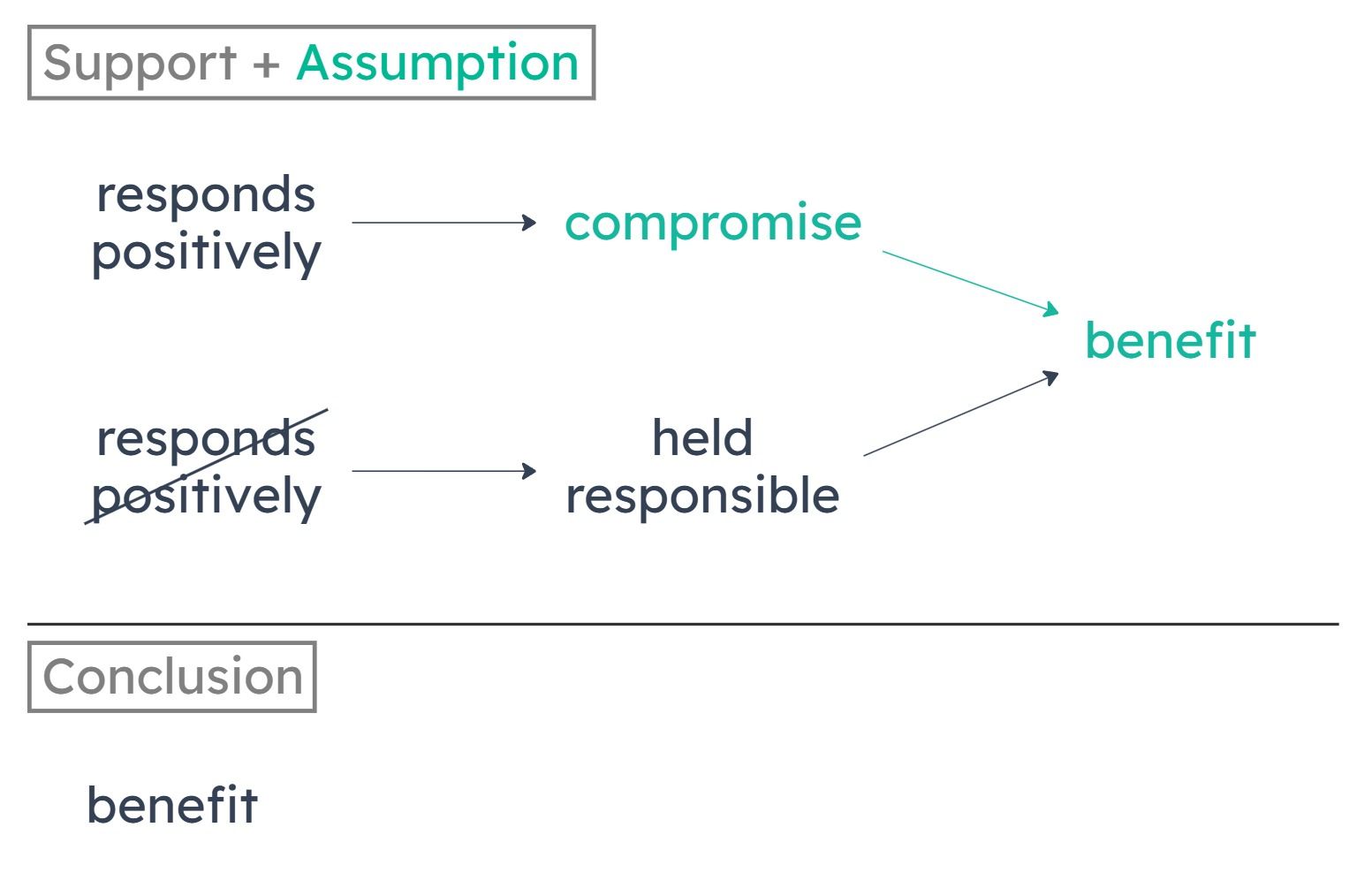
(C) allows us to infer that if the opposition responds positively, our side will benefit. If we add (C) to the premises, no matter whether the opposition responds positively or negatively, our side benefits. This establishes that our side will benefit from showing a desire to compromise.
D
The opposition would benefit from showing a desire to compromise.
(D) doesn’t establish that a compromise is to our side’s benefit. So it’s possible that if the opposition responds positively, we won’t necessarily benefit.
E
The opposition will compromise if the political leader’s side shows a desire to compromise.
(E) doesn’t establish that a compromise is to our side’s benefit. So it’s possible that if the opposition responds positively, we won’t necessarily benefit.

18 comments

Activist: Medical conditions such as cancer and birth defects have been linked to pollutants in water. Organic pollutants such as dioxins, and inorganic pollutants such as mercury, are ingested by fish and move up the food chain to people, where they accumulate in tissue. Since most cancers and birth defects are incurable, we need to aim at their prevention. Clearly, the only effective way to reduce significantly their overall incidence is to halt industries known to produce these pollutants, given that such industries are unlikely to comply adequately with strict environmental regulations.

Summarize Argument
The author concludes that the only effective way to reduce significantly the incidence of most cancers/birth defects is to stop industries that are known to produce certain organic pollutants that have been linked to those conditions. The author supports this conclusion by asserting that most cancers/birth defects are incurable, so we need to aim at preventing them. In addition, industries that produce pollutants are not likely to comply with strict environmental regulations.

Identify and Describe Flaw
The author assumes there’s no other significant cause of cancer and birth defects besides the pollutants. This overlooks the possibility that something else, such as people’s diets, might cause a significant number of cancers/birth defects. If so, then we might be able to reduce significantly the incidence of those conditions without stopping the industries.

A
fails to consider the possibility that a significant number of occurrences of cancer and birth defects may be caused by preventable factors other than industrial pollutants
If this possibility is true, then we might be able to significantly reduce cancers/birth defects through means that target those other factors. We wouldn’t necessarily have to stop the industries that produce organic pollutants.
B
does not consider the possibility that pollutants can cause harm to nonhuman species as well as to human beings
This possibility doesn’t undermine the argument. The author’s concerned about harm to humans; if the pollutants also hurt nonhumans, the author could find that additional reason we need to stop the industries that make those pollutants.
C
takes for granted that certain effects can be produced independently by several different causes
The author doesn’t take this for granted. The author OVERLOOKS the possibility that certain effects (cancer/birth defects) can be produced by several different factors.
D
fails to consider whether industries may voluntarily decrease their output of pollutants
The author does consider this — she states as a premise that the industries are unlikely to comply adequately with regulations.
E
fails to consider the possibility that chemicals now classified as pollutants have some beneficial effects not yet discovered
The author’s conclusion doesn’t recommend stopping use of the pollutants. All the conclusion says is that the only way to significantly reduce cancers/birth defects is to halt the industries. Whether there are benefits to the pollutants doesn’t affect the author’s reasoning.

46 comments

Nations that have little interaction with one another have little knowledge of one another’s needs and problems. Because both sympathy and justice depend largely on understanding the needs and problems of others, it follows that _______.

Summary
If nations have little interaction with one another, then those nations will have little understanding of each other’s needs and problems. Both sympathy and justice depend on the understanding of other’s needs and problems.

Strongly Supported Conclusions
It follows that nations that have little interaction with one another will likely not treat each other with sympathy and justice.

A
nations that have knowledge of one another’s needs and problems will treat each other with sympathy and justice
We don’t know what results from a nation understanding another nation’s needs and problems. Satisfaction of a necessary condition does not guarantee satisfaction of a sufficient condition.
B
without some interaction, nations are bound to find it difficult to extend sympathy and justice to one another
The stimulus fails the necessary condition of understanding among nations, therefore the sufficient condition of extending sympathy and justice must also fail.
C
almost all problems between nations stem from lack of sympathy and justice
We don’t know what causes any nation’s problems. We only know what results when nations don’t understand one another’s needs and problems.
D
there is no way to eliminate conflict among nations
We don’t know is there’s absolutely no way to eliminate conflict between nations. We don’t even know if these nations are in conflict with one another.
E
only nations that have some interaction with one another have knowledge of one another’s needs and problems
We don’t know whether only nations that interact with one another are also the only nations that understand one another. From the stimulus, we only know what results from nations having little interaction with other nations.

7 comments