The waters surrounding Shooter’s Island have long been a dumping ground for ruined ships and boats, and the wreckage there has caused these waters to be exceptionally still. An ornithologist found that the overall abundance of waterbirds around Shooter’s Island is similar to that around each of the neighboring islands, but that juvenile waterbirds are much more abundant around Shooter’s Island than around those other islands. This suggests that the still waters around Shooter’s Island serve as a nursery for the juveniles.

Summarize Argument: Phenomenon-Hypothesis
The author hypothesizes the abnormally still waters surrounding Shooter’s Island act like a nursery for juvenile waterbirds. Why? Because those waters have roughly as many total waterbirds as waters around nearby islands, but many more juvenile waterbirds.

Notable Assumptions
The author assumes there’s a higher proportion of juvenile waterbirds around Shooter’s Island because the still waters act as a nursery, and not for some other reason. This means assuming adult waterbirds prefer to raise their young in still waters, perhaps because still waters offer some benefit to the development of juvenile waterbirds.

A
The ruined ships and boats around Shooter’s Island have been there for decades.
This is irrelevant. It doesn’t say the ruined ships and boats make life any easier for juvenile waterbirds.
B
The number of juvenile waterbirds around Shooter’s Island, as well as the number around each neighboring island, does not fluctuate dramatically throughout the year.
This establishes that Shooter’s Island is surrounded by an unusually large proportion of juvenile waterbirds throughout the year, but it doesn’t favor the author’s hypothesis. It gives no reason to identify still waters as the cause of that juvenile presence.
C
Waterbirds use still waters as nurseries for juveniles whenever possible.
This makes concrete the author’s assumption that adult waterbirds prefer to raise their young in still waters. It’s a reason to single out still waters as the cause of the juvenile waterbird presence around Shooter’s Island.
D
The waters around the islands neighboring Shooter’s Island are much rougher than the waters around Shooter’s Island.
This offers detail, but doesn’t favor the author’s hypothesis. It doesn’t say juvenile waterbirds prefer still waters to rough waters—it just confirms that the waters around Shooter’s Island are, in fact, exceptionally still.
E
Waterbirds are typically much more abundant in areas that serve as nurseries for juvenile waterbirds than in areas that do not.
This weakens the argument. Since waterbirds in general are no more abundant around Shooter’s Island, it suggests waters around Shooter’s Island are probably not a nursery for them.

Further Explanation

Pretty hard question.

Premises tell us that Shooter Island's waters are exceptionally still and that there are lots of juvenile birds gathered around its waters. There aren't very many juvenile birds in waters in neighboring islands. We have to catch on that we are not told WHY the juveniles are gathering in still waters/Shooter Island. It could be for any number of reasons. The conclusion says that it's because it's their nursery. Okay, that makes sense I guess baby birds like still waters. They're probably using it as a nursery and that's why there are so many juvenile birds there.

If you thought that, then you likely overlooked (C). (C) tells us that whenever possible, waterbirds use still water as nurseries. We think... don't we already know that? Nope, we don't. This is a really powerful assumption that if established, would do wonders for the argument.

(C) tells us waterbird's preference is to use still waters for nurseries whenever it's possible. The stimulus tells us that there are in fact an overabundance of juveniles in still waters. You put the two statements together and now we're pretty sure that they're actually there because they're using it as a nursery and not for some other reason. Our argument is made much better.

(D) is an attractive trap. It says that the waters around the other islands are MUCH rougher. This seems like new information but it hardly is. We already knew from the premises that Shooter Island water is EXCEPTIONALLY still. Not just kind of still. It's exceptionally still. So even if the neighboring waters are a little bit rough, they're MUCH rougher than exceptionally still.

But let's just say that the waters in the neighboring islands are truly objectively rough. Okay, we still don't know why juvenile birds are gathering in still waters/Shooter Island. Is it as the conclusion says that it's because this is their nursery? Maybe. Or maybe it's for some other reason. That means the argument was as strong/weak as it ever was. We didn't do our job of strengthening the argument.


30 comments

Sociologists study folktales because they provide a means of understanding the distinctive values of a culture. However, the folktales in almost all cultures are adaptations of the same ancient narratives to the local milieu.

"Surprising" Phenomenon
How can folktales help sociologists understand cultures’ distinctive values when almost all cultures’ folktales are derived and adapted from the same ancient narratives?

Objective
The right answer will describe some way in which folktales from different cultures are distinct from each other even when the stories are adapted from semi-universal narratives. That distinctive feature will possess some capacity to teach folktale-studying sociologists about cultures’ distinctive values.

A
Because no single person is the author of a folktale, folktales must reflect the values of a culture rather than those of an individual.
This reinforces the idea that folktales are a good way to study a culture’s values, but it doesn’t touch on the discrepancy we need explained: how do folktales represent those unique values when the stories are usually based on the same ancient narratives cross-culturally?
B
Folktales are often oral traditions that persist from times when few people left written materials.
The manner in which folktales are passed down has no bearing on what sociologists are or aren’t able to learn from them. This doesn’t speak to the discrepancy at hand, so it isn’t helpful here.
C
The manner in which a culture adapts its narratives reveals information about the values of that culture.
This explains how sociologists learn about cultural values from folktales! Even if the stories are often based on the same ancient narratives, each culture adapts those narratives in a unique way. Those adaptations reveal information about a culture’s distinctive values.
D
The ancient narratives persist largely because they speak to basic themes and features of the human condition.
This is the opposite of helpful: it reinforces the idea that the narratives folktales are based on are universal, meaning we wouldn’t expect to be able to learn much about individual cultures from them. We need to know what makes the folktales distinct from one another.
E
Folktales are often morality tales, used to teach children the values important to a culture.
This reinforces the idea that folktales are a good way to study a culture’s values, but it doesn’t touch on the discrepancy we need explained: how do folktales represent those unique values when the stories are usually based on the same ancient narratives cross-culturally?

8 comments

It has been argued that the immense size of Tyrannosaurus rex would have made it so slow that it could only have been a scavenger, not a hunter, since it would not have been able to chase down its prey. This, however, is an overly hasty inference. T. rex’s prey, if it was even larger than T. rex, would probably have been slower than T. rex.

Summarize Argument: Counter-Position

The author concludes that the theory that Tyrannosaurus rex was exclusively a scavenger is an overly hasty inference. As support for this conclusion, the author addresses a possibility that those who believe that T. rex was a scavenger fail to consider: that the prey of T. rex could be even larger than T. rex. If this was the case, then the prey would probably have been slower than T. rex. This possibility weakens the theory that T. rex was primarily a scavenger.

Identify Argument Part

The claim in the question stem is the inference that the author concludes was made too hastily.

A
It is a hypothesis that is claimed in the argument to be logically inconsistent with the conclusion advanced by the argument.

The conclusion advanced by the argument is just that the theory that T. rex was exclusively a scavenger is a hasty inference. There is no logical inconsistency here; the author is just asserting that the given evidence is not enough.

B
It is a hypothesis that the argument contends is probably false.

The author does not claim that the hypothesis in the question stem is probably false––this language is too strong. The author only claims that this hypothesis was “overly hasty,” meaning that we cannot make this conclusion from the information given.

C
It is a hypothesis that the argument attempts to undermine by calling into question the sufficiency of the evidence.

In asserting that the claim in the question stem is “overly hasty,” the author is saying that this claim doesn’t have enough support, not that it’s false. This is why (C) is correct––the author claims that the evidence is not sufficient to claim that T. rex was a scavenger.

D
It is offered as evidence in support of a hypothesis that the argument concludes to be false.

The claim in the question stem is the hypothesis that the author is discussing; it is not offered as evidence of a hypothesis.

E
It is offered as evidence that is necessary for drawing the conclusion advanced by the argument.

The statement in the question stem is the hypothesis that the author claims was an overly hasty inference; it is not offered as evidence.


24 comments

A philosophical paradox is a particularly baffling sort of argument. Your intuitions tell you that the conclusion of a philosophical paradox is false, but they also tell you that its conclusion follows logically from true premises. Solving a philosophical paradox requires accepting any one of three things: that its conclusion is true, that at least one of its premises is not true, or that its conclusion does not really follow logically from its premises.

Summary
Philosophical paradoxes are particularly baffling arguments. On one hand your intuitions tell you the conclusion of the paradox is false, but on the other hand they also tell you that its conclusion follows logically from true premises. Solving a philosophical paradox requires accepting any one of three things: that its conclusion is true, that at least one of its premises is not true, or that its conclusion does not really follow logically from its premises.

Notable Valid Inferences
Solving a philosophical paradox requires denying one or the other of your intuitions.

A
Solving a philosophical paradox requires accepting something that intuitively seems to be incorrect.
Must be true. The stimulus tells us that solving a paradox requires accepting one of three things. Accepting any of these three things contradicts either sense of intuition described in the second sentence.
B
The conclusion of a philosophical paradox cannot be false if all the paradox’s premises are true.
Could be false. The stimulus tells us that one of the three things we could accept when solving a paradox is that its conclusion does not really follow logically from its premises.
C
Philosophical paradoxes with one or two premises are more baffling than those with several premises.
Could be false. We don’t have any information in the stimulus that tells us which types of paradoxes are more baffling than others. The stimulus introduces philosophical paradoxes as baffling in a matter-of-fact way, not in a comparative way.
D
Any two people who attempt to solve a philosophical paradox will probably use two different approaches.
Could be false. We don’t have any information in the stimulus about people who attempt to solve these paradoxes. It is possible that two people could use identical approaches.
E
If it is not possible to accept that the conclusion of a particular philosophical paradox is true, then it is not possible to solve that paradox.
Could be false. The stimulus gives us three options to accept in order to solve a philosophical paradox. It is possible for a person to solve a paradox by accepting either of the other two options instead.

29 comments

Some people prefer to avoid facing unpleasant truths and resent those whose unwanted honesty forces them into such a confrontation. Others dislike having any information, however painful, knowingly withheld from them. It is obvious then that if those in the former group are guided by the directive to treat others as they themselves want to be treated, _______.

Summary
Some people prefer to avoid facing unpleasant truths. These people resent those who force them into a confrontation with unwanted honesty. Other people dislike having any information withheld from them, including painful information.

Strongly Supported Conclusions
If people who prefer to avoid facing unpleasant truths are guided by the directive to treat others how they would want to be treated, they would withhold painful information from those who want all information given to them.

A
they will sometimes withhold comment in situations in which they would otherwise be willing to speak
This is unsupported because we don’t know in which situations members of the former group would usually be willing to speak.
B
they will sometimes treat those in the latter group in a manner the members of this latter group do not like
This is strongly supported because those in the former group, who wish to have painful information withheld, would do the same and withhold painful information from the latter group. The latter group does not like having any information withheld.
C
those in the latter group must be guided by an entirely different principle of behavior
This is unsupported because we don’t know what principles of behavior guide those in the latter group.
D
those in the latter group will respond by concealing unpleasant truths
This is unsupported because we don’t know that the latter group would reciprocate if the former group started withholding painful truths.
E
the result will meet with the approval of both groups
This is anti-supported because if the former group treated the latter how the former would want to be treated, then the former group would withhold painful information to the dismay of the latter group.

9 comments

Advocate: A study of people who had recently recovered from colds found that people who took cold medicine for their colds reported more severe symptoms than those people who did not take cold medicine. Therefore, taking cold medicine is clearly counterproductive.

Summarize Argument: Phenomenon-Hypothesis
The advocate argues that taking cold medicine is counterproductive. She supports this claim by citing a study wherein people who took cold medicine reported more severe symptoms than did those who didn’t take cold medicine.

Identify and Describe Flaw
This is a “correlation doesn’t imply causation” flaw, where the advocate sees a correlation and concludes that one thing caused the other without ruling out alternative hypotheses. Specifically, she overlooks two key alternatives:
(1) The causal relationship could be reversed—maybe people with more severe symptoms are more likely to take cold medicine!
(2) Some other factor could be causing the correlation—for example, maybe in parts of the world where colds tend to be more severe, cold medicine also happens to be more widely available.

A
treats something as true simply because most people believe it to be true
The advocate’s premise is a study, not a general belief. Furthermore, we have no reason to think that most people believe her conclusion or her premise to be true.
B
treats some people as experts in an area in which there is no reason to take them to be reliable sources of information
The advocate doesn’t arbitrarily treat anyone as an expert. Rather, she cites the results of a study wherein people reported on their own symptoms—a subject in which people do have some expertise!
C
takes something to be true in one case just because it is true in most cases
The advocate’s conclusion is extremely general; she does not mention any specific cases.
D
rests on a confusion between what is required for a particular outcome and what is sufficient to cause that outcome
The advocate’s argument doesn’t mistake sufficiency for necessity. She doesn’t claim in either the premise or the conclusion that cold medicine is sufficient or necessary to cause severe cold symptoms.
E
confuses what is likely the cause of something for an effect of that thing
This is the cookie-cutter flaw of confusing correlation and causation. The advocate’s argument forgets that the causal relationship could be reversed—maybe people with more severe symptoms are more likely to take cold medicine!

8 comments

Children clearly have a reasonably sophisticated understanding of what is real and what is pretend. Once they have acquired a command of language, we can ask them which is which, and they generally get it right. Even a much younger child who runs away when she sees her father roaring and prowling like a lion does not act as though she thinks her father is actually a lion. If she believed that, she would be terrified. The pleasure children get from make-believe would be impossible to explain if they could not distinguish the real from the pretend.

Summarize Argument
The author concludes that children have a good grasp on what’s real versus what’s pretend. For one thing, they can demonstrate their understanding if asked directly. For another, their make-believe games rely on being able to tell real and pretend apart.

Identify Conclusion
The conclusion is about how children think: “Children clearly have a reasonably sophisticated understanding of what is real and what is pretend.”

A
Children apparently have a reasonably sophisticated understanding of what is real and what is pretend.
Make-believe wouldn’t work without a good grasp on what’s real and what’s pretend, and children can tell the two apart if asked. Thus, children have a sophisticated understanding of what’s real and what’s pretend.
B
Children who have acquired a command of language generally answer correctly when asked about whether a thing is real or pretend.
This is a premise that supports the author’s argument. If children can answer correctly whether something is real or not, they clearly have a good understanding of real versus pretend.
C
Even a very young child can tell the difference between a lion and someone pretending to be a lion.
This is an example of children doing make-believe. Since they’re able to tell the difference between a pretend, fun lion and a real, terrifying lion, they must have a good grasp on what’s real and what’s pretend.
D
Children would be terrified if they believed they were in the presence of a real lion.
This supports the conclusion. Since children aren’t terrified in the presence of a pretend lion, they must know it isn’t real. Therefore, they have a good grasp on real versus pretend.
E
The pleasure children get from make-believe would be impossible to explain if they could not distinguish between what is real and what is pretend.
This premise supports the author’s conclusion. Since children are able to get pleasure from make believe, they must know what’s real and what’s pretend.

8 comments

The arousal of anger is sometimes a legitimate artistic aim, and every legitimate artwork that has this aim calls intentionally for concrete intervention in the world. Even granting that most art is concerned with beauty in some way, it follows that those critics who maintain that a concern for beauty is a characteristic of all legitimate art are mistaken.

Summary
The author concludes that some legitimate art is not concerned with beauty. Why? Because of the following:
Some legitimate art aims to arouse anger.
All legitimate art with the aim of arousing anger intentionally calls for concrete intervention.
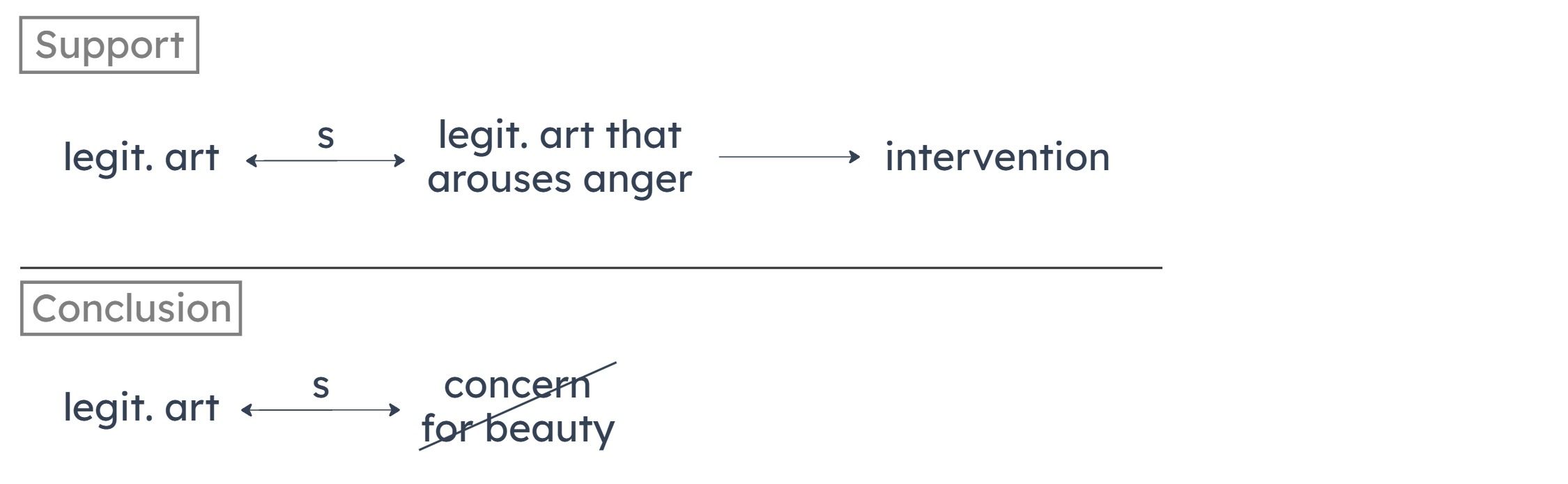
Missing Connection
The conclusion asserts that some legitimate art isn’t concerned with beauty. But the premises don’t tell us anything about what’s not concerned with beauty. So, at a minimum, we know that the correct answer should allow us to establish that something is not concerned with beauty.
To go further, we can anticipate some specific relationships that could get us from the premise to the concept “not concerned with beauty.” We know from the premises that some legitimate art aims to arouse anger. We also know that some legitimate art calls for concrete intervention. Either of these could make the argument valid:
Any art that aims to arouse anger is not concerned with beauty.
Any art that calls for concrete intervention is not concerned with beauty.

A
There are works that are concerned with beauty but that are not legitimate works of art.
(A) tells us that there are some works concerned with beauty that aren’t legitimate art. But we’re trying to prove that there are some legitimate artworks that are NOT concerned with beauty. Learning about works that ARE concerned with beauty doesn’t help us prove that certain works are NOT concerned with beauty.
B
Only those works that are exclusively concerned with beauty are legitimate works of art.
(B) asserts that in order to be legitimate, a work must be exclusively concerned with beauty. But we’re trying to prove that there are legitimate works that are NOT concerned with beauty. (B) contradicts our conclusion.
C
Works of art that call for intervention have a merely secondary concern with beauty.
(C) establishes that art that calls for intervention has a “secondary” concern with beauty. But we want to establish that some of these works are NOT concerned with beauty. Having a secondary concern with beauty does not imply NO concern with beauty.
D
No works of art that call for intervention are concerned with beauty.
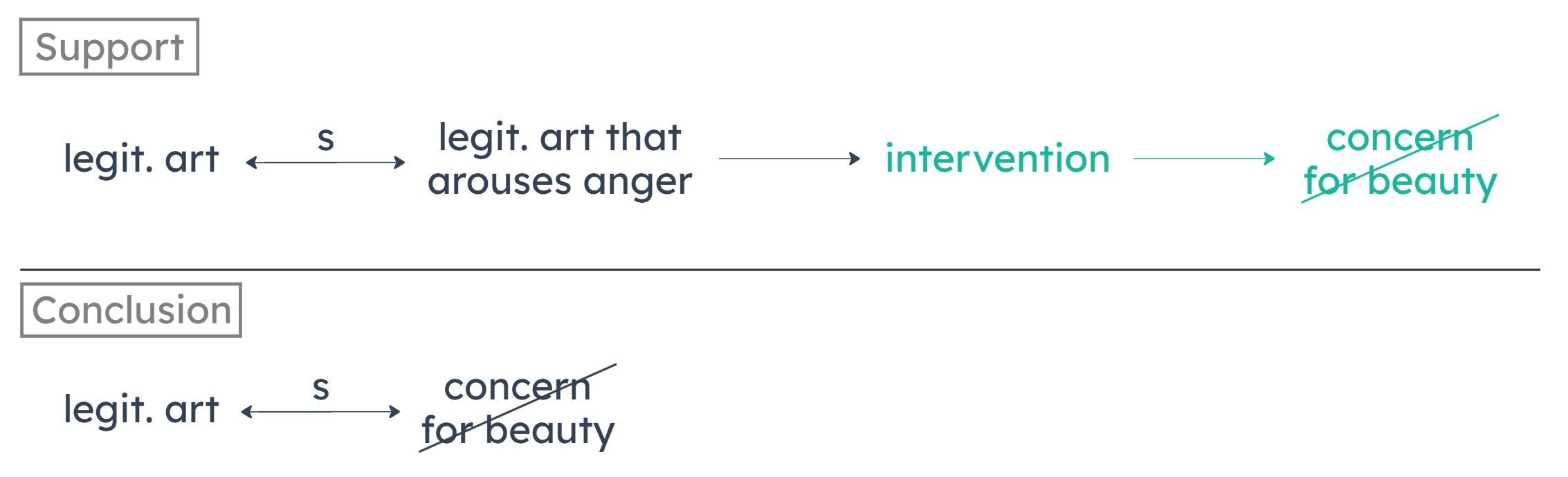
(D) asserts that if a work of art calls for intervention, then it’s not concerned with beauty. Since we know some legitimate art calls for intervention, (D) allows us to conclude that some legitimate art is not concerned with beauty.
E
Only works that call for intervention are legitimate works of art.
(E) doesn’t establish what kind of art is not concerned with beauty. Since neither this answer nor the premises tell us what kind of art is not concerned with beauty, there’s no way (E) can make the argument valid.

27 comments