Summarize Argument
The scientist concludes the first dinosaurs to fly probably glided out of trees, rather than flying from a running start. Why? Because gliding from trees requires only simple wings that are stepping stones, evolutionarily, to the larger wings of later dinosaurs.
Notable Assumptions
The scientist assumes it’s more likely the first flighted dinosaurs had wings for gliding than wings for lifting off. This means assuming wings for lifting off the ground are either less simple than wings for gliding or less of a stepping stone toward the wings of later dinosaurs. It also means assuming there’s no other characteristic of the first flighted dinosaurs that would make it less likely they glided from trees than lifted off the ground.
A
Early flying dinosaurs built their nests at the base of trees.
This doesn’t favor the scientist’s argument. It implies the first flighted dinosaurs lived on the ground, which if anything makes it less likely they flew by gliding out of trees.
B
Early flying dinosaurs had sharp claws and long toes suitable for climbing.
This strengthens the scientist’s argument. It implies the first flighted dinosaurs were capable of climbing trees, which rules out the possibility they were confined to the ground.
C
Early flying dinosaurs had unusual feathers that provided lift while gliding, but little control when taking flight.
This strengthens the scientist’s argument. It implies the first flighted dinosaurs had biological characteristics more consistent with gliding than with lifting off from the ground.
D
Early flying dinosaurs had feathers on their toes that would have interfered with their ability to run.
This strengthens the scientist’s argument. It implies the first flighted dinosaurs had toes that would have made it difficult to lift off from a running start.
E
Early flying dinosaurs lived at a time when their most dangerous predators could not climb trees.
This strengthens the scientist’s argument. It implies the first flighted dinosaurs had a reason to climb trees: to avoid predators. It rules out the possibility those dinosaurs would have gained no advantage by living in trees.
Summarize Argument
The author concludes that any impact from viewers’ perception that political candidates who blink excessively during a debate perform less well than those who blink an average amount is harmful. This is because a candidate’s rate of blinking is not a feature that contributes to performing well in elected office.
Notable Assumptions
The author assumes that blink rate is not a signal of features that are relevant to performing well in office, such as confidence.
A
Voters’ judgments about candidates’ debate performances rarely affect the results of national elections.
The argument never specifies that it’s concerned only with national elections. Effects on state elections or local elections can still be harmful. Also, the conclusion doesn’t assert that there are any effects on elections. Only that if there are effects, they’re harmful.
B
Blinking too infrequently during televised debates has the same effect on viewers’ judgments of candidates as blinking excessively.
This simply describes another way that blink rate can affect someone’s perception of a candidate. This doesn’t undermine the author’s position that perceptions based on blink rate are harmful.
C
Excessive blinking has been shown to be a mostly reliable indicator of a lack of confidence.
This suggests that excessive blink rate can be a signal of confidence, which is a feature that contributes to performance in elected office. So, judging a candidate based on excessive blinking might not be harmful, because it’s an indicator of something we were told is relevant.
D
Candidates for top political offices who are knowledgeable also tend to be confident.
This doesn’t tell us anything about blink rate or why judging candidates based on blink rate might not be harmful.
E
Viewers’ judgments about candidates’ debate performances are generally not affected by how knowledgeable the candidates appear to be.
This doesn’t tell us anything about blink rate or why judging candidates based on blink rate might not be harmful.
Summarize Argument
The argument concludes that one should not confuse the desire for money with the desire for material possessions. Why? Because there are many things that money can buy that are not material possessions, and material possessions are usually desired for experiences they make possible.
Identify Argument Part
The claim is the argument’s main conclusion.
A
It is a generalization from which the argument draws inferences regarding several particular cases.
The claim does not support a specific case. There are no specific cases in this argument, it stays in general territory.
B
It is the overall conclusion of the argument.
The claim is the argument’s main conclusion.
C
It is a subsidiary conclusion used by the argument to support its overall conclusion.
The claim is not a sub-conclusion.
D
It is a recommendation that the argument evaluates by considering specific counterexamples.
The claim is not evaluated by the argument.
E
It alludes to a problem for which the conclusion of the argument offers a solution.
The claim does not identify a problem.
Summary
Studies have concluded that song overlapping is a signal of aggression. These studies are based solely on receiver-response tests, which derive conclusions about behavior based on how others respond to it. Any response, including no response, can be interpreted as a reaction to aggression.
Strongly Supported Conclusions
The studies are inconclusive in showing that song overlapping is a signal of aggression.
A
birds do not respond in a predictable manner to signals of aggression
This is unsupported because we don’t know how birds respond to the signal of aggression based on what the author tells us.
B
receiver-response tests can provide no insight into bird behavior
This is unsupported because even if receiver-response tests could perceive any response as aggression, there may be other ways they could provide insight into bird behavior outside of evaluating the purpose of song overlapping.
C
song overlapping is likely not a signal of aggression
This is unsupported because even though we have reasons to doubt the existing studies conclusion, we cannot go so far as to conclude the opposite. We merely have to acknowledge that the prevailing hypothesis is unsupported.
D
song overlapping has no communicative function
This is unsupported because song overlapping may be used to communicate even if we have reasons to doubt existing studies showing it is a signal of aggression.
E
the conclusion of these studies is unconvincing
This is strongly supported because the studies rely on a method that could show any response to be a signal of aggression. This means we have little reason to believe that song overlapping is uniquely a sign of aggression.
Summary
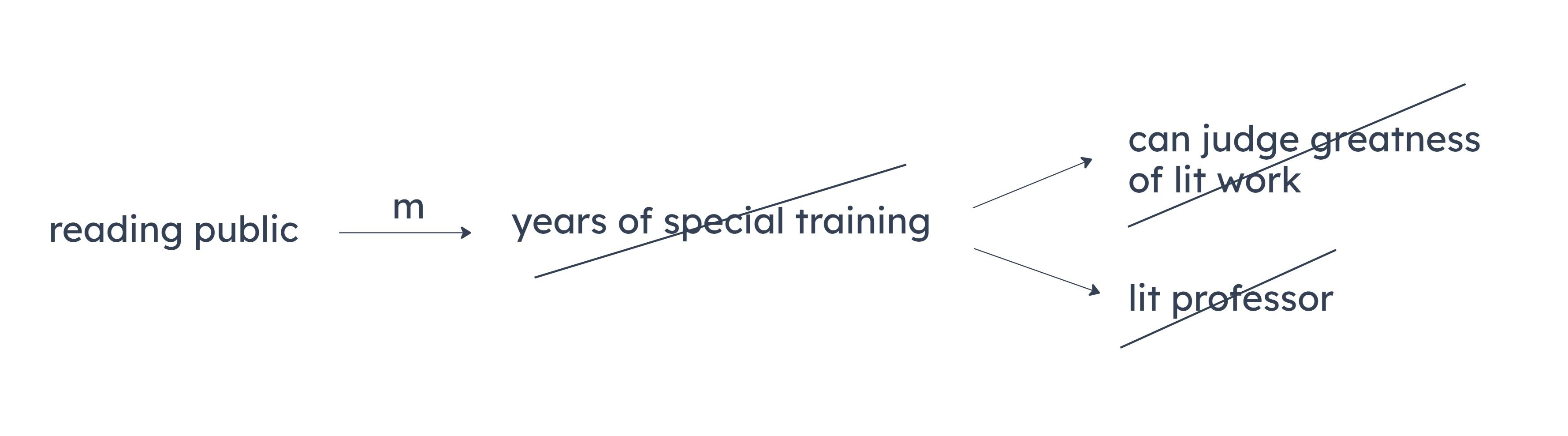
John’s literature professor believes the ability to judge the greatness of literary works accurately requires years of specialized training. Such training is also required to become a literature professor. Moreover, most of the reading public does not have access to this training.
Notable Valid Inferences
Most of the reading public cannot judge the greatness of literary works accurately.
Most of the reading public are not literature professors.
Most of the reading public are not literature professors.
A
John’s literature professor can judge the greatness of works of literature accurately.
Could be false. This answer choice confuses sufficiency for necessity. We know that literature professors have years of special training, but we don’t know if everyone with this training is also able to judge the greatness of literary works accurately.
B
Anyone who is not a literature professor cannot judge the greatness of works of literature accurately.
Could be false. We don’t have any information in the stimulus about people who are not literature professors. As shown on our diagram, there are no necessary conditions attached to the condition of not being a literature professor.
C
Specialized training like that received by John’s literature professor should be more broadly available to members of the reading public.
Could be false. The stimulus does not make a value judgment about what should occur. We are only given conditions in a matter-of-fact way.
D
Literature professors do not belong to the reading public.
Could be false. As shown on our diagram, we could only infer that most of the reading public are not literature professors.
E
The vast majority of the reading public is unable to judge the greatness of works of literature accurately.
Must be true. As shown below, we can combine the statements that most of the reading public does not have access to special training and that this special training is required for the ability to judge the greatness of literary works accurately. 
Summarize Argument
The pundit concludes that the two major political parties in the city have become sharply divided on issues. He supports this by noting that in the last four elections, the parties were separated by less than 1% of the vote.
Identify and Describe Flaw
The pundit concludes that the parties are sharply divided simply because they were separated by less than 1% of the vote in recent elections. He assumes that a close vote indicates a sharp division but doesn’t provide evidence for this. It's possible that the close vote actually shows that the two parties have very similar views and are united.
A
confuses the cause of the sharp division with an effect of the sharp division
The pundit actually doesn’t address any causes or effects of the sharp division, so he can’t be confusing the two. Instead, he simply argues that the close vote is evidence of a sharp division.
B
presumes, without argument, that sharp division is a bad thing
The pundit assumes that a close vote is evidence of sharp division, but he never claims or assumes that sharp division is a bad thing.
C
has a conclusion that is merely a restatement of one of its premises
This is the cookie-cutter flaw of circular reasoning. The pundit doesn’t make this mistake. His premise doesn’t support his conclusion very well, but the two are distinct from one another.
D
fails to indicate how what is happening in one city compares with what is happening in other cities
The pundit is only addressing the two major political parties “in this city.” How the elections in this city compare to the elections in other cities is irrelevant.
E
takes for granted that an almost even division in votes indicates a sharp division on issues
The pundit assumes that a close vote indicates a sharp division on issues, but he gives no evidence to support this assumption. It’s possible that an almost even division in votes actually indicates that the two parties are united.
Summarize Argument: Phenomenon-Hypothesis
The author hypothesizes that the reason Bach is remembered is that he was such a prolific composer. This is based on the fact that Bach wrote more than a thousand full compositions, which the author believes would inevitably have resulted in some outstanding compositions that would survive for a long time.
Notable Assumptions
The author assumes that there is no other explanation for why Bach is remembered.
A
Several of Bach’s contemporaries who produced more works than he did have been largely forgotten.
This provides evidence that being a prolific composer is not enough to make one remembered. This calls into question the author’s explanation for why Bach is remembered.
B
There are a few highly regarded composers who wrote a comparatively small number of compositions.
The author never suggested that writing a smaller number of compositions would make it impossible to be highly regarded or remembered. The author’s theory is just that writing a lot of compositions can make one remembered.
C
Bach wrote many compositions that were considered mediocre in his lifetime, and a large proportion of these compositions have been forgotten.
The author acknowledges that Bach could have written many mediocre compositions. But, the author believes that at least some were outstanding, they could allow Bach to be remembered.
D
The exact number of Bach’s compositions is not known, since many of them have been lost to posterity.
We don’t need to know the exact number of compositions. We still know that he wrote more than a thousand full compositions, which is a large number.
E
Some great creative geniuses are remembered because they had a very high ratio of outstanding works to mediocre works.
The author never suggested that having a high ratio of outstanding works to mediocre works could never be a reason someone is remembered. The author is simply arguing that in Bach’s case, that explanation doesn’t apply.