Editorial: Any democratic society is endangered by segmentation into classes of widely differing incomes between which there is little mobility. Such class divisions strengthen divisive political factions that stand in the way of good governance. Since economic expansion gives people more opportunities to improve their economic standing, democratic societies should adopt policies that ensure constant economic expansion.

Summarize Argument
The editorial concludes democracies should work to ensure constant economic expansion. Why? Because expansion gives people the opportunity to improve their economic standing, and economic classes that prevent people from improving their standing strengthen political divisions in democratic societies, making government worse.

Notable Assumptions
The editorial assumes a democracy is less likely to be segmented into classes if its people have better chances to improve their economic position. It also assumes that divisive political groups are less likely to stand in the way of good government if they’re weak, and that constant economic expansion wouldn’t create any new issues for good governance that outweigh its advantages.

A
Discord within a society tends to increase inequities in the distribution of wealth.
This doesn’t say eliminating discord reduces those inequities. In addition, the editorial doesn’t claim constant economic expansion will reduce the total amount of discord in a society—just that a failure to expand will cause divisive political factions to become stronger.
B
Political factions are sometimes willing to overlook their differences to back policies that are conducive to economic expansion.
This exception to the rule doesn’t disprove the rule. It doesn’t change the editorial’s premise that divisive political factions make good governance harder to achieve.
C
Economic expansion results in a proportionally greater increase in earnings for people at low income levels than for people at other income levels.
This strengthens the editorial’s assumption that improved economic mobility will make class divisions less stark. It rules out a damaging possibility: that economic expansion mostly helps higher-income people, making class divisions greater.
D
Economic expansion cannot occur unless there is significant financial investment in the economy by people at the highest income levels.
If anything, this weakens the argument. It suggests that economic growth may be self-defeating in the long run, since reducing class divisions may reduce the number of very wealthy people willing to invest.
E
The presence of divisive political factions can be an obstacle to economic expansion.
This doesn’t address the editorial’s primary assumption: that improved economic mobility decreases class divisions. It suggests that failure to expand the economy is self-reinforcing, not that it leads to bad governance.

21 comments

Taken as a whole, the computers that constitute the Internet form a complex, densely interconnected collection that transmits information like the neurons that form the human brain. And like a developing human brain, the Internet is growing at millions of points. So we can expect that the Internet itself will someday gain a humanlike intelligence.

Summarize Argument
The author concludes that the Internet will someday gain a humanlike intelligence. This is based on an analogy to the human brain. Computers that make up the Internet form an interconnected collection that transmits information, which is similar to how neurons form in the human brain. In addition, the Internet is growing at millions of points, which is similar to a developing human brain.

Identify and Describe Flaw
The author assumes that the superficial similarities between the Internet and a brain imply that the Internet will eventually gain a another similarity related to intelligence. This overlooks the possibility that there’s no connection between the existing similarities and the development of a similar intelligence.

A
equates the complexity of an entity with the intelligence of that entity
The author doesn’t assume that the more complex an entity is, the more intelligent. He notes that the Internet is similar to the brain in its complexity, but reasons that because of this similarity, another similarity will develop. This isn’t the same as equating two concepts.
B
fails to consider the possibility that other technologies may simulate human intelligence before the Internet does so
The author doesn’t say the Internet will be the first to simulate humanlike intelligence. So this possibility doesn’t undermine the argument.
C
draws a dubious analogy between the information that is processed by the human brain and the information that is transmitted on the Internet
The analogy isn’t between the info processed by a brain and the info transmitted by the Internet. It’s between a brain and the Internet. They are similar in that they both have components that transmit info (computers and neurons). But this doesn’t suggest the info is analogous.
D
fails to give an indication of why the characteristics it focuses on are sufficient for the eventual development of humanlike intelligence
The author fails to show why the features it focuses on (manner of transmitting info, growing at millions of points) would lead to the development of intelligence. Why do these superficial features establish that the Internet will become intelligent? We don’t get any reason.
E
presumes, without providing justification, that the people administering the Internet are interested in developing a system with humanlike intelligence
The argument doesn’t assume anything about people’s interest. The argument is based only on an analogy between brains and the Internet, and none of the analogous features involve the interests of people.

27 comments

The Amazon River flows eastward into the Atlantic Ocean from its source in the western part of South America. The land through which the Amazon flows is now cut off from the Pacific Ocean to the west by the Andes Mountains. Yet certain freshwater fish that inhabit the Amazon are descended from now-extinct saltwater fish known to have inhabited the Pacific Ocean but not the Atlantic. For this reason, some scientists hypothesize that the Amazon River once flowed into the Pacific Ocean.

Summarize Argument: Phenomenon-Hypothesis
Some scientists hypothesize that the Amazon River previously flowed into the Pacific Ocean, not the Atlantic Ocean. Why? Because some freshwater fish in the Amazon are descended from saltwater fish that lived in the Pacific but not the Atlantic, and the Andes Mountains currently separate the Amazon from the Pacific.

Notable Assumptions
The scientists assume some Amazon fish are descended from Pacific Ocean fish because the Amazon used to flow into the Pacific, and not for some other reason. This means assuming ancestors of the freshwater fish entered the Amazon when it flowed into the Pacific. It also means assuming the Andes Mountains prevent any fish from traveling from the Pacific Ocean to the Amazon River on its current route.

A
In many cases, species of freshwater and saltwater fish that share certain characteristics do not in fact share a common ancestor.
Since the Amazon fish are known to have descended from the Pacific-dwelling species, this is irrelevant. It doesn’t provide any new information suggesting the Amazon was once connected to the Pacific.
B
Most of the fossilized remains of the now-extinct saltwater fish from the Pacific Ocean date to a period prior to the formation of the Andes Mountains.
This confirms that the Pacific-dwelling species lived before the Andes separated the Amazon from the Pacific. It rules out the possibility that the Pacific-dwelling fish emerged when the Amazon was already inaccessible from the Pacific because of the Andes Mountains.
C
Many species of fish that inhabit the Atlantic Ocean are related to fish species that are known to inhabit the Pacific Ocean.
If anything, this weakens the argument. It suggests an alternative hypothesis: that an intermediate descendant of the Pacific-dwelling species lived in the Atlantic, and served as an ancestor for the current freshwater species in the Amazon.
D
The Andes Mountains extend from the northernmost to the southernmost extremes of the South American continent.
This is irrelevant. It’s important only that the Andes cut off the Pacific from the Amazon—their precise geographical span doesn’t affect the argument.
E
There are very few fish species that are known to be able to survive in both fresh and salt water.
If anything, this weakens the argument. It suggests it’s unlikely that saltwater fish from the Pacific entered the Amazon directly and descended into the present-day freshwater species.

12 comments

To be considered for this year’s Gillespie Grant, applications must be received in Gillespie City by October 1. It can take up to ten days for regular mail from Greendale to reach Gillespie City. So if Mary is sending an application by regular mail from Greendale, she will be considered for the grant only if her application is mailed ten days before the due date.

Summarize Argument

The author concludes that, if she’s using regular mail from Greendale, Mary must mail her application ten days before the due date to be considered for the grant. He supports this with the following premises:

(1) Applications must arrive in Gillespie City by October 1 to be considered.

(2) Regular mail from Greendale can take up to ten days to reach Gillespie City.

Identify and Describe Flaw

The author concludes that Mary must mail her application ten days before the due date to be considered for the grant. But his premises state that regular mail from Greendale can take up to ten days to reach Gillespie City. So he overlooks the possibility that some mail might take less than ten days.

What if Mary’s application only takes five days to arrive? In that case, he can’t conclude that she’ll only be considered if she mails it ten days before the due date.

A
does not establish that Mary is applying for the Gillespie Grant or mailing anything from Greendale

It’s true that the author never establishes this, but he doesn’t need to. He’s only addressing what would happen if Mary sends in an application from Greendale. Whether she actually does apply is irrelevant.

B
does not determine how long it takes express mail to reach Gillespie City from Greendale

It doesn’t matter how long it takes express mail to reach Gillespie City from Greendale. The author is only addressing what would happen if Mary sends her application by regular mail from Greendale.

C
does not consider the minimum amount of time it takes regular mail from Greendale to reach Gillespie City

What if the minimum amount of time it takes regular mail from Greendale to reach Gillespie City is five days? In that case, Mary might not need to send in her application ten days before the due date in order to be considered.

D
presumes, without providing justification, that if Mary’s application is received in Gillespie City by October 1, she will satisfy all of the other requirements of the Gillespie Grant application

The author doesn’t assume that Mary will satisfy all the requirements if her application is received on time. She might mail her application on time and still not be considered for the grant. The author just argues that if she is considered, she must mail her application on time.

E
overlooks the possibility that Mary cannot be certain that her application will arrive in Gillespie City unless she sends it by express mail

The author only addresses Mary sending her application by regular mail; express mail is irrelevant. Also, even if she can’t be sure that it will arrive by regular mail, this doesn't impact the conclusion that if it is considered, she must send it ten days before the due date.


19 comments

Andy Warhol’s Brillo Boxes is a stack of boxes that are visually indistinguishable from the product packaging of an actual brand of scouring pads. Warhol’s Brillo Boxes is considered a work of art, while an identical stack of ordinary boxes would not be considered a work of art. Therefore, it is not true that appearance alone entirely determines whether or not something is considered a work of art.

Summarize Argument
The author concludes that appearance alone does not entirely determine whether or not something is considered a work of art. This is supported by the example of Warhol’s Brillo Boxes. This artwork is visually indistinguishable from product packaging, but Brillo Boxes is considered a work of art, while the product packaging would not be considered a work of art.

Describe Method of Reasoning
The author supports a conclusion using an example.

A
highlighting the differences between things that are believed to have a certain property and things that actually have that property
The author doesn’t present something that’s believed to be art vs. something that’s actually art. Brillo Boxes are considered art. Product packaging isn’t considered art. Neither actually “is” art — we’re told what people consider or don’t consider to be art.
B
demonstrating that an opposing argument relies on an ambiguity
There is no opposing argument. An argument requires a premise and a conclusion. Although the author counters the view that appearance alone determines whether something’s considered art, that view isn’t an argument.
C
suggesting that two things that are indistinguishable from each other must be the same type of thing
The author doesn’t say that Brillo Boxes and the product packaging are the same type of thing. They are visually indistinguishable, but that doesn’t mean they’re both art or that they’re both not art. The point is whether something’s considered art involves more than appearance.
D
questioning the assumptions underlying a particular theory
If you consider “appearance alone determines whether something’s considered art” to be a theory, (D) is wrong because the author doesn’t question the assumptions underlying this. The author simply shows that it is false by pointing to a counterexample.
E
showing that something that would be impossible if a particular thesis were correct is actually true
Something that would be impossible (only Brillo Boxes is considered art even though identical packaging looks the same) if a particular thesis were correct (appearance alone determines whether something’s considered art) is actually true (only Brillo Boxes is considered art).

87 comments

Farmer: Farming with artificial fertilizers, though more damaging to the environment than organic farming, allows more food to be grown on the same amount of land. If all farmers were to practice organic farming, they would be unable to produce enough food for Earth’s growing population. Hence, if enough food is to be produced, the currently popular practice of organic farming must not spread any further.

Summarize Argument
The author concludes that if enough food is to be produced, the practice or organic farming cannot spread any further. This is based on the fact that if all farmers were to practice organic farming, they wouldn’t be able to produce enough food for Earth’s population.

Identify and Describe Flaw
The premise establishes that to make enough food, we can’t have “all farmers” doing organic farming. But the author mistakenly interprets that to mean we can’t have any increase in organic farming. The author overlooks the possibility that having an increase in organic farming can still allow us to feed Earth’s population, as long as that increase doesn’t extend to “all farmers.”

A
It takes for granted that farming with artificial fertilizers is only slightly more damaging to the environment than organic farming is.
The author acknowledges that artificial fertilizer-based farming is “more damaging” than organic farming. There’s no indication the author thinks this damage is only slight as opposed to significant.
B
It overlooks the possibility that even if the practice of organic farming continues to spread, many farmers will choose not to adopt it.
This possibility, if true, shows that it’s possible organic farming can spread without it extending to “all farmers.” And if it doesn’t extend to “all farmers,” then we have no reason to think we’d be in a position where it’s impossible to feed the world.
C
It fails to consider the possibility that, at some points in human history, enough food was produced to feed Earth’s population without the use of artificial fertilizers.
The premise establishes that in order to feed the world, we can’t have “all farmers” doing organic farming. What farming was like in the past and how much food such farming allowed has no bearing on what the premise says is currently required.
D
It overlooks the possibility that a consequence that would surely follow if all farmers adopted the practice of organic farming would still ensue even if not all of them did.
This isn’t a possibility overlooked by the author; it’s closer to something the author assumes. The author thinks that we’ll face inability to feed people if organic farming spreads even a little bit more. Since this possibility doesn’t hurt the argument, it’s not the flaw.
E
It takes for granted that damage to the environment due to the continued use of artificial fertilizers would not be detrimental to human health.
The author’s argument doesn’t assume anything about damage to human health. The issue is whether a further spread of organic farming would lead to inability to produce enough food. How fertilizers affect health doesn’t bear on this issue.

61 comments

It has been said that understanding a person completely leads one to forgive that person entirely. If so, then it follows that complete self-forgiveness is beyond our reach, for complete self-understanding, however desirable, is unattainable.

Summarize Argument
The author concludes that complete self-forgiveness is unattainable. He supports this by saying that completely understanding someone leads to completely forgiving them, but complete self-understanding is unattainable.

Identify and Describe Flaw
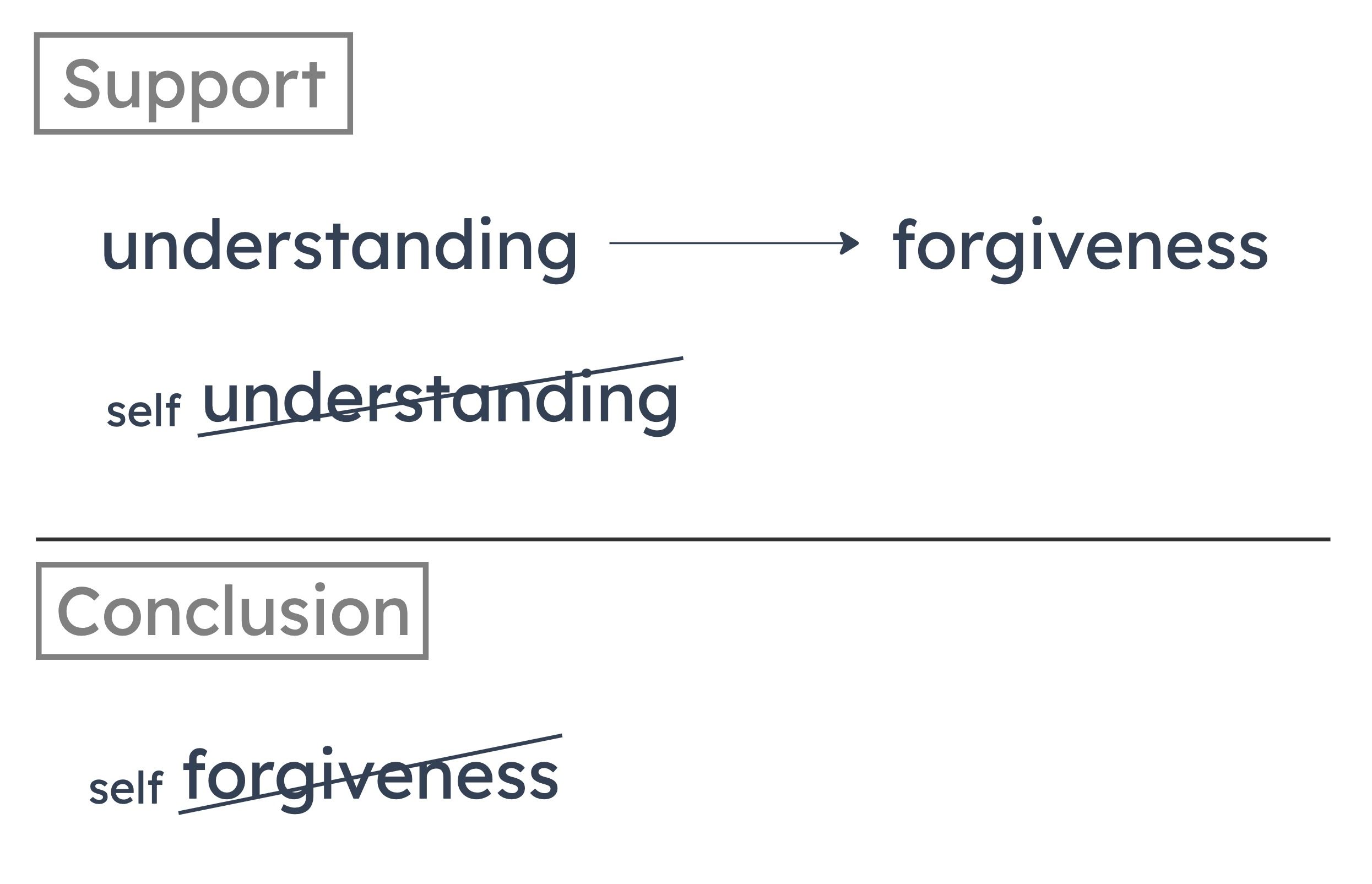
This is the cookie-cutter flaw of mistaking sufficiency and necessity. The author concludes that complete self-forgiveness is unattainable because complete self-understanding is unattainable. In doing so, he treats “understanding” as necessary for “forgiveness.” But according to his premises, “understanding” is merely sufficient. So negating “understanding” tells us nothing about “forgiveness.”
In other words, the author treats complete understanding as the only way to bring about forgiveness. But maybe it’s possible to forgive yourself completely, even though you can’t understand yourself completely.

A
treats the failure to satisfy a condition that brings about a particular outcome as if satisfying that condition is the only way to realize the outcome
The author treats the failure to satisfy “understanding,” which is sufficient to bring about “forgiveness,” as if satisfying “understanding” is the only way to bring about “forgiveness.” But what if self-forgiveness is attainable, even though self-understanding is not?
B
confuses something that is necessary for an action to occur with something that necessarily results from that action
Actually, the author confuses something that is sufficient for an action to occur with something that is necessary for that action to occur. He doesn’t confuse a conditional claim with a causal claim like (B) suggests.
C
takes for granted that something that has merely been said to be true is, in fact, true
The author doesn't assume that it’s true that complete understanding leads to complete forgiveness merely because it has been said to be true. He just says that if this is true, then complete self-forgiveness is unattainable.
D
ignores the possibility that a state of affairs is desirable even if it cannot be attained
The argument is about whether complete self-forgiveness and understanding are possible, not whether they are desirable. Also the author seems to acknowledge that complete self-understanding is desirable, even though it’s unattainable.
E
uses the difficulty of attaining a state of affairs as a reason for not attempting to attain it
The author doesn't make any claims about whether one should or should not attempt to attain self-forgiveness and understanding. Also, he doesn’t argue that self-forgiveness and understanding are simply difficult; he argues that they’re unattainable.

24 comments