A
it is possible that the families in the experiment who were not given a medical self-help book acquired medical self-help books on their own
B
the families in the experiment could have gained access to medical self-help information outside of books
C
a state of affairs could causally contribute to two or more different effects
D
two different states of affairs could each causally contribute to the same effect even though neither causally contributes to the other
E
certain states of affairs that lead families to visit the doctor less frequently could also make them more likely to have a medical self-help book in the home
A
patients who have strokes typically also have other health problems
B
it is very likely that just as many strokes occur in the right side of the brain as in the left side
C
doctors vary greatly in the accuracy of their diagnoses of strokes
D
the symptoms of right-side strokes tend to be different than the symptoms of left-side strokes
E
other studies have suggested that a large number of minor strokes go undiagnosed
A
Films that are whimsical and mischievous are not threatening.
B
Films that are appropriate for adults are seldom appropriate for children.
C
Films that have dark themes are threatening.
D
Children enjoy films only if the films include animation.
E
Children do not attend to some details in films aimed at adults.
Economist: There have been large declines in employment around the globe, so it’s not surprising that the number of workers injured on the job has decreased. What is surprising, however, is that the percentage of workers injured on the job has also decreased.
"Surprising" Phenomenon
There’s a decrease in the percentage of workers injured on the job.
Objective
Since this is an “Except” question, the correct answer will not explain the decrease in the percentage of workers injured on the job. Wrong answers will explain why workers are less likely now than before to be injured on the job. The correct answer will either not address that likelihood or else make it more likely that workers are injured on the job.
A
Overall, people who are employed are working fewer hours each day.
Employed people are working less than before, so there’re less chances for them to be injured while on the job. Less hours means less opportunities for accidents and mishaps.
B
A decrease in the demand for products has reduced the pressure on workers to meet production quotas and deadlines.
Since workers aren’t working as hard to meet deadlines, they’re less likely to rush into accidents. Moreover, they’re more likely to follow time-consuming workplace-safety protocols if time isn’t an issue.
C
Some of the most dangerous industries have had especially big declines in employment.
There are less people working dangerous jobs relative to the working population than before. Therefore, a lower percentage of people are likely to suffer injuries from dangerous work.
D
There has been a general decline in the resources devoted to workplace safety.
A decline workplace-safety resources suggests workers would actually be more likely to be injured on the job than before. This doesn’t explain why the rate of job-related injuries has actually fallen.
E
Inexperienced workers have lost their jobs at higher rates than experienced ones.
Experienced workers who know how to operate equipment safely have retained their jobs, while inexperienced workers who’re prone to injury have been let go. Hence, a reduction in injuries.
A
The university museum should return the ancient artifacts in dispute.
B
Any important ancient artifact belongs by rights to the nation on whose territory it was discovered.
C
The ancient artifacts whose ownership is in dispute were obtained legally by the university museum.
D
The university museum is in possession of several artifacts whose ownership is in dispute.
E
There is an overriding principle that any important ancient artifact belongs by rights to the nation on whose territory it was discovered.
A
Some newspapers do not publish any reviews of live plays.
B
The number of movies released last year was significantly greater than the number of live plays performed locally.
C
The newspaper has five movie critics, but only one theater critic.
D
The newspaper does not have the space in the arts section to publish a review of every movie that is released or every live play that is locally performed.
E
The newspaper published more reviews of live plays in the last year than it did two years ago.
A
Public health can be safeguarded through reducing traffic fatalities.
B
Those concerned with safeguarding public health should focus their efforts on reducing traffic fatalities.
C
Increasing seat belt use, reducing distracted driving, and improving automotive technology all safeguard public health.
D
A reduction in total miles traveled would contribute more to safeguarding public health than would any automotive safety measure.
E
Traveling by car is itself a major risk factor for traffic fatalities.
Researcher: During the rainy season, bonobos (an ape species closely related to chimpanzees) frequently swallow whole the rough-surfaced leaves of the shrub Manniophyton fulvum. These leaves are likely ingested because of their medicinal properties, since ingestion of these leaves facilitates the elimination of gastrointestinal worms.
Summarize Argument: Phenomenon-Hypothesis
The researcher hypothesizes that bonobos eat Manniophyton fulvum leaves during the rainy season because they have medicinal properties. For evidence, he points to one such property: the leaves help eliminate gastrointestinal worms.
Notable Assumptions
The researcher assumes bonobos eat Manniophyton fulvum leaves because of their medicinal properties, and not for some other reason. This means assuming bonobos benefit from having fewer gastrointestinal worms and that the leaves are not worth eating just for their nutritional value.
A
Bonobos rarely swallow whole leaves of any plants other than M. fulvum.
This suggests there’s something unique about M. fulvum leaves—but not necessarily their medicinal value. It makes bonobos’ ingestion of these leaves more anomalous, but throws no weight behind the researcher’s particular hypothesis.
B
Chimpanzees have also been observed to swallow rough-surfaced leaves whole during the rainy season.
This is irrelevant. It doesn’t say chimpanzees eat M. fulvum leaves in particular, nor does it imply chimpanzees eat those leaves for their medicinal properties.
C
Of the rough-leaved plants available to bonobos, M. fulvum shrubs are the most common.
This doesn’t suggest bonobos eat them for their medicinal value. It’s equally compatible with the leading alternative hypotheses—for example, that bonobos eat the leaves for their nutritional value.
D
The leaves of M. fulvum are easier to swallow whole when they are wet.
This implies bonobos would prefer to eat M. fulvum leaves during the rainy season, rather than the dry season—but not why they choose to eat them in the first place. It doesn’t say the leaves have greater medicinal value when wet.
E
The rainy season is the time when bonobos are most likely to be infected with gastrointestinal worms.
This suggests M. fulvum leaves have more medicinal value to bonobos during the rainy season, since those leaves are more likely to rid them of worms. It makes it more likely the bonobos eat the leaves for their medicinal properties, as opposed to nutritional or other reasons.
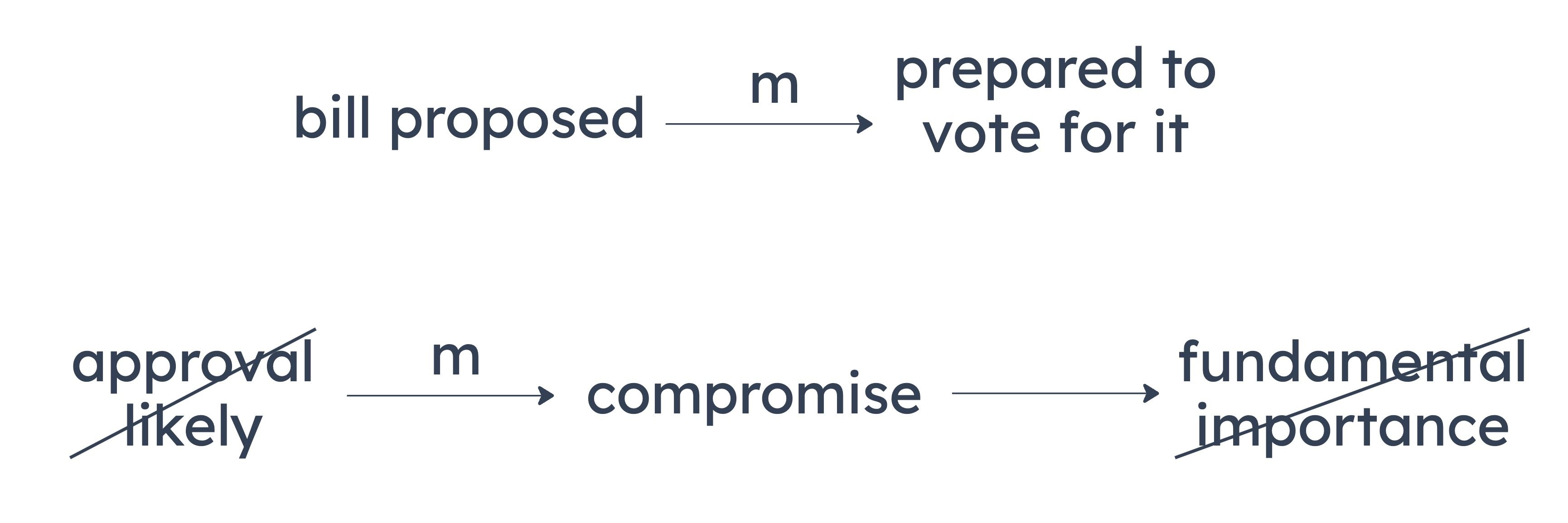
Political scientist: When a bill comes before a legislative body, the majority of the representatives are usually prepared to vote for it. Moreover, when a bill is at first unlikely to get approval by the majority, a compromise regarding the content of the bill is usually possible, allowing its passage into law. Such compromises are impossible, however, when the bill concerns an issue of fundamental importance to a large bloc of representatives.
Summary
When a bill comes before a legislative body, most representatives are prepared to vote for it. Most of the time when a bill is unlikely to get approval by the majority, compromise regarding the content is possible. Compromise is impossible, however, when the bill concerns an issue of fundamental importance to a large bloc of representatives.
Notable Valid Inferences
Most bills concerning issues of fundamental importance to a large bloc of representatives do not pass into law following compromise.
A
Compromises regarding issues of fundamental importance to large blocs of representatives in the legislature usually do not enable the passage of any bill into law.
Must be true. The stimulus tells us that compromise is not possible when a bill concerns issues of fundamental importance to a large bloc of representatives. Therefore, this type of compromise does not enable the passage of any bill into law.
B
Most bills that do not concern any issues of fundamental importance to any large bloc of representatives in the legislature pass into law.
Could be true. We don’t have any information in the stimulus to contradict this idea. It is possible that most of these types of bills pass into law, if there are any at all.
C
Most bills concerning issues of fundamental importance to a large bloc of representatives pass into law as a result of compromises over the bills’ contents.
Must be false. As shown on our diagram, compromise is possible only if the bill does not concern issues of fundamental importance to a large bloc of representatives. 
D
Most bills concern issues of fundamental importance to at least one large bloc of representatives in the legislature.
Could be true. We don’t have any information in the stimulus about the content of most bills.
E
Most bills do not concern any issues of fundamental importance to any large bloc of representatives in the legislature.
Could be true. We don’t have any information in the stimulus about the content of most bills.