The author also assumes that the inclusion of minor drug-related interactions will not distract/outweigh the importance of the major ones, thereby causing more harm than good.
A
Providing information on minor drug-related interactions would detract from a patient’s attention to serious interactions.
B
Many drugs have fewer documented drug-related interactions than does aspirin.
C
Providing information about all drug-related interactions would result in only negligible price increases for consumers.
D
Current research is such that many drug-related interactions have not yet been identified.
E
Pharmacists usually draw patients’ attention to printed warnings that are provided with drugs.
A
In the future, most private correspondence and diaries of public figures will be stored as encrypted text.
B
The widespread use of encryption software will cause the writing of biographical history to decline significantly or cease.
C
Historians will probably not have access to much of the private correspondence and diaries of public figures in the future.
D
In the future, biographers’ access to the most interesting, revealing material will be determined by their knowledge of the necessary passwords.
E
Public figures’ private correspondence and diaries are the most interesting and revealing sources for the writing of biographical history.
Sociologist: Some anthropologists claim that cultures can most effectively respond to the threat of cultural decay by replacing or abandoning many of their traditions so that other traditions may endure. But since each of its traditions is essential to a culture’s identity, this strategy _______.
Summary
A sociologist provides the position of anthropologists who claim a culture’s best response to the threat of cultural decay is to replace or abandon many of their traditions so that others can survive. The sociologist responds to this argument by contending that because each of a culture’s traditions is essential to its identity, this strategy… (the correct answer choice will be his conclusion)
Strongly Supported Conclusions
This strategy will destroy a culture’s identity.
A
can save those cultures capable of reflecting on their customs and envisioning alternatives
This is antisupported. The sociologist believes that every tradition in a culture is essential. If any of them are replaced or abandoned, the culture will be destroyed, not saved.
B
will ensure the elimination of a culture rather than prevent its decay
The sociologist’s main premise supports this. Because every tradition is essential to a culture's identity, replacing or abandoning a tradition will immediately destroy the culture.
C
can be implemented by all and only those cultures studied by anthropologists
The sociologist does not support this strategy, and there is no link to its success and the presence of an anthropologist.
D
constitutes the most effective response to the threat of cultural decay
This is antisupported. The sociologist strongly disagrees with this strategy.
E
can succeed if adopted by cultures whose traditions have been adopted only recently
The sociologist strongly disagrees with this strategy, and there is no condition that specifies that it will be successful if its traditions were adopted recently.
Cerrato: Economists argue both that the higher turnover rate of part-time workers shows them to be much more likely to be dissatisfied with their jobs than full-time workers are and that lower-paid, part-time workers threaten to take jobs from full-time employees. But because job efficiency is positively correlated with job satisfaction, companies are unlikely to replace satisfied employees with dissatisfied ones. Therefore, _______.
Summary
Some economists claim that part-time workers are more likely to be dissatisfied with their jobs than full-time workers, and that part-time workers threaten to take jobs from full-time employees. However, companies are unlikely to replace satisfied employees with dissatisfied employees, since job efficiency is positively correlated with job satisfaction.
Strongly Supported Conclusions
Therefore, dissatisfied part-time employees are unlikely to be a threat to full-time employees.
A
full-time workers are likely to lose jobs to part-time workers
Full-time workers are not likely to lose their jobs to part-time workers, since part-time workers are more likely to be dissatisfied with their jobs, and companies are unlikely to replace satisfied employees with dissatisfied ones.
B
the companies earning the greatest profits tend to be those that pay their workers the highest wages
We don’t know what companies earning the greatest profits pay their employees.
C
dissatisfied part-time workers are unlikely to threaten the jobs of full-time workers
Cerrato uses the economists’ claim regarding part-time workers being more likely to be dissatisfied to suggest that part-time workers are not a threat to full-time workers.
D
the higher turnover rate of part-time workers is only partly caused by their greater job dissatisfaction
Cerrato does not refute the economists’ claim that employee dissatisfaction causes a higher turnover rate for part-time workers.
E
companies generally hire part-time workers only when they are unable to hire full-time ones
We don’t know why companies hire part-time workers over full-time workers.
A
Popular music accounts for the success of social movements.
B
Popular music’s entertainment value has been overemphasized.
C
Popular music is the most effective way of converting people to social movements.
D
Popular music has purposes other than mere entertainment.
E
Popular music has a profound emotional impact on its listeners.
A
Solving a problem never requires finding the root cause of the problem.
B
Knowing the cause of the current recession would not necessarily enable people to find a solution to it.
C
The question of what caused the current recession is subject to considerable debate.
D
One need not ascertain the cause of the current recession in order to improve the economy.
E
Long before the cause of myopia was known to be genetic, corrective lenses were being used as an effective treatment for the disease.
A
Any radioactive elements created when the universe began have probably decayed into other, nonradioactive elements.
B
Radioactive elements are being created in the universe today.
C
If no new radioactive elements had been created after the universe began, almost no radioactive elements would be left in the universe today.
D
It is possible that radioactive elements were created when the universe began.
E
Due to their instability, most of the universe’s radioactive elements decay within at most a few million years into other, nonradioactive elements.
Some beliefs that are neither self-evident nor grounded in observable evidence are reasonable.
A
Beliefs for which a person does not have observable evidence are unreasonable.
B
Beliefs based on information from a reliable source are self-evident.
C
All reasonable beliefs for which a person has no observable evidence are based on information from a reliable source.
D
If a belief is not grounded in observable evidence, then it is not self-evident either.
E
Among reasonable beliefs that are not self-evident, there are some beliefs that are not grounded in observable evidence.
This is a Must Be True question.
This question tests your ability to manipulate grammar to reveal underlying logical relationships between sets. In particular, we are dealing with sets of intersections and supersets and subsets.
The stimulus states that if a belief is based on information from a reliable source, then it is reasonable to maintain that belief. This is a standard conditional claim using the “if... then...” formulation. Let's kick the idea of “a belief” up into the domain. This will simplify the analysis. You wouldn't know at this moment to do this. You have to finish reading the stimulus.
Kicking the idea of “a belief” as the subject up into the domain, we get to talk about the properties of beliefs. And it's those properties that have a sufficiency necessity relationship. The sufficient property is “based on reliable information.” If that's true, then the necessary property is “reasonableness.”
The next claim is an intersection claim. We know this from the presence of the word “some.” Some beliefs are based on information from a reliable source and yet are neither self-evident nor grounded in observable evidence. This is where you might notice that the subject once again is belief. The sentence here is talking about a triple intersection between three different sets of properties of beliefs.
- based on reliable information (same set as the sufficient condition in the previous sentence)
- not self-evident
- not grounded in observable evidence
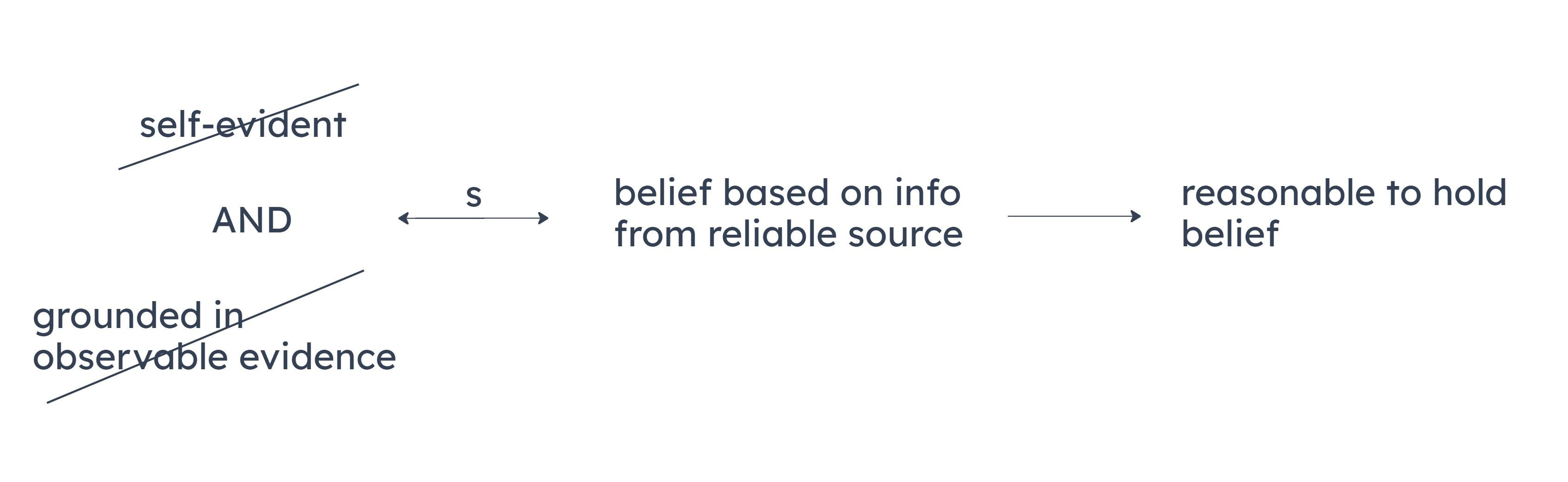
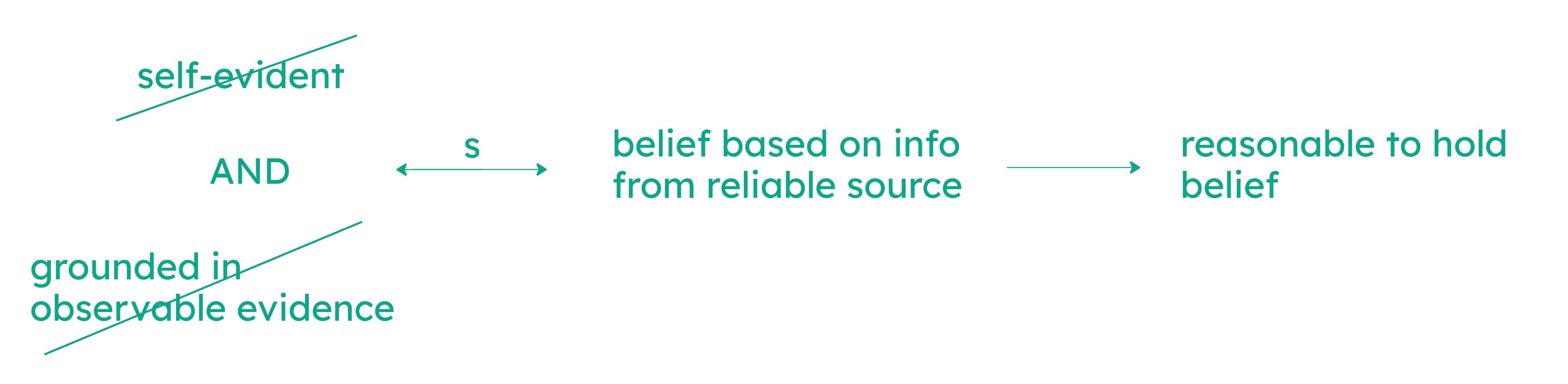
These three sets have an intersection. But we also know from the first sentence that if based on reliable information, then reasonable. That implies “reasonable” gets to join this intersection with “not self-evident” and “not grounded in observable evidence” as well.
Using logic, first, represent the intersection of 2 and 3 as simply A. B will represent based on reliable information. C will represent reasonable. The triple intersection can now be represented as A ←s→ B. The conditional is B → C. The valid inference is A ←s→ C. Again, that’s just the triple intersection between “reasonable” and 2 and 3.
If that was confusing, consider this. If a cat is mild-mannered, then it’s domestic. Some mild-mannered cats are large and fluffy. Therefore, some domestic cats are large and fluffy. That’s analogous to the question here. Kick the subject “cats” up into the domain. The “some” premise describes a triple intersection between mild-mannered, large, and fluffy. Because mild-mannered implies domestic, we know that domestic also intersects with large and fluffy.
Hopefully that clears up the logic. Translating it back into English reveals that we have many options. “Some domestic cats are large and fluffy” is probably the most straightforward translation. But we could also say, “Among the large cats, some domestic ones are fluffy.” Or we could say, “Among the fluffy cats, some large ones are domestic.” The order of the modifiers in “some” intersections doesn’t matter. “Some” can be reversibly read.
So, there are many ways to translate the valid inference from the actual stimulus back into English. We could say, “Some beliefs that are neither self-evident nor grounded in observable evidence are nonetheless reasonable.” Or we could state this as Correct Answer Choice (E) does. Among reasonable beliefs that are not self-evident, there are some beliefs that are not grounded in observable evidence. Or even differently still. Grammar is the reason for this flexibility. As long as you know that you're just trying to express a triple intersection, you should be all set.
Answer Choice (A) says beliefs for which a person does not have observable evidence are unreasonable. This is a mishmash of the concepts in the stimulus. What must be true is that some beliefs for which a person does not have observable evidence are reasonable. Or alternatively, we could say that unreasonable beliefs must not be based on unreliable information.
Answer Choice (B) says beliefs based on information from a reliable source are self-evident. This is also a mishmash of the concepts above. We have no information to make claims about self-evident beliefs.
Answer Choice (C) says all reasonable beliefs for which a person has no observable evidence are based on information from a reliable source. This does not validly follow from the premises. But if we changed the quantifier “all” into the quantifier “some,” then it would follow validly.
Answer Choice (D) says if the belief is not grounded in observable evidence then it is not self-evident either. This also does not follow. The relationship between these two concepts is only one of intersection. We don't know if the two sets have a superset-subset relationship.
A
The genetically engineered plants that have been developed so far have few advantages over plants that are not genetically engineered.
B
Whatever health risks there are in food from genetically altered plants may be somewhat reduced by other factors such as enrichment of the plants’ vitamin and mineral content.
C
Scientists have yet to determine, for each characteristic of some plants and animals used for food, the precise location of the genes that determine that characteristic.
D
There are plants that are known to be toxic to some animals and whose toxicity is known to be affected by the alteration of a single gene.
E
Research has shown that those consumers who are most strongly opposed to genetically altered foods tend to be ill-informed on the issue.
There is evidence that a certain ancient society burned large areas of land. Some suggest that this indicates the beginning of large-scale agriculture in that society—that the land was burned to clear ground for planting. But there is little evidence of cultivation after the fires. Therefore, it is likely that this society was still a hunter-gatherer society.
Summarize Argument: Phenomenon-Hypothesis
The author concludes that the society was a hunter-gatherer society. She bases this on evidence that they burned large areas of land with little sign of farming afterward, making it unlikely they were agricultural, as some suggest.
Notable Assumptions
The author assumes that because large areas of land were burned with little evidence of farming afterward, the society must have been hunter-gatherer. She doesn’t consider why a hunter-gatherer society would burn a large area of land, or whether an agricultural society might burn large areas of land for some reason other than farming.
A
Many ancient cultures had agriculture before they began using fire to clear large tracts of land.
Irrelevant—the society in the stimulus did use fire to clear large areas of land. Whether some ancient agricultural societies did not do this doesn't matter. Instead, we need an answer that helps us determine if these fires indicate a hunter-gatherer society.
B
Hunter-gatherer societies used fire for cooking and for heat during cold weather.
Irrelevant— using fire for cooking and heat during the cold is not the same as burning large areas of land. We need to know why burning large areas of land might be evidence of a hunter-gatherer society. Whether this society used fire in other ways doesn’t matter.
C
Many plants and trees have inedible seeds that are contained in hard shells and are released only when subjected to the heat of a great fire.
Even if we assume that these inedible seeds grow into edible plants and that the best way to release them is to burn a large area of land, (C) weakens the argument because it presents evidence of an agricultural society, not a hunter-gatherer society.
D
Hunter-gatherer societies are known to have used fire to move animal populations from one area to another.
This strengthens the argument by addressing the assumption that a hunter-gatherer society would have reason to burn a large area of land at all. If hunter-gatherer societies used fire to move animals from one area to another, the author’s conclusion becomes much more plausible.
E
Few early societies were aware that burning organic material can help create nutrients for soil.
Irrelevant—even if this society didn’t know that burning organic material can enrich soil, (E) only tells us that they probably didn’t plant on the land, which was already stated in the stimulus.
This is a Strengthen question.
The argument begins with a phenomenon that a certain ancient society burned large areas of land. Naturally, we wonder why they did this. The author presents other people's hypothesis: they burned large areas of land to prepare the ground for planting, which means that the ancient society was beginning the transition to agriculture.
To test this hypothesis, we can check its predictions. One prediction would be evidence of agriculture. If it's true that they burned the ground in preparation for planting, then we should expect to find evidence of agriculture. But we have little evidence of cultivation after the fires. This strongly implies that the other people's hypothesis of transition to agriculture is wrong. And so the author concludes it is likely that the society was still a hunter-gatherer society.
Now, one quick assumption you might've noticed is whether ancient societies fall into the binary buckets of either agricultural or hunter-gatherer. That is something to keep in mind, but as it turns out, those two buckets do largely capture all societies. The answer choices don't try to undercut that assumption.
But don't forget that we still have this phenomenon presented in the beginning argument. The author hasn't given an explanation of why the ancient society burned large areas of land. She has only, rather effectively, disposed of a bad explanation.
This is where Correct Answer Choice (D) improves the reasoning of the argument. It says hunter-gatherer societies are known to have used fire to move animal populations from one area to another. This presents a plausible explanation of the phenomenon unexplained in the original argument. If this is true, then that phenomenon itself becomes support for the author's conclusion that the society was still a hunter-gatherer society.
Answer Choice (A) says many ancient cultures had agriculture before they began using fire to clear large tracts of land. This means that fire clearing of land is not necessary for the transition to agriculture. That's good to know if you were curious about early human civilization. But this has nothing to do with the argument. The fact is the particular ancient society we’re talking about did clear large areas of land with fire. We’re trying to figure out what that means about the status of their civilizational development.
Answer Choice (B) says hunter-gatherer societies use fire for cooking and for heat during cold weather. This doesn't affect the argument at all. The argument told us that this particular society used fire to burn large areas of land and then we try to argue that this particular society was still a hunter-gatherer society. Information about hunter-gatherer societies using fire to do other things doesn't help the claim.
Answer Choice (C) says many plants and trees have inedible seeds that are contained in hard shells and are released only when subjected to the heat of a great fire. This is probably the most attractive wrong answer choice because it also looks like it's trying to provide an explanation for the phenomenon described above. It's trying to suggest that the reason why the ancient society burned large areas of land was to extract the seeds from the hard shells. There are at least two problems with (C), however. The first problem is that the seeds are inedible. That means you can't eat them. So what are you trying to do by extracting them? One plausible explanation is that you're trying to plant them. But that's not good for this argument, because that suggests that the culture might have been agrarian. The other problem is that this explanation doesn't fit very well with the phenomenon. Even if it's true that the seeds are released only when subjected to the heat of a great fire, it's not clear that the way to extract a seed is to burn down an entire tract of land. Why not collect all the shells and just burn them? Wouldn’t that be easier than setting a whole forest on fire? Notice (D) doesn't suffer from this problem. The hypothesis fits the facts. If you're trying to move entire populations of animals, then burning large areas of land makes sense. The solution is at the right scale for the problem.
Answer Choice (E) says few early societies were aware that burning organic material can help create nutrients for soil. This suggests the preclusion of a potential explanation. Before reading (E), one potential explanation for why the ancient society burned large areas of land was to fertilize the soil. After reading (E), it seems less likely that that's what our ancient society was attempting to do. What is the significance of this? I suppose it's less likely now that our ancient society was agrarian. But this was already established in the argument.